Innovation is referred to as the process of bringing about new ideas, methods, products, services, or solutions that have a significant positive impact and value in the society. It involves transforming creative concepts into tangible outcomes that improve efficiency and effectiveness, or address unmet needs.
Technological innovation is the introduction of new or significantly improved products, services, or processes to meet market needs, boost productivity, and solve problems through scientific and technical advances.
Human society has made tremendous progress in recent history in creation, development, and implementation of new technology, which have made incremental improvements.
The growth and power of industrialized nations such as the United States, China, UK, Japan, Russia Germany and the Asian Tigers are demonstrated by investment in Science Technology and Innovation(STI) which have transformed important sectors such as business, social sectors, or public services and led to economic growth, social progress, improved quality of life, and sustainable development.
Based on this premise, the National Agency for Science and Engineering infrastructure (NASENI), Nigeria’s prime institution that is turning hope into action through applied science and engineering, took the challenge of driving innovation that will put the country into the global map of industrialized nations.
Over the years, especially since the emergence of Khalil Suleiman Halilu as the Executive Vice Chairman of the agency, NASENI has deployed skill, energy, expertise and investment into turning research to local mass production of essential capital goods thereby reducing import dependence.
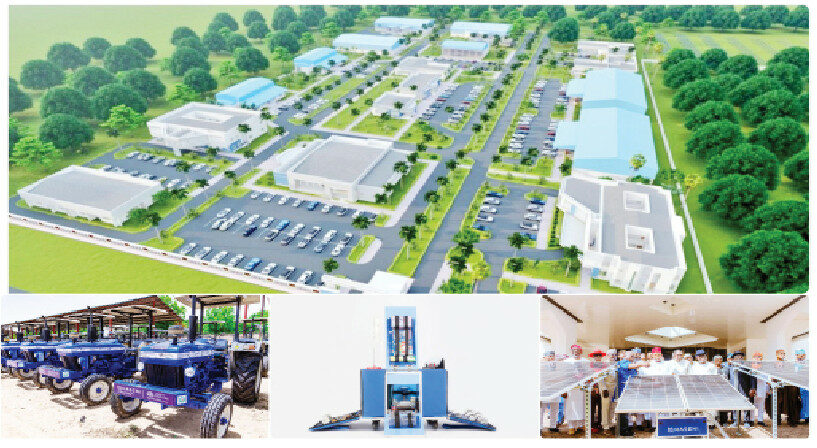
NASENI has made significant innovations in developing agricultural machinery, renewable energy solutions and scientific equipment. The agency has employed reverse engineering with the manufacturing of critical components locally to cut down on foreign exchange pressure. The agency has also embarked on strategic partnerships, with which it supports SMEs, fosters economic diversification, and manufactures tools for sectors like aviation, ICT, and education.
In agriculture for instance, NASENI has revived tractors through partnerships and producing coal-based fertilizer as well as the enormous efforts it has made in the industrial and manufacturing sector by developing machine tools, equipment, and manufacturing, including the Scientific Equipment Development Institute (SEDI) in Enugu and Minna. NASENI has also led in manufacturing agricultural machinery such as cassava processors, tractors, oil expellers and developing rural water solutions.
In the energy sector, the agency has made tremendous achievement in fostering advancements in renewable energy, power equipment, and materials. The agency has enhanced power infrastructure via transformer production at the Power Equipment Engineering and Management Development Institute (PEEMADI) in Okene, Kogi state.
In the education sector NASENI has extended its innovation in Education & Technology, where it has created local school science kits for Science Technology Engineering and Mathematics (STEM) education and developing digital, computing tools.
Its strategic initiatives for growth are centered on the 3Cs (Creation, Collaboration, and Commercialization to bring research into the market.
In order to harness the energy and talents of the Nigerian youth, NASENI has established specialized institutes and NASENI Skill and Capability Centers (NSACs) across Nigeria to train personnel and boost local production. Many of these youths are being trained in diverse skills that are marketable and relevant to the economy.
NASENI’s technology transfer policy is upgraded by its collaboration with international partners (e.g., in Indonesia for fertilizer production) to advance local capabilities.
In a related development, NASENI’s DELT-Her (Developing Engineering Leaders Through Her), a subset of the Delta-2 Program, was launched to empower young Nigerian women in engineering and tech through grants, mentorship, and project commercialization.
This project was launched in partnership with the Presidential Implementation Committee on Technology Transfer (PICTT) to close the 93% gender gap; the initiative fosters innovation, entrepreneurship, and economic growth. DELT-Her focuses on Czech-Nigeria bilateral technology transfer and R&D commercialization.
The program provides funding and support for converting innovative ideas into startups and DELT-Her 2.0 (announced for 2025) has already empowered female engineers with grants for projects.
Recently, NASENI launched the InnovateNaija Challenge that is designed to spark nationwide excitement and online engagement by identifying, empowering, and supporting innovative youths across Nigeria. This is another significant step to boost a nationwide movement designed to discover and empower the country’s brightest minds.
The launch of this creative idea during the important meeting of the Gulf Information Technology Exhibition (GITEX) 2025 in Lagos was remarkable as the initiative was designed for the future of Nigerian innovation and it is powered by the youth who will compete and display their immense talents.
With an impressive total prize pool of N250 million, this competition is set to become Nigeria’s largest showcase of homegrown products in science, engineering, and manufacturing. The grand prize winner will be awarded a whopping N100 million grant to turn their groundbreaking idea into a reality.
With this initiative, Halilu has opened opportunities for young Nigerians who are invited to submit their most creative inventions and products via engaging video entries to vie for a spot in this monumental event. The challenge aims to ignite creativity and generate vibrant energy within Nigeria’s innovation ecosystem.
Another tremendous effort to build the budding innovation skill in Nigeria is the FutureMakers. This initiative was introduced by NASENI in partnership with AfriLabs, to drive Nigeria’s industrialization by nurturing young talent, fostering a culture of innovation, and providing the foundation for homegrown technological solutions that aim to reduce import dependency and drive economic self-reliance.
The agency recently took another important step to boost Nigeria’s technology and innovation ecosystem through a well-thought out Inter-agency Competition and Awards where the agency has earmarked a whopping #140 million to benefit the participants.
This initiative is planned to increase the commitment of Nigerians to sustain the efforts at promoting indigenous technology and innovation as a strategic means of reducing excessive importation and strengthening local content development.
The competition will energize Federal Government Ministries, Departments and Agencies (MDAs) and it was flagged off by a roadshow that took place in Abuja on Monday, January 13, 2026 as the show of solidarity and enthusiasm is already palpable among the agencies, which have expressed their willingness to fully participate in the exercise.
It is within enlightened self- interest that NASENI is focused on reviving Nigeria’s technological relevance. This can only be done by looking at the abundant potential inherent in Nigerians.
Only Nigerians can build Nigeria and NASENI has proved to have sustained the quest for new innovation and the move to bring industrial renaissance to Nigeria through a massive commitment to technological advancement.
The task to industrialize Nigeria is huge and NASENI stands in front to lead the charge. However, the agency should be funded adequately to boost its production base.
We’ve got the edge. Get real-time reports, breaking scoops, and exclusive angles delivered straight to your phone. Don’t settle for stale news. Join LEADERSHIP NEWS on WhatsApp for 24/7 updates →
Join Our WhatsApp Channel