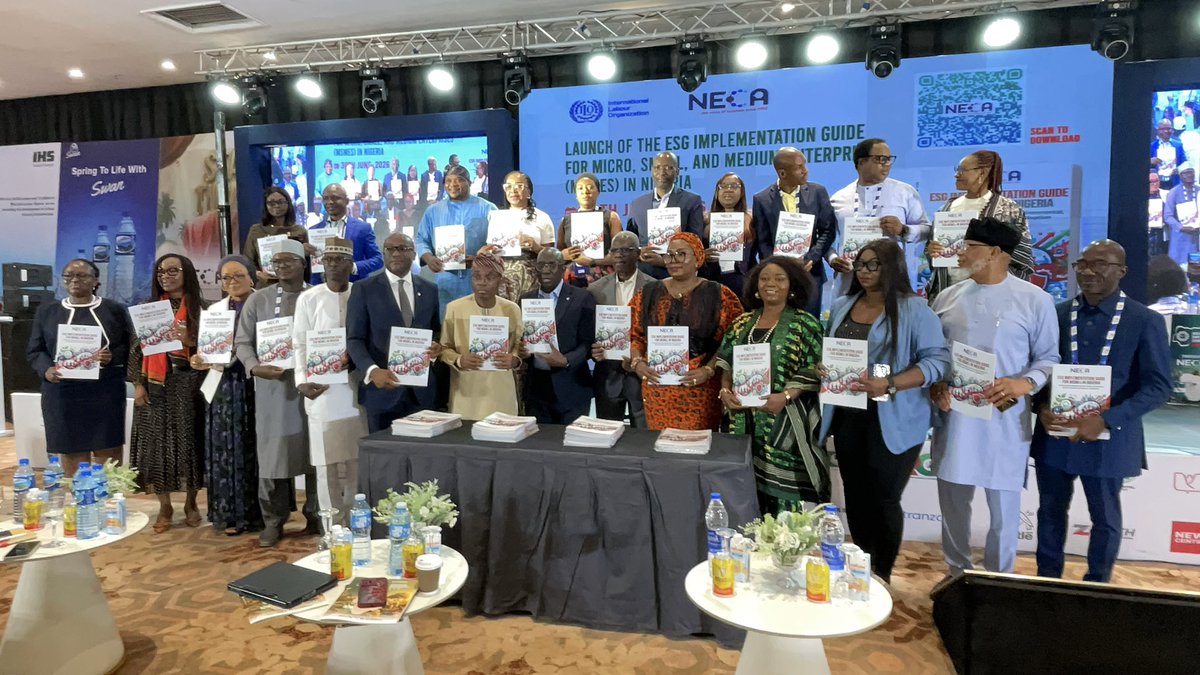
Nigeria Employers’ Consultative Association (NECA) has unveiled an Environmental, Social, and Governance (ESG) implementation guide to help Micro, Small, and Medium-sized Enterprises (MSMEs) improve their competitiveness, attract investment, and take advantage of emerging global business opportunities.
The launch was held at the Nigeria Employers’ Summit 2026 in Abuja yesterday.
The director-general, Adewale-Smatt Oyerinde, said the guide was designed to equip Nigerian businesses with the knowledge and capacity required to integrate ESG principles into their operations, noting that compliance with environmental, social and governance standards had become a critical consideration for investors and development partners.
He explained that businesses could no longer focus solely on profit maximisation, as investors now evaluate companies based on how they manage environmental responsibilities, their social impact and the quality of their governance structures.
According to him, the implementation guide will provide MSMEs with a practical pathway to understand ESG requirements, build institutional capacity and position themselves for long-term growth in both domestic and international markets.
Oyerinde said the initiative was part of NECA’s broader efforts to support enterprise competitiveness and advance inclusive national development.
He added that discussions at the summit also examined ongoing economic reforms and how government, businesses and other stakeholders could collaborate to create a more enabling environment for sustainable enterprises and decent job creation.
He stressed that thriving businesses remain the foundation for job creation, insisting that economic reforms should be regularly reviewed to ensure they deliver the desired outcomes without undermining business sustainability.
He further described the liberalisation of the foreign exchange market as one of the administration’s most significant reforms, saying it had eliminated distortions associated with multiple exchange rates.
While acknowledging that the removal of fuel subsidy had increased production costs and weakened consumers’ purchasing power, he maintained that the reforms were necessary to restore long-term economic stability and create conditions for sustainable growth.
He said, “There must be a business before there are workers. It takes a sustainable business to create jobs. If the business is not sustainable, then you will hardly create jobs.
ESG is progressively becoming like tax. Previously, the focus was profit maximisation. But now, everybody is looking at how you interact with your environment, your social impact, and the governance structures in your business.
For MSMEs, we need to first create an inroad for them to understand the opportunities that exist in ESG. Once they understand it, we also create a path for them to build their capacity. Once they understand and they have the capacity, then implementation becomes easy for them.
Investors are now looking at your compliance to those three important components before they can decide to grant you funds, grant you concessions or give support at the scale that you want.”
We’ve got the edge. Get real-time reports, breaking scoops, and exclusive angles delivered straight to your phone. Don’t settle for stale news. Join LEADERSHIP NEWS on WhatsApp for 24/7 updates →
Join Our WhatsApp Channel