
Nigeria’s private sector sustained its fragile recovery in April 2026 as the Nigerian Economic Summit Group (NESG) reported a marginal improvement in business conditions, with its Business Confidence Monitor (BCM) Current Business Performance Index rising to 102.1 points.
The latest figure represents a slight increase from 101.2 points recorded in March, marking the fourth consecutive month the index has remained above the 100-point threshold, which signals expansion in economic activities.
However, the report noted that despite the steady improvement, business conditions remain weaker compared to April 2025 when the index stood at 112.3 points, underscoring the slow pace of recovery.
Analysis of the data showed that the expansion in April was largely driven by gains in agriculture and non-manufacturing activities, even as performance across sectors remained uneven.
The agricultural sector recorded a strong rebound, with its index rising sharply to 103.2 points from 91.1 points in March, buoyed by increased crop production and livestock activities.
Similarly, the non-manufacturing sector returned to expansion at 101.6 points from 98.4 points, indicating improved performance in segments outside industrial production.
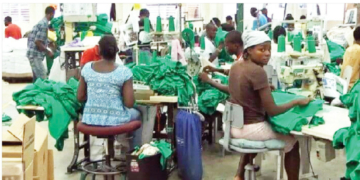
In contrast, the manufacturing sector slipped back into contraction, with its index declining to 98.7 points from 103.4 points in the previous month. The downturn was attributed to weak performance in key sub-sectors, including textiles, cement, chemicals, and motor vehicle assembly.
Only a few segments, notably food, beverages, tobacco, and basic metals, sustained growth within the manufacturing space.
The services sector maintained expansion at 101.5 points, although this represented a slowdown compared to 104.7 points recorded in March, reflecting moderating activity levels.
Meanwhile, the trade sector also remained in expansion territory at 102.7 points, supported by improved consumer spending, though the pace of growth softened relative to earlier months.
Further breakdown of the BCM report indicated that while production levels, demand conditions, cash flow, and employment recorded modest gains, investment and export activities continued to contract.
The NESG attributed the lingering weaknesses in investment and exports to persistent structural constraints within the economy, highlighting the need for sustained policy support to consolidate the recovery and drive stronger, broad-based growth.
We’ve got the edge. Get real-time reports, breaking scoops, and exclusive angles delivered straight to your phone. Don’t settle for stale news. Join LEADERSHIP NEWS on WhatsApp for 24/7 updates →
Join Our WhatsApp Channel