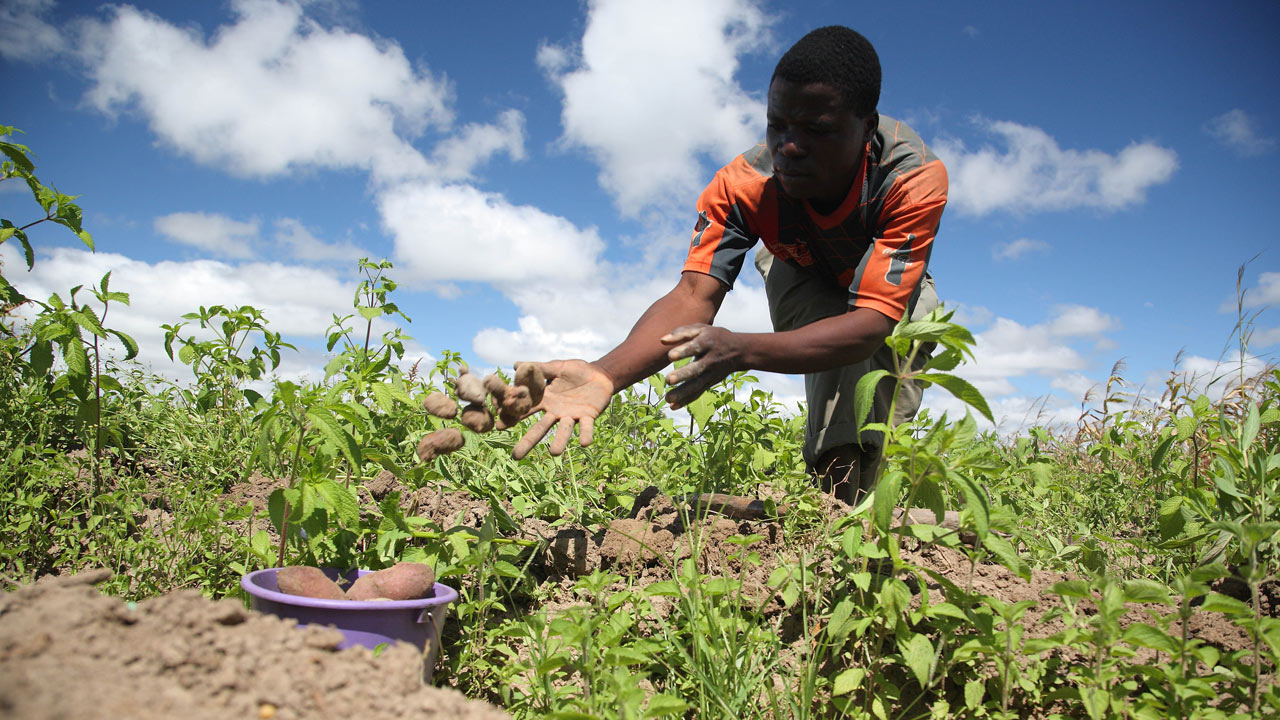
A new propagation technique that enabled farmers to grow yams from vine cuttings rather than bulky tubers is a major breakthrough toward addressing Nigeria’s chronic seed yam shortage and high production costs.
The method, known as leaf-bud cuttings technology, enabled farmers to rapidly multiply seed yams by using small sections of yam vine containing a leaf and a bud. Planted in shaded nursery beds with moist soil, the cuttings develop into mini seed yams suitable for field planting.
An agronomist who spoke to LEADERSHIP exclusively about the development said a single vine can produce between 100 and 300 cuttings, dramatically increasing multiplication rates compared to the traditional practice of planting whole or cut tubers.
For generations, Nigerian farmers have used traditional methods that result in slow yam multiplication, with an average 1:3 ratio. Farmers typically reserve up to 30 per cent of their harvest for planting, limiting food availability for households and markets. Seed tubers weighing between 200 and 500 grammes are commonly reused due to the absence of a structured seed system, exposing crops to pests and diseases and contributing to yield losses of up to 40 per cent.
By contrast, LEADERSHIP findings show that the new approach achieves a multiplication ratio of up to 1:300, reducing dependence on food-grade tubers, lowering storage and transportation challenges, and limiting the spread of viruses and nematodes. It also has the potential to cut seed costs, which currently account for as much as 60 per cent of total production expenses.
Data revealed the scale of the opportunity in this sector. With Nigeria cultivating roughly eight million hectares of yams annually and seed costs averaging N300 per unit, farmers spend an estimated N3 million per hectare on planting material. At the national scale, that translates into trillions of naira in seed value, pointing to significant business prospects if improved varieties are delivered through a formal, certified system.
Speaking to LEADERSHIP, an agronomist and seed system specialist at the International Institute of Tropical Agriculture, Beatrice Aighewi, said the technology is already being used to train farmers in rapid seed production.
“The technology that we have trained farmers to use in producing seed is known as the leaf bud technology. And it is obtained from the yam vines growing in the greenhouse. They cut it, and they plant it with root, and then they grow,” she said.
She told LEADERSHIP that while the method performs better with certain improved varieties, it can be applied to virtually all yam types. “It does very well with some varieties, not so well with others.
But every year, we can use that technology to multiply it,” she noted.
Aighewi added that the focus has been on newly released, improved varieties that meet national certification standards.
“For it to go into the formal seed system, we have to clean it to make sure there is no disease before it can go into the national system. So, when people are buying seed from that system, they are guaranteed the quality of the seed,” she said.
“If we look at the formal seed system, the one that National Agricultural Seeds Council (NASC) will approve of, it has to be an improved variety that has been registered and released into the national system,” she added, stressing that disease-free status is essential before seeds enter the certified market.
On adaptability, she said the varieties were selected with farmers to ensure acceptance and performance across yam-growing zones.
“Researchers will do their work at the research station. They still have to take it to the farmers. It is the farmers that make the final decision. If a farmer selects it, wherever he is growing his yam, it will grow”, she said.
We’ve got the edge. Get real-time reports, breaking scoops, and exclusive angles delivered straight to your phone. Don’t settle for stale news. Join LEADERSHIP NEWS on WhatsApp for 24/7 updates →
Join Our WhatsApp Channel