The National Senior Secondary Education Commission (NSSEC) has introduced the National Minimum Standards for Secondary Education and called on state governments to begin enforcing the new guidelines.
Speaking in Abuja during a media interaction, the commission’s executive secretary, Dr Iyela Ajayi, said NSSEC was committed to overhauling the secondary education system through the strict enforcement of standards, improved teacher development, expanded digital learning, and enhanced school infrastructure.
“The National Minimum Standards have to do with benchmarking requirements for all aspects of secondary education. How many teachers do you have? What should be their qualification? What should be the teacher-student ratio? The infrastructures that you have on the ground, and so on.
“The type of buildings you have, the quality of the buildings, all these are clearly spread out in the Minimum Standards. We have developed the Minimum Standards, which were launched in February of this year. We have distributed the Minimum Standards to all the states of the Federation.
“We have given them 12 months within which to comply, because the law establishing this commission has not only given us the power to produce Minimum Standards, but to enforce them. Therefore, we have given them 12 months to comply.
“There must be standards and uniformity. We cannot continue with a situation where students learn under trees or in classrooms without roofs. Those days must end,” he added.
Ajayi noted that improving teacher competence remains a significant focus, with the Commission pushing continuous professional development initiatives, including targeted training for English and Mathematics teachers as well as capacity-building programmes on AI-enabled teaching for educators and school leaders.
He listed NSSEC’s major priorities as strengthening teacher training, improving recruitment and retention of qualified teachers, expanding digital learning and ICT access, and undertaking large-scale infrastructure rehabilitation. He added that technical and vocational education, inclusive learning for girls and learners with disabilities, practical skill-based curriculum reforms and enhanced school governance were also central to the Commission’s agenda.
On curriculum reforms, Ajayi stressed the Commission’s involvement in recent adjustments such as the return of History to the syllabus, reducing curriculum overload and boosting skill-oriented learning.
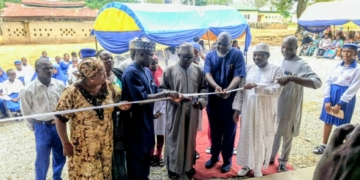
Despite financial limitations, he said NSSEC has facilitated upgrades in 50 senior secondary schools, one per state, through constituency projects.
“These include new classrooms, laboratories and ICT facilities. We are not yet like UBEC but the little we have done is already changing the narrative,” he said.
We’ve got the edge. Get real-time reports, breaking scoops, and exclusive angles delivered straight to your phone. Don’t settle for stale news. Join LEADERSHIP NEWS on WhatsApp for 24/7 updates →
Join Our WhatsApp Channel