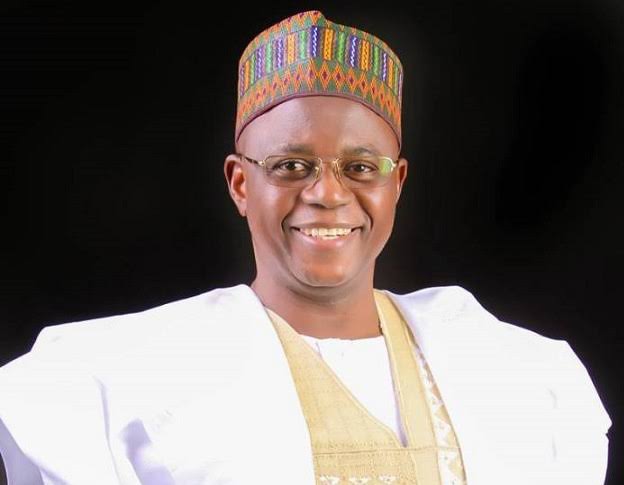
Former Nigeria Football Federation (NFF) president Sani Abdullahi Lulu has urged FIFA and the Confederation of African Football (CAF) to clarify the circumstances of Ibrahim Gusau’s resignation before deciding how to address the leadership vacuum in Nigerian football.
Lulu said it would be premature for FIFA and CAF to consider establishing a Normalisation Committee without first speaking directly with Gusau, who resigned as NFF president alongside former secretary-general Mohammed Sanusi and several members of the federation’s executive committee.
The former NFF boss made the call while explaining why he refused to endorse a position paper prepared by a group of former NFF presidents and secretaries-general during their recent engagement with the FIFA/CAF delegation in Abuja.
According to Lulu, he expected Gusau and Sanusi to participate in the meeting with the international football governing bodies to explain the circumstances that led to their resignations.
“My thought was that the immediate NFF president, Ibrahim Gusau, and his secretary-general, Dr Mohammed Sanusi, who just resigned their positions, would be part of the meeting and I would be able to ask personally, why did they resign or what propelled them to quit?”
Lulu said Gusau’s resignation should not simply be accepted without seeking clarification from the former NFF president himself.
“He has resigned, but did he inform or write FIFA or CAF of his resignation?” he asked.
“Before taking any decision, either to set up a Normalisation Committee or not, there is a need for you people to sit and have a one-on-one discussion with him to find out why he chose to resign.”
The former NFF president said he was particularly concerned that the former officials’ position paper appeared to have been prepared before all members of the group had an opportunity to contribute.
Lulu said he had been given the impression that the former NFF officials would meet to agree on a common position before they engaged with FIFA and CAF.
However, he claimed that the meeting was brought forward and decisions were taken without him.
“I was there as the most surviving former NFF president, and they gave me the impression that we were going to have a meeting before the meeting with the FIFA/CAF delegation,” he said.
“Before I knew it, they had manipulated it, changed the date and only for the former secretary-general to call me to say they were already meeting and had taken a decision on what they were going to do.”
Lulu said he was subsequently asked to endorse the document, but insisted that he could not do so without first examining its contents.
He claimed that instead of receiving the full document, former NFF secretary-general Musa Amadu sent him only the final page containing the signatures of those who had already endorsed it.
“Out of about eight to nine people, it was only me and Obinna Ogba that had not signed at the time; everybody, including Aminu Maigari and others, had signed already,” he said.
After reviewing the page, Lulu said he identified what he considered significant flaws in the proposal and decided against endorsing it.
His principal objection, he explained, was not necessarily to the reform itself but to the procedure by which the proposal had been produced and to the failure to hear directly from those whose resignations triggered the current crisis.
Lulu said his own experience as NFF president had made him particularly sensitive to attempts to remove federation officials without allowing them to explain their position.
He recalled how, during his tenure, he was approached by a government delegation led by former FIFA executive committee member Amos Adamu and asked to resign.
“I asked Amos, who was the leader of the delegation, why I should resign? Am I a thief, or have I done anything wrong?” Lulu recalled.
He said he subsequently challenged his removal in court after an attempt to impeach him and claimed victory in the legal battle.
Against that background, Lulu said he could not endorse a process in which Gusau’s resignation was being discussed without first determining the reasons for his resignation.
The former NFF president also used the opportunity to defend his administration’s role in the evolution of football governance in Nigeria, particularly the move away from the government-imposed Decree 101 framework towards an NFF statutory system.
“I was the first president to start operating the statute; nobody was operating the statute before I came. It was Decree 101,” he said.
Lulu claimed that his administration pushed FIFA and CAF to support adopting the NFF Statutes and that the process eventually received government approval before FIFA endorsed the framework.
He said the current situation should therefore be viewed against the background of Nigeria’s long-running struggle over football governance and the relationship between the federation and government.
The former NFF president also rejected speculation that his refusal to endorse the position paper was motivated by an ambition to return to football administration.
“I heard people are speculating that Sani Lulu wants to bring himself back again. God forbid,” he said.
“There is nothing that will bring me back to NFF. I am not interested in the NFF job again.”
Lulu said he had largely stayed away from the NFF since leaving office, adding that he had visited the federation’s headquarters only once in the past 16 years.
He maintained that his intervention was intended to ensure that the consultations with FIFA and CAF were based on a full understanding of the circumstances surrounding the current leadership crisis.
He also proposed that the position paper should have been discussed with the National Sports Commission chairman, Shehu Dikko, before the former officials sought his endorsement.
“My suggestion was that before signing the letter, I had to see the NSC chairman and let us deliberate over it,” Lulu said.
“If he is convinced that what they were saying is correct and I make two or three inputs, I’ll sign.”
The former NFF chief said he remained convinced that his decision was justified, insisting that the circumstances surrounding Gusau’s resignation needed to be established before any major structural decision was taken.
“If I have the opportunity, I will tell Nigerians that something is wrong with their submission,” he said.
His intervention further highlights the differing views among former football administrators and other stakeholders over the appropriate route out of the NFF leadership vacuum, with FIFA and CAF continuing consultations with various groups before determining their next steps.
We’ve got the edge. Get real-time reports, breaking scoops, and exclusive angles delivered straight to your phone. Don’t settle for stale news. Join LEADERSHIP NEWS on WhatsApp for 24/7 updates →
Join Our WhatsApp Channel