
Nigeria has been listed among the top 10 countries driving the world’s worst food crisis, with conflict and instability pushing millions into acute hunger, a new global report has revealed.
The 2026 Global Report on Food Crises, released on Friday by an alliance of United Nations agencies, the European Union and development partners, showed that Nigeria and nine other conflict-affected nations account for nearly two-thirds of people facing acute food insecurity worldwide.
According to the report, about 266 million people across 47 countries experienced high levels of acute food insecurity in 2025 representing almost a quarter of the population analysed and nearly double the proportion recorded in 2016.
The report highlighted that the global hunger crisis was no longer temporary but increasingly entrenched, particularly in conflict-affected regions.
“Acute food insecurity today is not just widespread it is also persistent and recurring,” said Qu Dongyu, Director-General of the Food and Agriculture Organization (FAO), warning that the crisis has become structural rather than temporary.
Earlier in January, the United Nations Office for the Coordination of Humanitarian Affairs (OCHA) in Nigeria disclosed that about 35 million Nigerians are at risk of acute hunger in 2026.
The report identified conflict as the leading driver of food insecurity, accounting for more than half of those facing severe hunger globally.
The 10 hardest-hit countries include Afghanistan, Bangladesh, Democratic Republic of the Congo, Myanmar, Nigeria, Pakistan, South Sudan, Sudan, Syria and Yemen.
At the most extreme level, famine was confirmed in 2025 in Gaza and parts of Sudan the first time since the report’s inception that two separate famines have been recorded in a single year.
United Nations Secretary-General António Guterres, in the report’s foreword, described the findings as urgent and alarming.
“This report is a call to action,” Guterres said, “to summon the political will to rapidly scale up investment in lifesaving aid, and work to end the conflicts that inflict so much suffering on so many.”
The report also points to a worsening severity of hunger, with more than 39 million people in 32 countries facing emergency levels of food insecurity, while the number of those experiencing catastrophic hunger has surged ninefold since 2016.
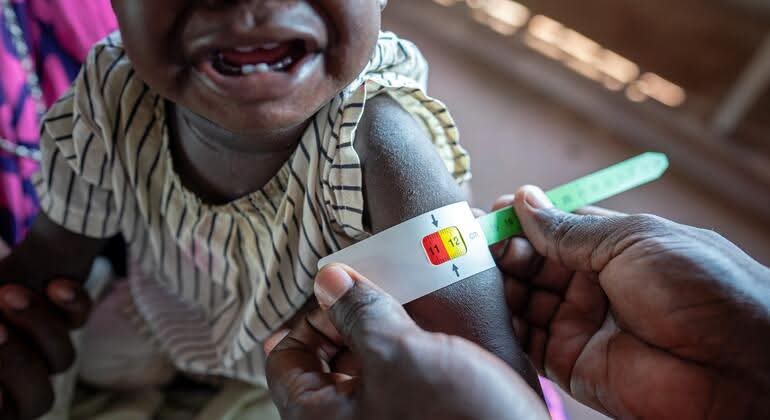
Children remain among the most vulnerable. In 2025, about 35.5 million children were acutely malnourished, including nearly 10 million suffering from severe acute malnutrition—a life-threatening condition.
“Children with severe wasting are too thin for their height. Their immune systems weakened to the extent that ordinary childhood illnesses can become fatal,” said Ricardo Pires of UNICEF.
The report noted that in severely affected areas such as Gaza, Myanmar, South Sudan and Sudan, overlapping crises—including conflict, disease outbreaks and limited access to essential services—are worsening malnutrition and increasing mortality risks.
Forced displacement is further exacerbating the crisis. More than 85 million people were displaced across food-crisis regions in 2025, with displaced populations facing higher levels of hunger than host communities.
“Forced displacement and food insecurity are deeply interconnected, forming a vicious cycle,” said Barham Salih, stressing that humanitarian assistance alone cannot resolve the crisis.
Despite the growing scale of need, funding for food and nutrition interventions is declining. The report indicates that humanitarian and development financing has dropped to levels last seen nearly a decade ago, limiting response efforts.
It also warns of widening data gaps, with fewer countries able to produce reliable food security assessments—raising concerns that the actual scale of hunger may be underreported.
Looking ahead, the outlook for 2026 remains grim, as ongoing conflicts, climate shocks and economic instability continue to threaten global food systems.
The report further cautions that disruptions in global markets, particularly linked to the Middle East crisis, could drive up food prices and strain supply chains.
“We must shift from reacting too late to acting early, and from relying solely on food assistance to protecting local food production—because that is how we reduce needs, save lives and build resilience over time,” Qu said.
We’ve got the edge. Get real-time reports, breaking scoops, and exclusive angles delivered straight to your phone. Don’t settle for stale news. Join LEADERSHIP NEWS on WhatsApp for 24/7 updates →
Join Our WhatsApp Channel