
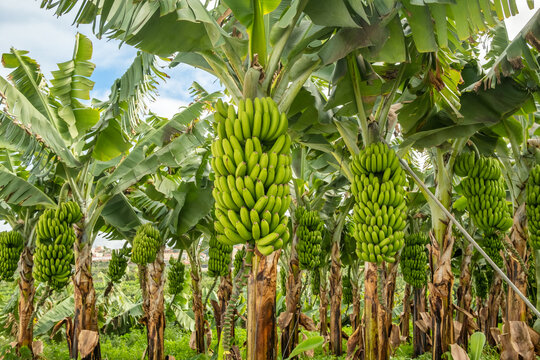
Nigeria has been ranked first top banana producers in West Africa, but lacks potential for export growth.
According to data compiled by the Food and Agriculture Organization of the United Nations (FAO), West Africa harvested nearly 8.7 million tons of bananas in 2024. This represented about 28 per cent of Africa’s estimated output of nearly 31.3 million tons that year.
Nigeria is top among West Africa’s five largest producers of dessert bananas and by far West Africa’s largest producer of dessert bananas.
According to FAO estimates, the country produced an annual average of 6.69 million tons between 2020 and 2024 but most of this output is consumed domestically.
Unlike some other producers in the subregion, Nigeria has not emerged as a major banana export hub. Production is largely in the hands of local farmers rather than concentrated among a small number of large, integrated plantations.
About 500,000 hectares are devoted to dessert banana cultivation in Africa’s most populous country, according to the FAO.
According to the ranking, Côte d’Ivoire is second, with average annual production of 539,000 tons between 2020 and 2024. According to the FAO, dessert banana plantations cover about 12,178 hectares in the country.
This gives Côte d’Ivoire the highest average yield among the five countries, at an estimated 44 tons per hectare.
Côte d’Ivoire, Africa’s leading banana exporter, has an industry dominated by major agribusiness companies. Compagnie Fruitière is the leading producer through its subsidiary SCB. Other producers include Belgium’s Sipef and French Caribbean conglomerate Groupe Bernard Hayot, which controls BANACI and BACIBAM. Small farmers operating independently or through cooperatives also participate in the industry.
Mali ranks third, with average annual production of 484,120 tons between 2020 and 2024. According to the FAO, dessert banana cultivation covers about 43,000 hectares in the country. As in Nigeria, production is consumed almost entirely within the country, while exports are negligible.
Mali’s banana industry is primarily made up of family farmers organized under the Federation of Banana Producer Organizations (FOPB). The organization provides technical assistance, helps farmers obtain agricultural inputs and equipment, and supports the marketing of their produce.
According to the report, Guinea ranks fourth, with average annual production of 230,000 tons between 2020 and 2024. As in Nigeria and Mali, most of the country’s output is consumed domestically, while exports are negligible. According to the FAO, banana cultivation covers about 40,000 hectares. Production largely comes from family farms, particularly in the Kindia region.
Ghana ranks fifth in West Africa, with average annual production of nearly 124,000 tons between 2020 and 2024. The country is also the region’s second-largest banana exporter after Côte d’Ivoire. As in Côte d’Ivoire, the industry includes both small farmers and major agribusiness companies.
According to the Banana Producers Association of Ghana, large-scale commercial production is mainly handled by Golden Exotics Limited (GEL), a subsidiary of France’s Compagnie Fruitière; the long-established Volta River Estates Limited (VREL); and Musahat Farms Limited. Dessert banana cultivation covers about 11,000 hectares in Ghana, according to the FAO
We’ve got the edge. Get real-time reports, breaking scoops, and exclusive angles delivered straight to your phone. Don’t settle for stale news. Join LEADERSHIP NEWS on WhatsApp for 24/7 updates →
Join Our WhatsApp Channel