
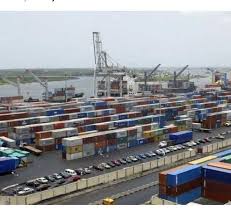
Nigeria may have lost more than $600 million in revenue over the past three decades due to the illegal sale of shipping containers imported under temporary admission arrangements, a trade and customs expert, Okey Ibeke, has alleged.
Speaking to members of the Shipping Correspondents Association of Nigeria (SCAN), on Monday, Ibeke, who is the Principal Consultant at International Trade Advisory Services, called on the Nigeria Customs Service (NCS) to immediately investigate what he described as a longstanding practice by foreign shipping lines of disposing of temporary import containers in Nigeria without complying with customs regulations and payment of statutory duties.
According to him, the issue came to the fore following reports that Grimaldi Agency Nigeria plans to sell more than 2,500 empty containers to members of the public, with payments allegedly required in U.S. dollars through domiciliary accounts.
Ibeke argued that beyond concerns over dollar-denominated transactions, the more fundamental issue is that the containers were brought into the country under a temporary import regime and therefore cannot be legally sold without first being converted to permanent import status through Customs.
“For years, importers and clearing agents have complained about several practices by foreign shipping companies that increase the cost of doing business in Nigerian ports. However, the planned sale of temporary import containers without compliance with customs procedures raises far more serious concerns regarding government revenue, fiscal policy and national economic sovereignty,” he said.
He explained that under Nigeria’s customs regulations, shipping containers are classified as temporary imports and are expected to be re-exported after use. Any shipping line seeking to dispose of such containers locally must first obtain approval from Customs, undergo valuation, pay applicable duties, taxes and levies, and receive authorization converting the containers to home use before any sale can take place.
According to Ibeke, reports surrounding the Grimaldi container disposal exercise indicate that 40-foot containers are being offered at about $2,000 each, while 20-foot containers are priced at approximately $1,600, with transactions allegedly invoiced and settled strictly in U.S. dollars.
He maintained that if the containers are sold without undergoing the required conversion process, government stands to lose substantial customs revenue.
“Based on the current tariff structure, government loses approximately $350 to $400 per container in duties and taxes where conversion procedures are not followed. For 2,500 containers, the revenue loss could approach $1 million from a single transaction,” he stated.
The trade consultant cited provisions of the Nigeria Customs Service Act 2023, which require temporary imports either to be re-exported or formally converted to permanent imports upon payment of applicable duties.
He also referenced Central Bank of Nigeria regulations requiring domestic transactions to be conducted in naira except where specific exemptions have been granted.
Ibeke noted that Nigeria’s chronic trade imbalance has contributed to the accumulation of empty containers across the country. While imports account for the bulk of containerized cargo entering Nigerian ports, exports remain relatively low, leaving shipping companies with large volumes of empty containers that are costly to return to Asia, Europe and other destinations.
According to him, the high cost of repatriating empty containers has encouraged some operators to dispose of them locally rather than export them.
He argued that the challenge extends far beyond a single company and reflects an industry-wide problem that has persisted for decades.
“For more than 30 years, several international shipping lines have operated in Nigeria. Industry estimates suggest that hundreds of thousands of containers have been sold locally and converted into shops, security posts, storage facilities and other structures,” he said.
Ibeke estimated that if as many as 250,000 containers were sold over the years without proper customs conversion and duty payments, Nigeria could have lost more than $375 million in duties and VAT alone, with the broader economic impact exceeding $600 million.
He therefore urged the Comptroller-General of Customs to suspend all ongoing container sales by shipping companies pending a comprehensive investigation.
Among other measures, he called for a system-wide audit of shipping lines and agents that have handled temporary import containers from 2006 to date, reconciliation of port and customs records to identify containers that were neither re-exported nor formally converted, and recovery of all outstanding duties, taxes, levies and penalties.
He also urged Customs to sanction any operators found to have violated the provisions of the Customs Act.
“This is not about discouraging investment or disrupting maritime trade. It is about enforcing existing laws and protecting government revenue at a time when Nigeria urgently needs resources to support economic reforms and national development,” Ibeke said.
We’ve got the edge. Get real-time reports, breaking scoops, and exclusive angles delivered straight to your phone. Don’t settle for stale news. Join LEADERSHIP NEWS on WhatsApp for 24/7 updates →
Join Our WhatsApp Channel