
Nigeria has met its production quota set by the Organisation of the Petroleum Exporting Countries (OPEC) for the fifth consecutive month, producing an average of 1.53 million barrels per day (bpd) of crude oil in September 2026, about 102% of its 1.5 million bpd allocation.
Data from the Nigerian Upstream Petroleum Regulatory Commission (NUPRC) showed that, in strict crude oil terms (excluding condensate), the country produced 1.53 million bpd in May, 1.55 million in June, 1.51 million in July, 1.5 million in August and 1.53 million in September. This means Nigeria has stayed at or above its assigned quota every month in that period.
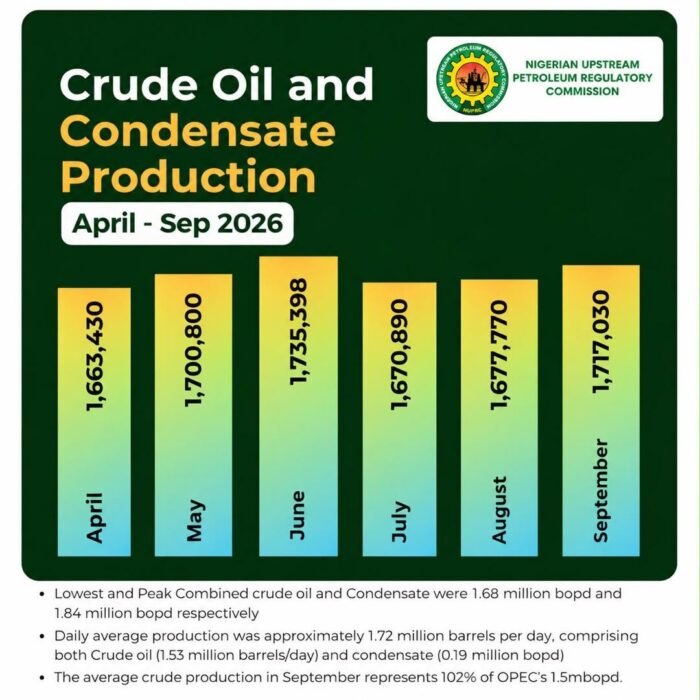
With condensate, Nigeria’s output averaged 1,717,030 bpd in September, a 2.34 per cent increase from the 1,677,770 bpd recorded in August. Of the daily average of about 1.72 million bpd, crude oil accounted for roughly 1.53 million bpd, while condensate contributed about 0.19 million bpd.
The September figure is the second-highest monthly average in the April to September 2026 period, behind June’s 1,735,398 bpd. It also marks a recovery from the dip in July, when combined output fell to 1,670,890 bpd from June’s level. Production then edged up to 1,677,770 bpd in August before the stronger gain in September.
Looking at the wider trend, combined output has risen from 1,663,430 bpd in April, the lowest of the six months, to 1,700,800 bpd in May and 1,735,398 bpd in June. September’s average is about 3.2% higher than April’s.
Single-day production peaked at 1.84 million barrels during the month, reinforcing Nigeria’s position as Africa’s largest crude oil producer. The lowest single-day output was 1.68 million barrels.
The commission attributed the improved performance mainly to stable production operations across most producing assets and the absence of any major pipeline outage during the period. This, it said, supported better production uptime and crude evacuation efficiency.
It added that the sustained growth recorded in September reflects the continued commitment of operators and industry stakeholders to improving operational efficiency, maintaining asset integrity and enhancing production reliability across the Nigerian upstream petroleum sector.
A breakdown of the daily average production by terminal shows that the Forcados Terminal accounted for 320.32 thousand bpd, followed by the Bonny Terminal with 303.27 thousand bpd.
We’ve got the edge. Get real-time reports, breaking scoops, and exclusive angles delivered straight to your phone. Don’t settle for stale news. Join LEADERSHIP NEWS on WhatsApp for 24/7 updates →
Join Our WhatsApp Channel