
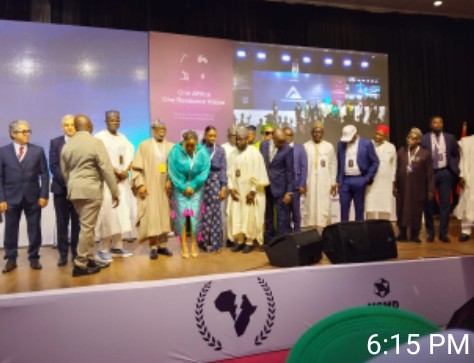
The federal government has announced the discovery of a world-class polymetallic mineral province in Kaduna State containing significant deposits of platinum group metals, gold, nickel, copper, lithium and rare earth elements. Minister of Solid Minerals Development, Dr. Dele Alake, disclosed the breakthrough on Wednesday during the opening of the 5th African Natural Resources and Energy Investment Summit (AFNIS 2026) held at the State House Conference Centre, Abuja. Speaking at the summit with the theme,“One Africa, One Resource Vision,” Alake described the discovery as a landmark development that could strengthen Nigeria’s standing in the global critical minerals market.
According to him, the mineral find was confirmed by the Nigerian Geological Survey Agency (NGSA) following exploration activities conducted by a private company in collaboration with the agency. Alake, who hinted that this was the first time the discovery was being mentioned publicly, said the newly identified mineral province contains exceptionally high-grade deposits of strategic minerals that are in growing demand worldwide for clean energy technologies and advanced industrial applications.
“Recently, and this is very, very important for newsmen and stakeholders to take note, this is the first time I am announcing this publicly. Recent exploration breakthroughs verified by our Nigerian Geological Survey Agency have unveiled a world-class polymetallic mineral province in Kaduna State, consisting of world-class platinum group metals, precious and critical mineral deposits,” Alake said.
“The province is notable for significant deposits of gold, nickel, copper, lithium and rare earth elements of exceptionally high grades, positioning Nigeria among the emerging destinations for strategic mineral resources and sustainable mining investment.
“This is a new discovery by a private company assisted by our agency, the Nigerian Geological Survey Agency,” he added.
The minister said the discovery aligns with the federal government’s ongoing efforts to reposition the mining sector as a major driver of economic growth, industrialisation and diversification under President Bola Ahmed Tinubu’s Renewed Hope Agenda. He noted that the administration has embarked on wide-ranging reforms aimed at attracting credible investments, promoting local processing of minerals and improving regulatory compliance across the sector.
According to Alake, Nigeria is gradually moving away from the traditional practice of exporting raw minerals and is instead prioritising value addition, beneficiation and domestic processing.
“For too long, Nigeria’s mineral endowment did not translate into sufficient national value. The paradox was very clear: vast mineral potential but limited beneficiation, rising global demand but inadequate geological confidence, legal authority but weak enforcement, abundant activity but too much informality,” he said.
The minister highlighted measures taken by the government to sanitise the sector, including the revocation of 924 dormant mineral titles to discourage speculation and ensure that mining licences are held by investors capable of developing them.
He further disclosed that the government now requires applicants for mining leases to submit detailed value-addition plans, signalling a shift from the old “pit-to-port” model towards industrial development driven by processing plants, refineries, technology transfer and job creation.
Alake said the policy direction is already yielding positive results, with investments flowing into lithium processing and other strategic mineral projects across the country.
Among the projects cited were an $800 million investment in lithium processing, comprising a $600 million lithium processing plant and a $200 million lithium refinery near Abuja, alongside additional processing facilities in Nasarawa State. He also referenced the $50 million ASBA lithium plant in the FCT, the $600 million Avatar lithium processing project in Nasarawa and a $1 billion iron ore-to-steel project in Kogi State. The minister added that reforms in the sector have significantly boosted government revenue, which rose from about ₦6 billion at the inception of the current administration to over ₦38 billion in 2024 and approximately ₦68.1 billion in 2025. While acknowledging that the figures do not yet reflect the full potential of the mining industry, Alake maintained that ongoing reforms, stronger enforcement and improved investor confidence are beginning to deliver measurable outcomes for the nation’s economy.
We’ve got the edge. Get real-time reports, breaking scoops, and exclusive angles delivered straight to your phone. Don’t settle for stale news. Join LEADERSHIP NEWS on WhatsApp for 24/7 updates →
Join Our WhatsApp Channel