Nigerian football stakeholders have reacted angrily to the inclusion of former Nigeria Football Federation (NFF) president Amaju Pinnick in the delegation that met FIFA President Gianni Infantino in Zurich, with reform advocates questioning the credibility of Nigeria’s proposed football restructuring.
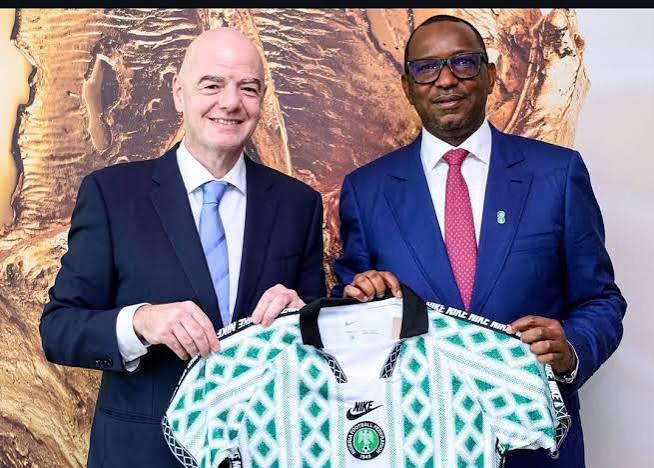
The controversy came as Infantino expressed FIFA’s readiness to work with Nigeria to strengthen football structures and create clearer pathways for young talent, following his meeting with a Nigerian delegation led by National Sports Commission (NSC) Chairman Shehu Dikko at FIFA headquarters in Switzerland.
Infantino said the discussions centred on institutional, governance and developmental issues, as well as areas where FIFA could provide further support for football development in Nigeria.
“I was pleased to sit down with a delegation from Nigeria, led by National Sports Commission chairman Shehu Dikko, at the home of FIFA in Zurich to hold important discussions and align on our vision for football in the country,” Infantino said in a post on his official X handle.
The FIFA president added that both sides discussed the need for stronger structures and pathways to provide greater opportunities for young Nigerians.
“While stressing the need to create stronger structures and pathways to provide even more opportunities for the youth, we explored areas where FIFA can further support the growth of our beautiful game in this football-passionate country,” he said.
But while Infantino’s comments have raised hopes of stronger international support for Nigeria’s football development, the composition of the delegation has triggered a fresh debate over the direction of the reform process.
Founder and Chairman of the Board of Trustees of the Athletics and Other Sports Initiative, Ahmed Shuaibu Gara-Gombe, accused some football stakeholders of regrouping to influence the future administration of the NFF.
Gara-Gombe specifically questioned the presence of Pinnick in the Zurich delegation, alongside Dikko, arguing that figures associated with previous football administrations should not dominate a process billed as reform.
“It’s unfortunate and sad that the rush to replace the Ibrahim Gusau-led NFF board has clearly started to point at motives behind it,” Gara-Gombe said.
He alleged that the Zurich discussions were part of a broader attempt by individuals who had previously exercised influence over Nigerian football to regain control of the federation.
He also questioned reports surrounding a possible NFF normalisation process and argued that FIFA should hear directly from the elected NFF Congress and former president Ibrahim Gusau before any major decision is taken.
Gara-Gombe further challenged the suggestion that FIFA could simply accept the NFF leadership’s resignation, insisting that the federation’s Congress, which elected the board, had a constitutional role in the process.
He recalled previous disputes involving the NFF in which FIFA insisted on dealing with the recognised structures of the football federation rather than government officials seeking to influence its administration.
The former Gombe United chairman also questioned why the Confederation of African Football (CAF) had apparently not played a more prominent role in the current situation.
His concerns were echoed by Prince Harrison Jalla, Chairman of the Advocacy for Nigeria Football Reform Initiative, who criticised the composition of the Zurich delegation and warned that Nigeria’s reform programme could get off to a “shaky start”.
Jalla said football followers were particularly concerned by the inclusion of Pinnick, arguing that if a former NFF president was required to be part of the delegation, other former federation presidents, including Ibrahim Gusau, Aminu Maigari and Sani Lulu Abdullahi, could also have been considered.
“The question bothering many Nigerians is that, if a former NFF president must be in the delegation, what is wrong with the immediate past president, Ibrahim Gusau, former presidents Aminu Maigari and Sani Lulu Abdullahi?” Jalla asked.
He also questioned Dikko’s decision-making, urging the NSC chairman to ensure that the reform process was guided by national interest rather than personal relationships within football administration.
Jalla further argued that Nigeria could formally engage with FIFA in a normalisation process under the relevant provisions of the FIFA Statutes, rather than creating uncertainty around the transition.
He warned that bringing figures associated with previous administrations into the reform process could undermine public confidence and reopen old divisions within Nigerian football.
The criticism comes as FIFA appears willing to engage with Nigeria on a new development framework. Infantino thanked the Nigerian delegation for its “time, ideas and positive intent to work together in taking Nigerian football forward”, signalling an appetite for continued cooperation.
He also wished Nigeria’s U-20 women’s national team, the Falconets, success in their FIFA U-20 Women’s World Cup campaign.
For Nigerian football, however, the Zurich meeting has opened two competing narratives: FIFA’s stated desire to help the country build stronger institutions and youth pathways, and growing concern among local stakeholders over who should be entrusted with driving the proposed reforms.
As the debate intensifies, attention is likely to shift to the NFF Congress, the Federal Government and FIFA over the next steps in determining the structure and leadership of Nigerian football.
We’ve got the edge. Get real-time reports, breaking scoops, and exclusive angles delivered straight to your phone. Don’t settle for stale news. Join LEADERSHIP NEWS on WhatsApp for 24/7 updates →
Join Our WhatsApp Channel