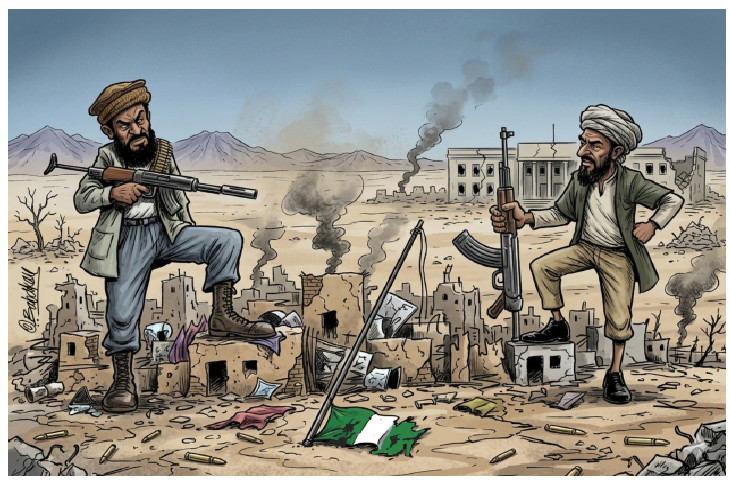
At the outset of this week, Boko Haram terrorists continued their relentless assault on Nigerians, striking the Guyaku community in Gombi Local Government Area of Adamawa State. No fewer than 39 people were reportedly killed by the heavily armed attackers who stormed the serene community and unleashed terror for hours.
A friend of mine who is a native of Guyaku and works in Abuja as a director in the federal civil service invoked the most pathetic emotional moment of the gory incident in a text she sent to me. “All those killed are my relatives. I feel this brutal and gruesome attack deeply. We ask for just one thing: the government should protect us,” she wrote.
There was nothing abstract about my friend’s pain. Behind every casualty figure is a name, a face and a family whose story will never be the same again. And while Guyaku was still reeling, more tragic scenarios were unfolding in Kogi, Benue and Katsina states.
Black Sunday
In what can only be described as a black Sunday, kidnappers attacked an orphanage and school in the Zariagi area of Lokoja, Kogi state, abducting 26 people, including 24 children. The abductors are reportedly demanding an astonishing N150 million ransom for their release.
The Adamawa and Kogi attacks happened on the same day, and at roughly the same time, late Sunday night. Still on that same Sunday, bandits killed about 11 people in Gurbi village, Kankara Local Government Area of Katsina state. If the attacks are not a stark reminder of the fragile state of Nigeria’s security, then nothing is.
Three separate attacks in different states of the north, a region battling different challenges: poverty, low literacy, high maternal mortality, high child malnutrition, deepening hunger and starvation in some areas, and imminent famine. This attack is no coincidence as it points to a troubling pattern of a renewed surge in coordinated violence by Boko Haram terrorists, bandits, and armed herders in some northern states.
Nigeria may not be officially at war, but for many citizens, daily life resembles a war zone. Armed groups raid communities with shocking audacity. They kill, rape, abduct, and loot. Then they vanish into forests, often taking their victims with them. Worse still, they are rarely apprehended.
Constant threat of attack
Across the north-central states of Benue, Plateau, Nasarawa, and Niger, entire communities live under constant threat of attack. Families are thrown into mourning. The story is hardly different in the north-western states of Zamfara, Sokoto, Kebbi, and Katsina, whose residents have become all too familiar with this reality.
According to the International Society for Civil Liberties and Rule of Law, terrorists operating in Nigeria killed or abducted 1,402 people between 1 January and 6 April 2026.
Beyond the tragic loss of life, there is another consequence: the devastating impact on food production. Many of the communities most affected by these attacks are farming communities. Residents flee for safety, abandoning their farms. Although the nation is blessed with vast arable land suitable for both food and cash crops, we are struggling with a 14.31 per cent food inflation amid soaring food prices.
The recurring question on many Nigerians’ lips is, as it is, painfully simple: what exactly is the government doing? The primary duty of any government is to protect lives and property. It is the foundation upon which every other responsibility rests. That is why many rightly argue that any government unable to guarantee its citizens’ safety has lost its moral legitimacy.
Given the choice between a government that builds infrastructure while neglecting security, and one that guarantees the safety of lives and property but neglects infrastructure, many Nigerians would choose the latter without hesitation. In any case, there is no reason why a government should not do both. It is not magic.
That is why my one-penny advice to governments at both the national and subnational levels is clear: prioritise security. Sadly, there seems to be a growing obsession with the 2027 elections while communities burn.
Focus on 2027 polls
National conversations are increasingly focused on permutations, alliances, and succession calculations ahead of the 2027 polls, even as insecurity worsens. The politicians are too focused on debating tomorrow’s election while the citizens are struggling to survive today’s violence.
Regrettably, a concerning trend is emerging. Instead of tackling insecurity directly, some in positions of authority, including the leadership of the country’s security agencies, seem more intent on dismissing reports of increasing violence. There appears to be an effort to suppress discussions about insecurity and manipulate the narrative to portray an image of stability and competence ahead of the 2027 election.
The government cannot address insecurity by silencing those who speak about it. It must tackle insecurity by confronting it. Nigeria needs decisive action.
The reality is that insecurity is worsening and despair is deepening. Many Nigerians no longer wonder when this nightmare will end. They ask: Which community will be next? Who will be the next victim? For many displaced persons in camps and makeshift shelters, the hope of returning home is fading because safety and their homes now seem like two separate ideas.
Today, the Nigerian Senate is proceeding on recess to allow members to participate in their parties’ primaries ahead of the 2027 elections. At a time when the nation is suffering, politics appears to have taken precedence over the country’s urgent needs. The Senate has woefully failed to provide the robust scrutiny and intervention this crisis demands.
Senate President Godswill Akpabio has acknowledged that the police and the military are underfunded. Under normal circumstances, that admission should have prompted legislative action. However, there has been little visible effort to investigate the extent of this underfunding or to scrutinise how the allocated funds are being utilised. That is a colossal failure. No amount of gaslighting can justify it.
The inadequate funding of the security sector partly explains why soldiers on the frontline reportedly receive a mere N3,000 as Ration Cash Allowance. And to think that the amount was only recently increased by the current Chief of Defence Staff, General Olufemi Oluyede, when he served as the Chief of Army Staff.
In today’s Nigeria, where food prices have soared, we cannot justify expecting a soldier to survive on N3,000 a day. We are starving the soldiers defending the country and expecting peak performance in return. That is neither rational nor just.
A country that underfunds its security forces, which are essentially its defenders, weakens its own defence. A country that pays little attention to accountability in security spending will always struggle with insecurity. It is not a matter of choice. Nigeria must align its security rhetoric with sufficient funding, transparent spending, strategic coordination, and political will. Unless that is done, the cycle of rising insecurity will continue.
Yahoo Boys As Our Future Leaders
Olanipekun Olukoyede, the chair of Nigeria’s Economic and Financial Crimes Commission, recently made a startling revelation: six out of every 10 students in Nigerian universities are involved in cybercrime. This data, Olukoyede said, is the result of his research over the past year. At this rate, I can bet that unless very drastic action is taken, we are a few years away from legalising cybercrime. When these students graduate and are inevitably entrusted with leadership roles, one can imagine their attitude towards cybercrime. Legalising cybercrime loading. If this does not alarm all well-meaning Nigerians, nothing else will.
We’ve got the edge. Get real-time reports, breaking scoops, and exclusive angles delivered straight to your phone. Don’t settle for stale news. Join LEADERSHIP NEWS on WhatsApp for 24/7 updates →
Join Our WhatsApp Channel