

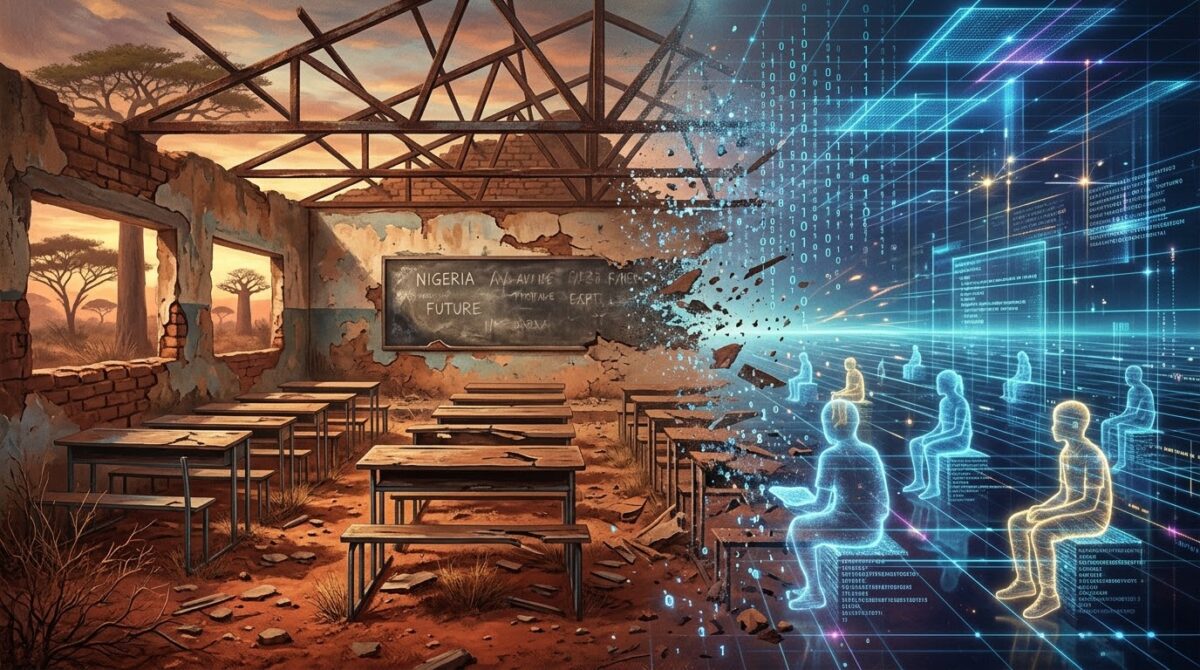
A boy called Ismail Idris begins his day before school. In Gwoza, Borno State, the fourteen-year-old works on farms, earning a little money to help support his grandmother and younger sisters.
He is partially blind, a lasting consequence of measles, and had been out of school after his father died. When he sought a place in a catch-up literacy class at Guduf B Primary School, registration had closed. His teacher, Muhammed Ngwave, offered him a test: attend every class for one week and he would be enrolled. Ismail did. Today, he is learning again.
UNICEF told his story on 30 June 2026. Why must a child display exceptional resolve to obtain an ordinary public service?
The scale behind one boy
Nigeria carries one of the world’s largest education deficits. UNICEF says one in every five out-of-school children globally lives here. Its country profile cites about 10.5 million children aged five to fourteen outside school.
A 2024 estimate put 10.2 million primary-age and 8.1 million junior-secondary-age children outside formal education, or 18.3 million combined. UNESCO estimated 18.2 million across primary, lower-secondary and upper-secondary ages. These figures use different age bands, sources and methods; they should not be treated as interchangeable. Together, they describe a national emergency.
In May 2026, UNICEF identified Jigawa, Kano and Katsina as the states with the highest numbers, together accounting for nearly 30 per cent of the national total. Earlier estimates also identified Bauchi, Kebbi, Yobe, Kaduna and Niger among heavily affected states. The South is not insulated.
Kano’s statistically representative statewide assessment, conducted in March 2026, estimated 875,593 children aged five to eighteen out of school. It found 99.6 per cent of caregivers considered education important or very important. Parental indifference is therefore an inadequate explanation: demand exists, but accessible, affordable provision often does not.
Reading beneath the headlines
Causal Layered Analysis, developed by futurist Sohail Inayatullah, helps us see why the crisis persists. It examines four layers. The first is the litany: the visible headlines of absent pupils, crowded classrooms, unsafe journeys, child labour and school closures. The second is the system: household poverty, insecurity, weak teacher deployment, fragmented federal and state responsibilities, unreliable financing and poor data.
The third is worldview: assumptions that a poor child’s labour matters more than learning, that girls’ education is optional, or that Qur’anic and formal education must compete. The fourth is myth and metaphor: the stories a society tells itself.
Nigeria has too often accepted mass exclusion as inevitable, treated education as a government favour, and confused launching a programme with solving a problem.
These layers reinforce one another. Hunger may compel a child to hawk or farm. Distance, transport costs, unsafe roads and teacher absence weaken the incentive to attend. Conflict has devastated schooling in the North-East: UNICEF says 2.8 million children in Borno, Yobe and Adamawa need education-in-emergencies support. Girls face additional barriers, including early marriage, domestic work, inadequate sanitation and insecurity.
UNICEF reports female primary net attendance rates of 47.7 per cent in the North-East and 47.3 per cent in the North-West. UNICEF’s public-finance report notes that in 2022, 49 per cent of Primary 3 learners, 67 per cent of Primary 5 learners and 86 per cent of Junior Secondary 2 learners failed to reach minimum mathematics proficiency. A child sitting in a classroom but not learning is also being failed.
When reform becomes theatre
Nigeria has repeatedly thrown solutions at the problem: new policies, agencies, committees, school buildings, enrolment drives and digital platforms. Yet the machinery of reform too often substitutes for results. Harvard Kennedy School professor Matt Andrews and Lant Pritchett, alongside Michael Woolcock, a former Harvard Kennedy School lecturer and World Bank social scientist, describe this danger in their book titled Building State Capability. Their concept of isomorphic mimicry captures institutions that copy the outward appearance of successful systems without developing the ability to perform.
A state may have policies, digital platforms and impressive school blocks yet remain unable to tell who attends, whether teachers are present or whether pupils can read.
They also warn against premature load-bearing: asking weak institutions to carry complex reforms before they have mastered basic functions. A local education authority unable to maintain classrooms, deploy teachers fairly or verify attendance cannot be transformed by simply adding a sophisticated technology platform. It is problem-driven iterative adaptation, or PDIA: identify a locally defined problem, test a response, learn from evidence, adjust and expand what works. It creates room for positive deviance: schools outperforming peers despite similar constraints.
A different compact for 2030
Nigeria should establish a public Child Learning Compact, while wards and local governments diagnose their own barriers.
First, create a verified child register by combining household mapping, civil registration, school census and attendance data, with privacy safeguards. Publish annual ward-level figures on enrolment, attendance, transition and foundational learning, disaggregated by sex, disability and displacement. Kano’s 2026 survey shows the value of local baselines, identifying sharp differences between local government areas and barriers of cost and access.
Second, fund solutions that fit the problem. Provide predictable cash transfers, school meals, learning materials and safe transport. Establish flexible calendars and mobile learning hubs for pastoral communities. Rebuild safe schools in conflict-affected areas and fund community early-warning systems.
Create voluntary bridges between Qur’anic schools and formal education, adding literacy, numeracy, science and civic learning while respecting religious identity. Offer accelerated learning for over-age children, accessible facilities and assistive devices for children with disabilities, and stipends, female mentors and safe toilets for girls.
Third, learn from positive deviants. Identify schools that sustain attendance despite poverty, distance or insecurity. Study what teachers, parents and traditional leaders do differently. Test those practices in comparable communities, adapt them with local partners and scale only when evidence supports expansion. Give frontline officials permission to experiment, while requiring transparent reporting and independent verification.
Fourth, make money follow performance and need. UNICEF’s September 2026 public-finance analysis says education’s share of total government expenditure fell from 9.3 per cent in 2015 to 3.6 per cent in 2023, below the 15 to 20 per cent international benchmark.
In 2024, UBEC reported more than ₦135 billion in matching grants unaccessed by states between 2020 and October 2024. Simplify access, provide technical support to weaker states, publish spending and tie staged releases to independently verified improvements in attendance, retention and learning, not ribbon-cuttings.
The test of a nation
The 1976 Universal Primary Education programme showed Nigeria’s capacity for national ambition, but also the cost of expanding access without enough teachers, facilities, finance and local ownership. By December 2030, the SDG deadline, every child of compulsory school age should be identified, offered a safe and suitable learning place, and supported to attend and acquire foundational literacy and numeracy. Governments and partners should publish annual progress.
Ismail’s teacher did not wait for a perfect system. He noticed a child, made room and created a practical route back to learning. This is not a substitute for government responsibility; it shows where capability begins. Nigeria can count oil barrels, voters and taxable transactions. It must become equally determined to find every missing child. The Sustainable Development Goals may end in 2030. The duty to educate does not.
Abdulrauf [email protected] 08114509855 sms only
We’ve got the edge. Get real-time reports, breaking scoops, and exclusive angles delivered straight to your phone. Don’t settle for stale news. Join LEADERSHIP NEWS on WhatsApp for 24/7 updates →
Join Our WhatsApp Channel


