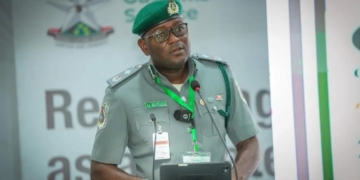
The director-general of the Institute for Peace and Conflict Resolution (IPCR), Dr Joseph Ochogwu, has said Nigeria’s stability must be understood beyond the absence of conflict.
He said true national resilience lies in political legitimacy, economic stability, social cohesion, inclusivity and effective governance.
Speaking at the Advancing Knowledge Exchange Seminar organised by Contemporary World Nigeria Magazine in Abuja, Ochogwu stated that Nigeria operates in a rapidly evolving global order defined by shifting power dynamics, economic uncertainty, technological disruption and complex security challenges.
According to him, today’s global system presents a paradox of rising conflicts alongside expanding opportunities for cooperation through diplomacy, regional integration and multilateral engagement. Nigeria’s task, he said, is to strategically balance these forces by converting vulnerabilities into platforms for resilience and partnership.
Ochogwu said the seminar was designed to deepen public understanding of Nigeria’s foreign policy direction, particularly its pursuit of strategic autonomy. He recalled the minister of foreign affairs stating that Nigeria is leveraging cooperation as the basis of its international engagement to achieve political, economic, and security objectives through diplomacy, trade, investment, and partnerships.
He described Nigeria as a medium power in Africa and the West African sub-region, noting that President Bola Ahmed Tinubu’s active diplomatic engagements across the globe reflect deliberate efforts to reposition the country to derive greater benefits from international cooperation, especially in security and economic development.
The IPCR boss stressed that foreign policy must not be detached from citizens, warning that misinformation often undermines public trust in government actions. He said stability should be viewed as the state’s capacity to manage crises effectively, not as the absence of challenges.
In a lead presentation, Prof. Istifanus Zabadi, a professor of International Relations at Bingham University, Nasarawa State, argued that while the global system may appear stable on the surface, it is fundamentally unstable beneath the surface. He warned that Nigeria’s ambition to reclaim its leadership role in Africa and globally is constrained by internal challenges.
The scholar highlighted Nigeria’s prolonged struggle with terrorism, insurgency, banditry, and kidnapping, alongside less visible threats such as poverty, hunger, weak healthcare systems, and the circulation of fake drugs. He likened Nigeria’s condition to a patient receiving blood transfusions while being expected to donate blood.
He called for the restoration of a shared national identity, noting that deepening divisions between indigenes and non-indigenes weaken national cohesion. He also emphasised the need for meritocracy and the strict application of the rule of law, warning that widespread alienation and everyday civic violations collectively undermine national progress.
The seminar, themed “Between Conflict and Cooperation: Reimagining Nigeria’s Stability in an Evolving Global Order,” reinforced the need for unity, strategic cooperation, and inclusive governance as Nigeria navigates an increasingly complex global environment.
We’ve got the edge. Get real-time reports, breaking scoops, and exclusive angles delivered straight to your phone. Don’t settle for stale news. Join LEADERSHIP NEWS on WhatsApp for 24/7 updates →
Join Our WhatsApp Channel