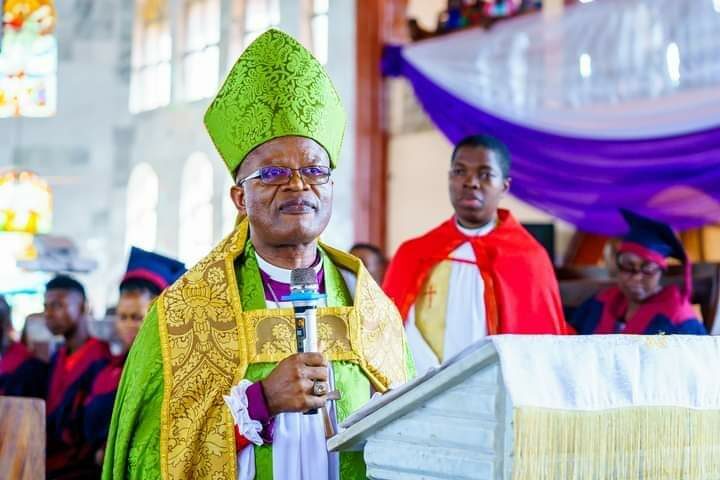
President of the Christian Council of Nigeria (CCN) and Archbishop of the Owerri Province of the Anglican Communion, Most Revd David Onuoha, has warned that Nigeria will continue to grapple with insecurity, corruption, hunger and political instability unless justice becomes the foundation of national life and public policy.
At the council’s 32nd Triennial General Assembly rch, Abuja, Onuoha said the country is “bleeding” because justice—social, economic, political and moral—has been consistently neglected across successive administrations.
Commending the federal government for recent gains in foreign exchange stability, rising reserves and lower inflation figures, the CCN president said the positive macroeconomic indicators have not translated into relief for ordinary Nigerians.
“Hunger, suffering and pain remain a present reality among greater number of the citizens,” he said, urging the government to “give economic policies a human face” rather than impose excessive taxes on essential commodities such as energy and food.
He warned that increasing taxes on struggling citizens was akin to “drawing blood from an anaemic patient.”
Onuoha condemned the disparity between political office holders and professionals, describing Nigeria’s wage structure as “unfair and ungodly.”
“It is disturbing that no teacher or medical personnel can earn in an entire career what a Senator receives in a month,” he said, adding that such imbalance is fueling the exodus of skilled workers and repeated industrial actions in critical sectors like health and education.
He urged the government to treat all sectors “fairly and equitably” to maintain peace and sustainable development.
The Archbishop questioned the effectiveness of the Federal Government’s social intervention programmes, particularly the conditional cash transfers, saying it is unclear who the beneficiaries are.
He recommended that churches and town unions be included in the verification and disbursement processes to prevent the programmes from becoming “avenues for self-enrichment by the privileged few.”
Onuoha expressed deep concern that corruption has worsened under successive governments despite repeated promises to tackle it.
“We regret the inability and lack of moral courage and political will to address this malaise decisively,” he said, calling on the Federal Government to declare a state of emergency on corruption rather than continue excessive borrowing that “mortgages the future of generations.”
A successful anti-corruption campaign, he argued, would free up resources urgently needed for national development.
The CCN president also raised alarm over what he described as a dangerous drift toward a one-party state, marked by mass defections of politicians seeking self-preservation.
“Those who undermine the opposition will be remembered as the undertakers that buried democracy in our land,” he warned, urging political actors to embrace principles and ideological discipline.
He appealed to citizens to pray for President Bola Tinubu, saying his place in history will be defined not by a second-term victory in 2027 but by “returning the country to peace, safety, and value for human life.”
Archbishop Onuoha faulted the non-implementation of the Supreme Court judgment granting financial autonomy to local governments.
“That huge allocations to the third tier of government hardly reflect in the council areas is very unfortunate,” he said, urging the Federal Government to enforce the ruling to enhance grassroots security and development.
The cleric decried worsening insecurity, citing recent attacks in Kebbi, Kwara and Niger states. He questioned why the country has not sought international assistance, despite being overwhelmed.
He endorsed U.S. President Donald Trump’s recent expression of interest in helping Nigeria defeat terrorists, calling it a gesture that should be “welcomed with open hands.”
Referencing the abduction of schoolgirls in Kebbi, he echoed the state governor’s query:
“Who ordered the withdrawal of security personnel 45 minutes before the terrorists struck at Maga?”
He demanded decisive action, including flushing out groups occupying sacked communities so that internally displaced persons can return home.
We’ve got the edge. Get real-time reports, breaking scoops, and exclusive angles delivered straight to your phone. Don’t settle for stale news. Join LEADERSHIP NEWS on WhatsApp for 24/7 updates →
Join Our WhatsApp Channel