North Korea has expressed support for Iran’s decision to appoint a new supreme leader, while accusing the United States and Israel of destabilising regional peace and undermining Tehran’s sovereignty.
According to state media on Wednesday, Pyongyang said it respects Iran’s decision to install Mojtaba Khamenei as the country’s new supreme leader following the death of his father, Ali Khamenei, who was reportedly killed in an Israeli airstrike on February 28.
The Islamic Republic announced Mojtaba Khamenei as the new leader on Sunday, a move that comes amid heightened geopolitical tensions involving the United States, Israel and Iran.
In a statement carried by the official Korean Central News Agency, an unnamed spokesperson of North Korea’s Foreign Ministry said Pyongyang fully respects the Iranian people’s decision.
“We respect the rights and choice of the Iranian people to elect their supreme leader,” the spokesperson said.
The official also criticised Washington and Tel Aviv, accusing them of worsening global instability and violating Iran’s sovereignty.
According to the statement, the United States and Israel are “destroying the regional peace and security foundations and escalating instability worldwide.”
The spokesperson further accused both countries of interfering in Iran’s internal affairs by attempting to undermine the country’s political structure.
“They are violating Iran’s political system and territorial integrity and attempting to overthrow its social system,” the official said, adding that such actions “deserve worldwide criticism and rejection as they can never be tolerated”.
The remarks come amid renewed geopolitical friction involving Pyongyang and Washington. The United States has for decades spearheaded international efforts aimed at dismantling North Korea’s nuclear weapons programme, though diplomatic engagement, sanctions and negotiations have yielded limited results.
Recent months have seen the administration of Donald Trump attempt to reopen high-level talks with North Korea, with discussions reportedly aimed at arranging another summit with the North’s leader, Kim Jong Un, later this year.
During a visit to Asia in October, Trump said he was “100 pe rcent” open to meeting Kim again, although the North initially remained silent on the proposal.
After months of ignoring the overture, Kim recently suggested that relations between the two countries could improve if Washington acknowledged North Korea as a nuclear power.
Meanwhile, North Korean state media reported that Kim personally supervised another test launch of strategic cruise missiles from the naval destroyer Choe Hyon destroyer.
The missile test followed a similar launch carried out last week, which Pyongyang said was part of efforts to equip its navy with nuclear capabilities.
According to KCNA, Kim stressed the need to expand a “powerful and reliable nuclear war deterrent.”
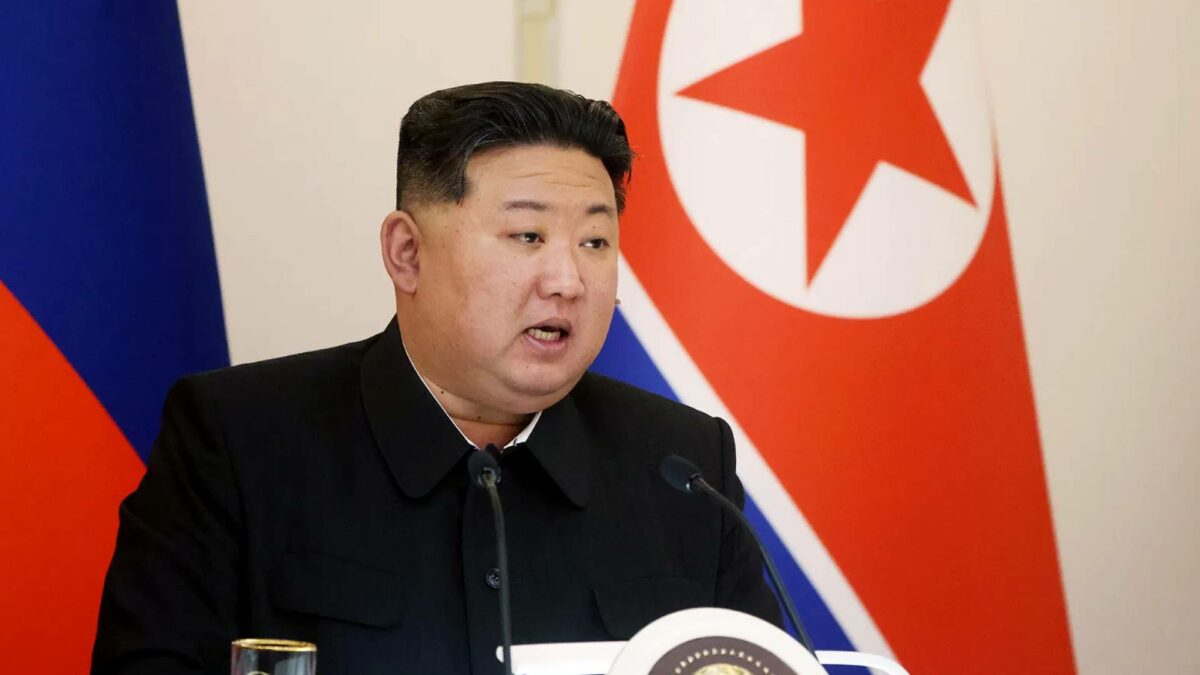
Photographs released by the agency showed the North Korean leader monitoring the missile launch through video footage alongside his teenage daughter, Kim Ju Ae, who is widely believed to be his likely successor.
Kim said the country had achieved “important successes” in deploying both strategic and tactical strike capabilities.
South Korea’s intelligence agency has previously indicated that Pyongyang appears to be preparing Kim Ju Ae for future leadership, noting her frequent appearances alongside her father at official events.
The latest missile test coincided with the start of the joint United States–South Korea military exercise known as Freedom Shield, which began on Monday.
The drills involve forces from South Korea and the United States, and are held annually to strengthen military coordination between the allies.
However, North Korea has repeatedly condemned the exercises, describing them as preparations for war.
In response to the latest drills, Pyongyang warned they could lead to “unimaginably terrible consequences.”
Analysts say the developments reflect North Korea’s broader strategy of reinforcing its military deterrence amid rising global tensions.
Yang Moo-jin, former president of the University of North Korean Studies, said Pyongyang appears to be using the current geopolitical climate to justify strengthening its military posture.
According to him, North Korea is seeking to “secure legitimacy and justification for bolstering war deterrence,” particularly by portraying the US-South Korea drills as more than routine defensive exercises.
He added that Pyongyang is framing the exercises as potential preparation for a preemptive strike, especially in the context of the ongoing conflict involving Iran.
We’ve got the edge. Get real-time reports, breaking scoops, and exclusive angles delivered straight to your phone. Don’t settle for stale news. Join LEADERSHIP NEWS on WhatsApp for 24/7 updates →
Join Our WhatsApp Channel