I don’t know who will be Nigeria’s next president, or the one after that, or even beyond—perhaps until the end of time. However, I am certain about who cannot be president. And His Excellency, Peter Gregory Obi, the 2023 presidential candidate of the opposition Labour Party, is one of them.
It doesn’t take much for any discerning individual to arrive at this conclusion, especially against the backdrop of the early manoeuvrings and significant shifts occurring among opposition parties. A careful review of Mr Obi’s political journey suffices.
Party switching
Time and again, he has shown habitual slothfulness, shifting from one political party to another whenever his new political base encounters difficulties. Instead of leveraging his political experience and insight to address such challenges, he quietly withdraws and moves on. This pattern does not reflect the temperament of someone capable of leading a country as complex as Nigeria.
There is no doubt that Mr Obi has impressive credentials. As a reputable banker and trader, he built a solid profile before venturing into politics. However, since entering the political arena, he has repeatedly switched parties. A closer look at this pattern of venue shopping reveals a troubling trend that raises fundamental questions about his readiness for the presidency.
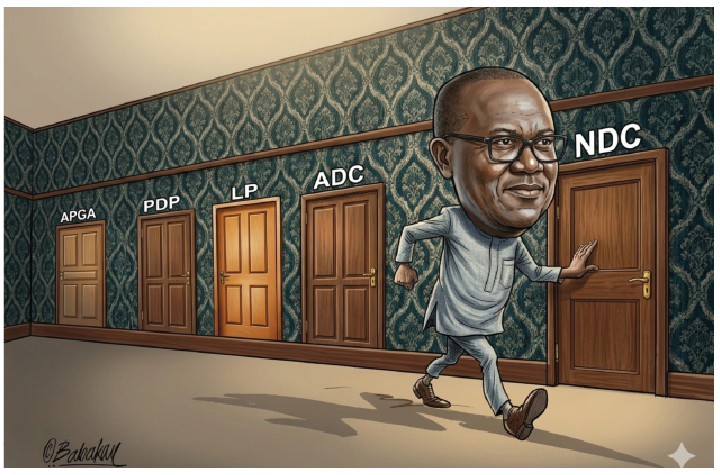
He served as governor of Anambra State under the opposition All Progressives Grand Alliance (APGA) and, by many accounts, performed commendably. However, rather than strengthening the party and helping to transform it into a national political force, he left. He moved to the PDP, where he later became the running mate to former Vice President Atiku Abubakar in the 2019 presidential election.
Ahead of preparations for the 2023 elections, Mr Obi was still a member of the PDP. He positioned himself and contested the party’s presidential ticket alongside Atiku Abubakar and other aspirants. He lost. What followed was predictable: he defected from the PDP and joined the Labour Party, where he was handed its presidential ticket.
In the 2023 presidential election, Mr Obi recorded an impressive showing. He won several states, including areas long considered strongholds of the ruling party. For many, that performance indicated momentum and potential. But politics does not end at the ballot box. Shortly after the elections and the inauguration of a new administration, a crisis emerged within the Labour Party, widely believed to have been fuelled by the government and, indeed, the ruling APC. At that critical moment, when leadership demanded resolve, Mr Obi chose to move on once again.
He failed to remain with the Labour Party. He couldn’t transform the energy of the Obedient Movement into a strong political institution either. The movement, after all, garnered support from a wide range of Nigerians across regions, social classes, and demographics. Turning it into a structured, enduring political force would have demonstrated not just ambition but also capability.
It would have proven that he could develop, organise, and maintain a national coalition. That opportunity came up, and he, unfortunately, let it go. Instead, he began exploring multiple options to find the venue most sympathetic to his political ambitions.
His next destination was the African Democratic Congress (ADC), a coalition platform that has since become entangled in yet another leadership crisis, again widely seen as influenced by the government. What followed? Mr Obi left. This time, to the National Democratic Congress (NDC). I can bet my last penny that if another crisis arises in the NDC, he will take the same path once again.
No easy route
There is a perception that Mr Obi is looking for an easier route to the presidency. However, such a route does not exist. It has never existed, nor will it ever, for him or anyone else. By habitually withdrawing in moments of difficulty, the leader of the Obedient Movement shows not caution but a reluctance to undertake the challenging and often messy work of political leadership.
I am persuaded to believe that Mr Obi is quietly attempting to surpass former Vice President Atiku Abubakar, a man whose long-standing presidential ambitions have seen him switch from one political party to another since 1999. The former Vice-President has moved from PDP to AC/ACN, back to PDP, then to APC, and back to PDP, and now to ADC. However, with each change of party, Atiku’s prospects seem to decline. It is hard not to wonder why Mr Obi has not learned from this pattern.
Among those who have served as elected presidents, only the late Muhammadu Buhari had notable affiliations with more than two parties. Others, including Bola Ahmed Tinubu, have maintained relative consistency. Olusegun Obasanjo remained with the PDP throughout his presidency. The late Umaru Musa Yar’Adua did the same. Goodluck Jonathan followed a similar path.
Even in Buhari’s case, his movement across parties did not stem from an unwillingness to confront the crisis. His exit from the ANPP, which led to the formation of the CPC in 2010, was driven by ideological disagreements and concerns over internal democracy, particularly after the controversial 2007 elections and the party’s alignment with the PDP-led Government of National Unity.
Buhari was an exception in many ways. He commanded a deeply loyal support base, one that consistently delivered 12 million votes in each election cycle. That organic following sustained him through repeated defeats until a broad, national coalition helped him to victory.
Lesson to learn
There is a vital lesson here. Even with such a strong support base, Buhari did not win alone. It took a coalition across different regions and political interests to secure the presidency. In Nigeria, forming coalitions is not optional; it is essential to defeat an incumbent.
The 2023 election underscored this reality. The votes garnered by the trio of Atiku, Peter Obi and Rabiu Musa Kwankwaso during the 2023 polls showed clearly that had these three, who in 2019 were all in the opposition PDP, pulled their strength together, we wouldn’t be here talking about this ruse called Renewed Hope. It is clear: a divided opposition benefits the ruling party.
Yet, rather than remain within the ADC coalition and work through its challenges, Mr Obi and Kwankwaso chose to defect. Now in the NDC, Mr Obi is certainly going to be given the party’s ticket. He will contest. But the outcome seems predictable.
Currently, the opposition risks entering the 2027 election fragmented again, splitting votes and unintentionally enabling the ruling party a narrow win. The basis for this scenario is already clear. If it happens as expected, unless a significant realignment occurs, which is unlikely, it will deal a further fatal blow to Mr Obi’s prospects.
If President Tinubu wins a second term and stays in office until 2031, power is likely to shift to the north for another eight years. That would extend the term to 2039. By then, Mr Obi would be 78.
The man who could not stay to contain the crisis rocking political parties that are supposed to serve as the vehicle for his assumption of power at 64 cannot be trusted to fight at 78. That is the tragedy of Mr Obi’s desire for the nation’s presidency.
An ACF In Crisis
If anyone still wonders whether northern Nigeria is on the brink, the current crisis rocking the Arewa Consultative Forum (ACF) offers their answer. Established in 2001 following the March 2000 meeting of the region’s Emirs and Leaders of Thought, the ACF was meant to energise the north, speak with a united voice, and work towards resolving the many issues facing the region and its people. Less than three decades after its formation, amidst numerous challenges confronting the region, the ACF is now embroiled in a dispute. Sad. The northern leaders and traditional rulers must intervene and save the region from this embarrassment. Time is running out.
We’ve got the edge. Get real-time reports, breaking scoops, and exclusive angles delivered straight to your phone. Don’t settle for stale news. Join LEADERSHIP NEWS on WhatsApp for 24/7 updates →
Join Our WhatsApp Channel