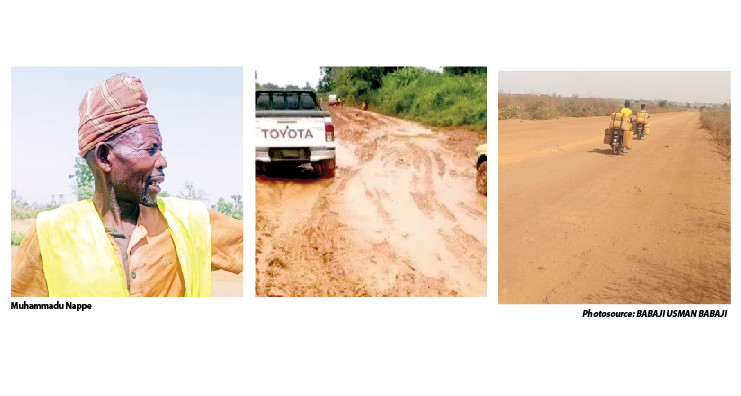
For locals along the Gombe–Dukku Road, every journey is a distress. From patients travelling to access proper treatments, to commuters trapped for hours, the dilapidated highway has turned daily movement into a nightmare. Residents say they are compelled to endure the economic hardship and grief. In this piece, BABAJI USMAN BABAJI travels through the road and tells the ordeal of the communities.
When Adamu Zubairu’s pregnant daughter, Saleema, was rushed out of Dukku Hospital in 2023 for emergency medical attention in Gombe, their hope of her survival was already slim.
They feared the long journey along the Dukku-Gombe road. For 53-year-old Zubairu, every pothole deepened their panic, and every failed section of the road delayed their evening journey.
He told LEADERSHIP Weekend that before they could reach the Federal Teaching Hospital in Gombe, both the mother and her 30-minute-old baby were no more.
“We lost the daughter and the baby that was just born on the road. Any serious sickness that cannot be treated here (in Dukku) is a life-and-death journey,” he said.
Corroborating, Yaya Sule, another resident of Dukku, said several sick people attempting to reach Gombe for treatment never made it alive.
For thousands of residents travelling daily along the Gombe–Dukku Road, the route is a failed infrastructure project.
The poor condition of the road affects transportation costs, farming activities and trade across neighbouring communities. Commercial drivers often spend hours navigating failed portions and frequently battle mechanical faults caused by the rough terrain.
Commuters described the road as a dangerous corridor marked by accidents, economic hardship, delayed healthcare, and damaged vehicles.
Large sections of the road remain riddled with potholes, failed shoulders and erosion, making movement difficult. In some places, motorists are forced to drive partially off-road to avoid damaged surfaces, especially during the rainy season.
The Gombe-Dukku route links the northeastern states of Gombe, Bauchi, Adamawa, and Taraba to the Northwestern states of Jigawa, Kano, etc.
Across communities from Bojude, Wasadu, Nappe to Bazanchilwa and Dukku, the road serves as a critical route for farmers, traders, transporters and patients travelling between villages and urban centres of Gombe State.
But many residents described it as abandoned despite repeated government promises and funds reportedly released for rehabilitation, compelling them to endure years of neglect, accidents and suffering.
Countless Problems
Standing beside the damaged road, Ibrahim Saleh Wasadu, a local community leader, said, “This road has troubled us greatly. The problems it causes us are many and difficult to describe.”
For him and many locals, the road affects nearly every aspect of life — transportation, water access, healthcare, farming and trade.
“Whenever we want to fetch water from here, we have to travel all the way to Bojode (over 10km away). In fact, communities as far as Bozonshilwa also depend on Bojode for access to clean water, yet there is no proper road,” he said.
He explained that vehicles frequently kn ock their livestock while trying to dodge potholes.
“At times, even our people, when crossing the road, a vehicle trying to avoid potholes may suddenly hit someone,” he decried.
The community leader said residents had repeatedly complained to authorities, including local government officials, but little changed beyond assurances that plans are underway.
Accidents, Deaths
In the Nappe community, Muhammadu Abdullahi has spent over a decade filling potholes with sand, only to see the road turn into a death trap.
He recalled tragic accidents he witnessed, and then came the memory he could not forget.
“Sometimes a vehicle hits a pothole and develops a fault. Other times, a vehicle loses control and enters the bush. There was a time when a vehicle overturned due to potholes. Out of over a dozen passengers inside, only one person survived.”
But what stayed with him was what followed days later.
He said, “Even after three days, you could still find parts of human bodies like tongues, noses, buried in the sand.”
Transporters’ Losses
For transport workers already battling inflation and rising fuel costs, the deteriorating highway has become another burden threatening livelihoods.
Especially during the rainy season, muddy sections of the road become nearly impassable, while dry-season travel covers passengers, goods and nearby homes in thick dust.
Abdulaziz Shehu, a commercial driver plying the route, lamented that a 30-minute journey is taking them several hours due to the poor condition of the road.
He said he just spent over N50,000 to repair and replace parts of his vehicle that were knocked down on the road, noting that the money they get only goes for petrol and vehicle repairs, leaving them with mounting debts.
At the Ibrahim Dankwambo Mega Park in Gombe, transport operators say the poor condition of roads across the region has destroyed their vehicles and raised operational costs.
Mamuda, Chairman of the Road Transport Employers Association of Nigeria (RTEAN) at the Gombe Mega Park, said transporters now spend heavily on vehicle repairs due to the poor condition of roads.
“If you buy a tyre here, it may not last up to six months. Shock absorbers are destroyed, and vehicles become completely worn out,” he lamented.
Suffering Remains Despite the Billions
Public finance records reviewed for this report show that billions of naira were released to over 20 contracting companies for works tied to interventions connected to the Gombe–Dukku–Darazo Road.
Yet, communities insist that the condition of the road tells a different story, with large sections riddled with severe challenges.
Some residents and community leaders questioned why Transport Minister (now former), Senator Saidu Ahmed Alkali, being the son of the state, could not influence the federal government for the road project. Others acknowledged that, while the project is under the Federal Ministry of Works, their son had little relevance to it.
While the Dukku-Darazo axis is better than the Gombe-Dukku corridor, road users report little on-the-ground improvement despite.
Government Promises
In 2024, Governor Muhammadu Inuwa Yahaya called for federal government intervention to address deplorable federal roads linking Gombe to neighbouring states.
According to the governor, the roads are vital for economic development and regional connection.
In 2025, the Senate asked the federal government to rehabilitate all dilapidated roads in the North-eastern states as part of its superhighway project.
In a motion during the plenary session, Gombe Central Senator Danjuma Goje expressed concern about the exclusion of the North-east zone from the N4.2 trillion road project approved by the Federal Executive Council (FEC).
Goje pointed out that the North-east was allotted only two projects, valued at N16 billion out of the fund.
But for residents living along the route, budgets, promises, and meetings in Abuja have yet to translate into relief on the ground.
Now, the communities continue to endure the dust and mud. In some instances, horrific accidents.
While for families like Adamu Zubairu’s the consequences are irreversible, for others plying the road, like drivers, success often depends on luck.
We’ve got the edge. Get real-time reports, breaking scoops, and exclusive angles delivered straight to your phone. Don’t settle for stale news. Join LEADERSHIP NEWS on WhatsApp for 24/7 updates →
Join Our WhatsApp Channel