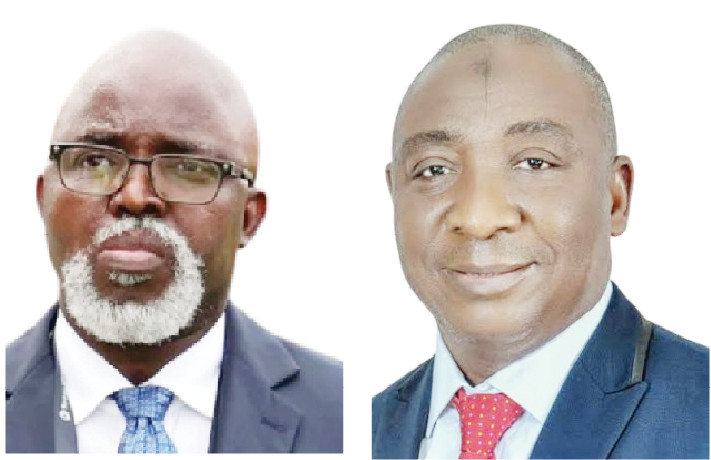
A fresh war of words has erupted over the finances of the Nigeria Football Federation (NFF), with a senior member of the Amaju Pinnick-led administration rejecting claims that the Ibrahim Gusau board inherited huge debts from its predecessor and used a N17 billion Federal Government intervention largely to settle them.
The response followed comments by National Sports Commission (NSC) Chairman Shehu Dikko that the Federal Government provided the NFF with about N15 billion throughout Pinnick’s eight-year tenure between 2014 and 2022, compared with a single N17 billion intervention under the Gusau-led board.
Dikko cited the figures as evidence of the need for greater financial accountability and compliance within the federation, warning that stakeholders must drive reforms themselves or risk external intervention.
Peseiro Debt at Centre of Dispute
The financial controversy centres largely on competing accounts of the liabilities allegedly transferred from the Pinnick administration to the Gusau board.
A member of the Gusau-led board had earlier claimed that the former administration left substantial debts, including a 23-month backlog of Peseiro’s salary, reportedly calculated at $70,000 per month.
At that rate, the arrears would amount to more than $1.6 million.
The source also claimed that outstanding obligations included match allowances and bonuses owed to Super Eagles players dating back to the qualifying campaign for the 2018 FIFA World Cup in Russia.
“Of course, N17 billion is a fairly tidy sum, but don’t forget that the Gusau-led board inherited lots of debts from the previous board and one of those huge debts was the 23-month backlog of coach José Peseiro’s $70,000-a-month salary,” a member of the last board said.
“Peseiro’s unpaid salary alone gulped over a million dollars. Unfortunately, this was the same salary that the previous board claimed had been bankrolled by Aiteo, but that was not the case; it was the Gusau board that cleared the mess.”
The Gusau camp therefore maintains that a substantial portion of the N17 billion intervention was used to settle historical liabilities rather than being available as fresh operational funding.
The source also questioned Dikko’s ability to distance himself from the financial challenges associated with the Pinnick era, given that he served as second vice-president on the Pinnick-led board.
“They say whoever calls for equity must come with clean hands, but can Dikko himself exonerate himself from the mess befuddling Nigerian football, having participated fully on the Pinnick-led board?” he asked.
Exchange Rate Complicates N15bn-N17bn Comparison
The Gusau camp also challenged the significance attached to Dikko’s comparison between the N15 billion provided during Pinnick’s eight years and the N17 billion received by Gusau’s administration.
The source argued that comparing the nominal naira figures without taking exchange-rate differences into account gives a misleading impression of the relative value of the funds.
“When Pinnick was in charge, the dollar was going for between N200 and N600 to a dollar, but when Gusau got N17 billion, the dollar-to-naira rate was about N1,500 to a dollar,” he said.
The argument is that the purchasing power and dollar equivalent of government funding during the two administrations cannot be fairly assessed by comparing naira totals alone.
Pinnick Camp’s Response
But a senior member of the Pinnick-led board, who spoke to our correspondent on condition of anonymity because anti-graft agencies are investigating transactions involving the immediate past NFF administration, disputed the narrative that Gusau inherited an overwhelming financial burden.
The source argued that the NFF is a continuing institution and that liabilities incurred under one administration remain obligations of the federation unless otherwise settled.
He also insisted that Pinnick’s administration had left sponsorship funds from Aiteo specifically to settle the outstanding salary of former Super Eagles coach José Peseiro.
“Was Gusau not part of the Pinnick board, an integral member of the board?” the source asked, while appealing to the parties involved in the controversy to seek reconciliation.
“Let us try to make peace with everybody, including Shehu and Gusau.
“We don’t want to go into this controversy. Shehu didn’t say Gusau should be removed or resign. It went beyond him, and Gusau should take it in good faith that he has made his contribution and done well.”
The source said Pinnick himself had declined to be drawn into the latest controversy, preferring to focus on his business interests.
According to him, the Peseiro salary issue should be viewed in the context of the NFF’s sponsorship arrangement with Aiteo.
“They asked Pinnick to come, and he said no, because he has his businesses and he is okay with it,” he said.
“So, if in Pinnick’s days we owed Peseiro, is the government not a continuity? Aiteo was our sponsor, and whenever Aiteo gave us money, we paid.
“We don’t want to join issues with anybody. If Aiteo paid some funds after we left office, the money was meant to pay coach Peseiro.”
Pinnick Camp Rejects Poor Documentation Claims
The Pinnick camp also rejected suggestions that its administration left the federation without adequate financial records.
“During the Pinnick board, we paid the debt of 2008 because every administration is a continuation,” he said.
“And everything that we did during Pinnick’s time was documented, captured in our year-end reports by PwC.”
He urged stakeholders to avoid turning the dispute into a personal or political campaign against Pinnick.
“Everybody is shouting Amaju Pinnick everywhere on social media and the internet. The hatred is just too much,” he said.
“If you correlate it, the person they’re trying to destroy at home is accepted and appreciated globally because they know his value, which Nigerians back home don’t see.
“Let us stop politicising the matter and work together for the betterment of Nigerian football.”
Dikko Calls for Accountability
Dikko’s intervention came amid the wider crisis engulfing Nigerian football following Gusau’s resignation, the departure of several members of his board and subsequent moves towards reform of the NFF.
Speaking on Arise TV at the weekend, the NSC chairman said the Federal Government provided approximately N15 billion to the NFF during Pinnick’s eight years in charge, from 2014 to 2022.
He contrasted that figure with the N17 billion intervention received by the Gusau administration in a single payment.
Dikko used the comparison to argue for stronger financial controls and greater accountability within the federation.
The former NFF leadership does not dispute the figures attributed to Dikko. Its contention is that the figures must be considered alongside how the funds were spent and the liabilities each administration inherited or incurred.
The Gusau camp maintains that substantial portions of the N17 billion went towards clearing salary arrears, players’ outstanding allowances and other historical obligations.
The Pinnick camp, however, insists that some of those obligations were covered by sponsorship arrangements established during its tenure and argues that, as a continuing institution, the NFF cannot simply attribute financial commitments to a particular administration.
‘Let’s Make Peace’
The Pinnick loyalist also sought to lower the temperature of the dispute, noting that Pinnick had supported the Gusau administration despite their political differences.
“Pinnick didn’t ask Shehu to go and say what he said, and Shehu, too, didn’t say it in bad faith,” he said.
“We know the roles Pinnick played in the Gusau administration in terms of support.
“Eighty or 90 per cent of the sponsors that they still have in the NFF today and tomorrow were because of Pinnick, and they still benefit from them because of him.”
He further claimed that Pinnick had access to information about the administration of Nigerian football that might not be available to the current NSC leadership.
“There is information that Pinnick has that Shehu doesn’t even have as chairman of the National Sports Commission because Pinnick has people in the Presidential Villa,” he claimed.
The source nevertheless urged stakeholders to focus on resolving the crisis rather than deepening existing divisions.
“Pinnick’s administration was outspoken as anything, and everything that we did was documented for people to verify,” he said.
“People should not get busy trying to destroy Shehu Dikko or trying to put people’s heads together. Let us make peace.”
The latest exchange comes as scrutiny of the NFF’s finances intensifies following the leadership crisis that culminated in Gusau’s resignation and the Federal Government’s push for reforms at the federation.
The central issue is now not simply how much public money the NFF received, but how the funds were accounted for, what liabilities existed when each administration assumed office, and whether sponsorship and government interventions were applied for their stated purposes.
With anti-graft agencies also examining transactions linked to the immediate past administration, the competing accounts are likely to remain under scrutiny as stakeholders seek to establish a clearer financial record of the NFF’s recent years.
We’ve got the edge. Get real-time reports, breaking scoops, and exclusive angles delivered straight to your phone. Don’t settle for stale news. Join LEADERSHIP NEWS on WhatsApp for 24/7 updates →
Join Our WhatsApp Channel