
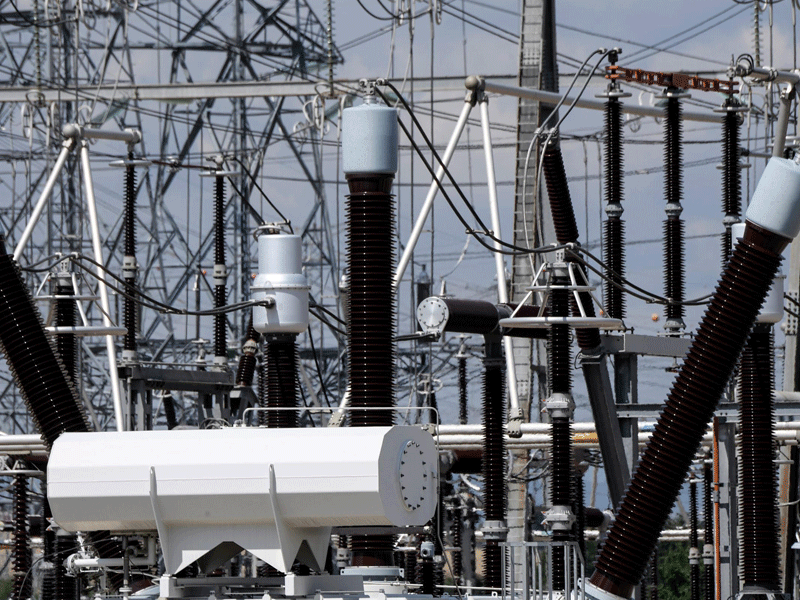
Power generation across Nigeria has degraded even further, worsening electricity supply across the country as the national grid continues to face instability and gas shortages.
The National Grid of Nigeria disclosed this on Friday morning in a post on its official X account, reporting a sharp drop in electricity generation nationwide.
The development continues a pattern of grid instability, with at least three collapses recorded earlier this year. Each incident reduced power generation to near-zero megawatts, according to operational data from the Nigerian Independent System Operator (NISO).
Nigeria’s power sector has long struggled with inadequate supply despite the country’s vast natural gas reserves. Transmission losses, infrastructure gaps and years of underinvestment have limited electricity supply to under 5,000 megawatts for more than 200 million people, according to recent reports by the Nigerian Electricity Regulatory Commission (NERC).
A check on X also showed that several areas across the country have experienced total blackout in the last 24 hours, disrupting daily life and economic activities.
Among the affected communities are Odogunyan and Odonla in Ikorodu North Local Council Development Area (LCDA) of Ikorodu in Lagos, where residents said they have been without electricity since Thursday morning.
System dispatch data further showed that Nigeria’s electricity distribution companies (DisCos) received only 2,830 megawatts (MW) of electricity on Thursday as persistent gas shortages forced several power plants to limit operations, leaving many homes and industries without power.
Operational data from NISO indicated that generation on the grid stood at 3,940.53MW at about 05:00 hours on March 5, 2026.
However, between 06:00 and 08:00 hours, several generation units were forced offline because of inadequate gas supply, resulting in an additional 292MW drop in available generation.
The reduced output sharply constrained electricity available to the 11 DisCos, leaving them with a combined load allocation of 2,830MW, according to the system operator.
Generation later dropped further to about 1,490MW at around 6:00 p.m., highlighting the fragile state of the country’s electricity supply system.
Among the distribution companies, the Abuja Electricity Distribution Company (AEDC) received the highest allocation of 490MW, followed by Ikeja Electric with 484MW and Eko Electricity Distribution Company with 413MW.
Other allocations included 306MW to Ibadan Electricity Distribution Company, 207MW to Benin Electricity Distribution Company and 198MW to Enugu Electricity Distribution Company.
Further allocations were 178MW to Port Harcourt Electricity Distribution Company, 173MW to Kano Electricity Distribution Company, 161MW to Kaduna Electricity Distribution Company, 144MW to Jos Electricity Distribution Company and 76MW to Yola Electricity Distribution Company.
Meanwhile, the federal government says Nigeria will add more than 200MW of solar electricity to its power system as it pushes ahead with more than 1,000 mini-grid projects under a nationwide rural electrification programme.
Managing director of the Rural Electrification Agency (REA), Abba Aliyu, disclosed this in Abuja during a visit by officials from the National Judicial Institute (NJI).
Aliyu said the projects form part of a $750 million public programme aimed at expanding electricity access in rural and underserved communities across Nigeria.
Industry observers say the limited supply underscores the severity of Nigeria’s gas shortages, which continue to hamper electricity production despite the country’s large natural gas reserves.
They also noted that the ongoing crisis in the Middle East has made gas exports more attractive as global prices rise, while domestic gas prices in Nigeria remain regulated at relatively low levels.
We’ve got the edge. Get real-time reports, breaking scoops, and exclusive angles delivered straight to your phone. Don’t settle for stale news. Join LEADERSHIP NEWS on WhatsApp for 24/7 updates →
Join Our WhatsApp Channel