Nigeria and Bangladesh have maintained cordial bilateral relations in key sectors to promote development for mutual benefits. Both countries have strengthened relations significantly, with bilateral trade surpassing $100 million as of March 2025.
However, the flourishing ties between both countries are also focused on cooperation to preserve and promote indigenous languages as component parts of culture and the perpetuation of tradition.
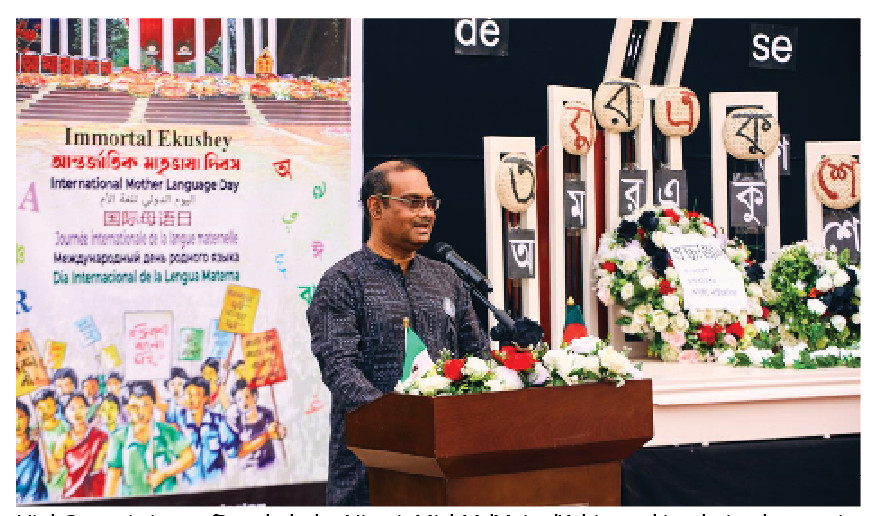
This was the crux of an event to celebrate the Shaheed Dibosh(Martyrs Day) and International Mother Language Day 2026 (often observed every February 21) held recently at the High Commission of Bangladesh in Abuja.
The high Commissioner of Bangladesh to Nigeria Miah Md Mainul Kabir was very emphatic about the fact that desires can never be fulfilled without one’s mother tongue.
The Martyrs Day is a day of national mourning, reflection and action and the expression of the pride and profound respect to Bangladeshi brave sons-Rafiq, Salam, Barkat, Jabbar, and numerous others who made supreme sacrifice on this day in 1952 for the honor and preservation of the mother language, Bangla.
Going through memory lane the envoy noted that the struggle of these brave sons was a pivotal moment in history, a testament to the unbreakable bond between language, identity, and dignity. It was an era replete with the heroic episode which sowed the seeds of Bangladeshi long struggle for self-determination, ultimately culminating in its independence in 1971.
“It is because of this unparalleled sacrifice, UNESCO proclaimed the 21st of February as the International Mother Language Day in 1999. Now 21st February belongs not just to Bangladesh, but to the entire world. It stands as a universal reminder of the importance of linguistic diversity and the fundamental right of every person to learn, speak, and preserve their mother tongue.
“About 7000 documented languages are currently spoken through-out the world. But social, demographic and political factors are causing their disappearance. A language lost is not only a means of expression silenced; it is a worldview extinguished. And this loss deepens inequality when speakers of marginalized languages are excluded from education, civic participation, or economic opportunity.
“Following the free, fair, inclusive and internationally recognized 13th National Parliamentary Election and referendum the present Government of Bangladesh assumed office on 17th February under the leadership of Honourable Prime Minister Tarique Rahman. Our government remains steadfast in upholding the dignity of all linguistic and cultural identities,” he said.
By way of cooperation and partnership the spirit of 21 February resonates deeply in Nigeria, a nation celebrated as one of the most linguistically diverse countries on Earth. With over 500 living languages, Nigeria is a vibrant mosaic of cultures. Nigeria’s experience mirrors the belief that diversity is not a challenge to be managed, but a profound strength to be celebrated.
“I reaffirm the warm and fraternal ties that exist between Bangladesh and Nigeria. Our two nations share a common outlook on many global issues and a deep respect for our cultural heritage. As we move forward, I am confident that we can find newer avenues to further collaboration in the fields of education, culture, and the preservation of our shared linguistic heritage,” he said.
The Nigerian government was represented at the event by Senior Counsellor of Asia and Pacific Division Mrs. Ogunmilua Aduke Temilola. The Nigerian government highlighted the universal rights of every person to preserve their cultural identities, adding that Nigeria is rich indigenous languages and the commemoration resonates with the efforts made by the government of Nigeria to preserve the Mother Tongue.
According to her “language promotes trust, peaceful coexistence and global harmony”, adding that Nigeria will support the efforts to preserve these mother tongues in a digital era.
Yachat Nuhu, Head of Communication and Information at the United Nations Education Scientific and Cultural Organization (UNESCO) noted that young people are the main guardians of languages, adding that preserving linguistic diversity has become necessary in the era of digital expansion.
The celebration focuses on protecting, revitalizing, and promoting indigenous languages, with a strong emphasis on the role of indigenous women as custodians of language.
The need to employ technology and Artificial Intelligence for archiving, creating open-access resources, and developing digital tools to support are at the center of the move to enhance indigenous languages.
UNESCO is also making enormous efforts in advocating for mother-tongue-based, multilingual instruction from early childhood to enhance learning and preserve cultural identity and encouraging governments to adopt policies that support linguistic diversity, particularly in Africa, where a significant portion of language loss occurs.
We’ve got the edge. Get real-time reports, breaking scoops, and exclusive angles delivered straight to your phone. Don’t settle for stale news. Join LEADERSHIP NEWS on WhatsApp for 24/7 updates →
Join Our WhatsApp Channel