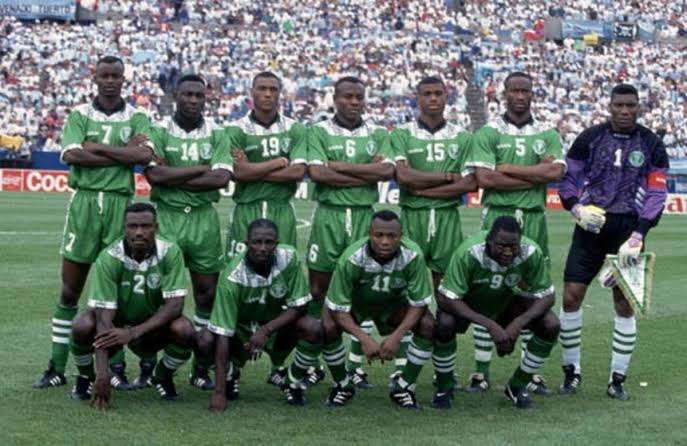
From the illustrious 1994 Super Eagles to the formidable D’Tigress, Nigerian athletes have consistently been lauded in stadiums, only to be neglected by officialdom. Their hard-won medals, often mere props for photo opportunities, are followed by rewards that are delayed for months, years, and sometimes even decades. AFFA ACHO chronicles the widening chasm between governmental pledges and the eventual recompense champions receive, exploring the profound human cost of such prolonged waits.
The narrative of Nigeria’s abandoned sporting heroes is far from novel. It is a recurring chronicle of public adulation followed by private neglect – a cycle that has relentlessly repeated itself across generations, administrations, and sporting disciplines.
In 1994, the Super Eagles clinched the Africa Cup of Nations in Tunisia. The military government of General Sani Abacha promised each player houses in their state of origin. Astoundingly, it took 28 years – until 2022 – for the government to finally commence the handover of these properties. Some players endured nearly three decades for a reward earned through national glory.
Similarly, the Golden Eaglets, triumphant at the 1985 U17 World Cup, had to wait until 2015 for President Buhari to fulfil a cash promise – a staggering 30-year delay. Even the iconic Dream Team of 1996, Olympic football gold medallists, continue to face protracted delays with their promised land allocations, despite receiving cash rewards relatively swiftly.
Chioma Ajunwa, Nigeria’s first individual Olympic gold medallist, once waited 25 years to receive her housing reward for her monumental achievement at the Atlanta 1996 Olympic Games.
“I served Nigeria for 13 years, and we were never accorded the honour we deserve. Instead, we got empty promises, golden handshakes, golden cards and N300,000. We were promised landed properties that we never received. Most of my colleagues are suffering.” — Patience Avre, former Super Falcons player
This quote poignantly captures the disillusionment felt by many athletes who dedicated their careers to representing Nigeria, only to be met with unfulfilled promises and subsequent hardship.
The 2025 Super Falcons – A Promise in Peril
Perhaps no case better encapsulates the disparity between government rhetoric and stark reality than the predicament of the 2025 WAFCON-winning Super Falcons.
President Tinubu’s reward package, officially announced and widely reported, includes $100,000 USD for each player and technical crew member, a three-bedroom apartment in Abuja for each squad member, and the National Honour of Member of the Order of the Niger (MON).
This package was hailed as the most substantial reward in African women’s football history, with the President declaring it “a statement that Nigeria values its daughters.” Yet, one year later, none of the three components has been fully delivered.
Super Falcons captain Rasheedat Ajibade confirmed last month that the team was still awaiting the $100,000 reward and other benefits. With a hint of bitter humour, she revealed that while discussions had progressed to deciding how the players would divide the money, “People want to suffocate me. The money has already been split up into percentages, but we haven’t gotten it yet.”
According to multiple players and officials, discontent began brewing in the camp ahead of WAFCON 2026. Players started questioning, “Where is our 2025 money? Where are the Abuja houses?” Nigerian Football Federation (NFF) officials allegedly became aware that the players were planning a quiet protest – including a training boycott and a unified statement to the press. Three urgent letters were subsequently dispatched to the team.
The link between unfulfilled promises and on-field performance is undeniable. A team that had dominated African women’s football for a decade appeared disjointed and sluggish in 2026. As one columnist aptly put it: “Did the failure to deliver break the team?”
The Super Eagles – A Recurring Nightmare
The men’s national team has endured similar indignities for years.
During the 2025 Africa Cup of Nations, Super Eagles players threatened to boycott training and their trip to Marrakech until they received win bonuses for four matches – group-stage victories over Tanzania, Tunisia, and Uganda, plus their round-of-16 triumph against Mozambique.
The situation became so dire that captain Wilfred Ndidi pledged to pay his teammates’ outstanding win bonuses out of his own pocket if the government failed to deliver. “I’ve now made a commitment to the staff and players that I will personally pay the bonuses if the authorities don’t do it before Saturday. I don’t want these unpaid bonuses to affect our preparations.”
Ndidi’s willingness to use personal funds echoes actions by former Nigeria captain John Mikel Obi, who claimed he covered team expenses during the build-up to the 2016 Rio Olympics – and was never reimbursed.
Then Minister of State for Finance, Dr. Doris Uzoka-Anite, attributed the delays to “conversion of funds into foreign currency.” The government announced it had “streamlined the foreign exchange processing” to prevent future payment disputes.
However, this was not the first instance of such issues. And, as history suggests, it will not be the last.
Beyond Football — A Crisis Across Sports
The abandonment of sporting heroes transcends football. The national senior women’s basketball team, the D’Tigresses, won the FIBA Women’s Afrobasket title five consecutive times, each victory marred by unfulfilled promises. After their win in Côte d’Ivoire, President Bola Ahmed Tinubu announced a naira equivalent of $100,000, while each official was awarded the equivalent of $50,000—completing their package of cash rewards, national honours, and three-bedroom homes in Abuja. Recently, President Tinubu confirmed via his X handle that the D’Tigress had finally received the promises made to them one year prior.
D’Tigress captain Amy Okonkwo expressed deep gratitude on behalf of the team, describing the President as a father figure committed to the welfare of Nigerian athletes.
“On behalf of the entire D’Tigress team, I want to specially thank our dear President, Bola Ahmed Tinubu, GCFR, for this show of love and support,” Okonkwo stated. “We are genuinely grateful for everything he has done to ensure we receive all that he promised us after winning the Afrobasket last year.”
Tinubu acknowledged that, for the first time, a federal government had fulfilled such a scale of presidential sporting rewards in full within one year. He also revealed that the unresolved cash rewards for the Super Falcons were being finalised, and confirmed that players and officials had received the title documents for their house allocations and National Honours certificates.
“Our athletes who bring honour to Nigeria deserve more than applause. They deserve a country that keeps its word,” Tinubu asserted. He reiterated his promise to Nigerian athletes to ensure they return to a grateful nation.
Home-Based Olympians
Home-based athletes representing Nigeria at the Paris 2024 Olympics revealed they had not received their full entitlements. While they received N2,170,000 as a training allowance and N6,200,000 as appearance fees, the promised $1,000 training grant has yet to be disbursed. One athlete, wishing to remain anonymous, disclosed: “This is a top secret; we were instructed not to discuss financial matters with anyone.”
The 2008 Olympic Dream Team
Members of the 2008 Olympic Dream Team, who secured silver in Beijing, are still waiting for promised national honours and other rewards—more than 16 years later.
Oluwafemi Ajilore took to social media: “Where are the promises and national honour commitments for us? Someone should help and remind the FG. It’s not too late.”
Victor Obinna Nsofor poignantly remarked, capturing the despair of a generation of neglected athletes: “No be today my brother, promise promise but never redeemed.”
State-Level Failures
The issue is not confined to the federal government. In Oyo State, athletes who represented the state in national competitions have voiced their frustrations to Governor Makinde over unpaid monetary rewards, with gold medalists promised N1 million each, silver medalists N500,000, and bronze medalists N300,000. During the 22nd National Sports Festival, Ogun State athletes protested and blocked the Games Village gate over unpaid allowances.
The Human Cost — Why Athletes Leave
The failure to fulfil promises has repercussions that extend far beyond wounded pride.
Chioma Ajunwa has attributed the rising trend of Nigerian athletes switching allegiances or relocating abroad to inadequate welfare systems and the lack of long-term security for athletes after their competitive careers.
“Athletes don’t compete forever,” Ajunwa stated. “Your peak years are short, and if there is no insurance, no proper welfare, and no security for life after sports, people will understandably seek better options elsewhere.”
She noted that many Nigerian athletes dedicate their best years to representing the country but are often left to fend for themselves once injuries, age, or retirement set in. “Athletes need to feel valued—not just when they are winning medals, but throughout their careers. When people feel abandoned, they will leave.”
The loss of elite athletes significantly impacts Nigeria’s performance at major events. Replacing experienced athletes is challenging, and their absence creates a vacuum that young talents may struggle to fill immediately.
Former President Goodluck Jonathan has also expressed his sorrow on the matter: “I always feel sad when I see individuals who have represented Nigeria, won medals at the Commonwealth Games or Olympics, and are later abandoned.”
Budgets, Promises, And The Accountability Gap
The lingering question surrounding every unfulfilled promise is straightforward: Did the government make these commitments without adequate budgetary provisions?
In the 2026 Appropriation Bill, the Federal Government earmarked N2 billion for reward packages for outstanding national teams and athletes, as well as provisions for financially struggling retired sports stars. The National Sports Commission allocated another N2 billion for presidential rewards, bringing the total to N4 billion.
Under the budget line “Special Support to Deserving Retired Nigerian International Athletes, Players/Coaches and Other Unredeemed Federal Government Obligations to Sports Persons,” a total of N2 billion has been set aside to address the welfare needs of retired athletes and settle outstanding obligations owed to them.
President Tinubu has mandated that “all funds so appropriated are released immediately once the budget is passed and assented to.”
Yet, a considerable gap remains between budgetary allocation and actual disbursement.
The N12 billion invested in the Paris Olympics campaign yielded no medals, raising concerns about whether funds are being directed to the right priorities—or even reaching the right people at all.
Sports consultant Tolu Ogundeji has called for systemic reform: “The government must move beyond ceremonial pledges and establish transparent, binding mechanisms for delivering promised rewards. This could include a dedicated, structured National Sports Rewards Fund that survives administrative transitions; public quarterly reports on the status of all outstanding pledges; automatic timelines that trigger delivery within 90 days of any public commitment; and personal accountability for officials whose promises remain unfulfilled.”
The Cost To Nigeria’s Reputation And Future
The consequences of this pattern of abandonment are profound and long-lasting.
A Deterrent to Future Talent: Young athletes observing their heroes beg for what was promised learn a devastating lesson: representing Nigeria is a gamble, not a guarantee. Why sacrifice years of training, endure the pressures of international competition, and bring glory to the nation when the nation fails to honour its word?
A Crisis of Trust: “Such protracted waits erode trust, dampen the spirit of future athletes, and send a clear message of systemic neglect,” remarked former athlete Richard Terver. The relationship between athlete and state becomes transactional at best, adversarial at worst.
A Sporting Brain Drain: As Ajunwa warned, the ongoing loss of elite athletes could have dire consequences for Nigeria’s performance at the Commonwealth Games, Olympic Games, and other significant events.
An International Embarrassment: When Nigerian athletes publicly plead for what was promised—when captains must offer to pay teammates from their own pockets—the image projected is one of a nation that celebrates victory but neglects its victors. This is not the reputation of a sporting powerhouse.
Beyond The Podium
Nigeria’s sporting narrative is one of promise, achievement, and unfulfilled potential. Our victories often arise not from a robust, supportive system, but despite its glaring deficiencies.
The 2026 WAFCON elimination of the Super Falcons—a team that has won 10 of 13 titles—may be traced back to the unfulfilled promises of 2025. A team cannot be expected to perform at its best when its members feel abandoned, disrespected, and exploited.
A New Attempt to Break the Cycle
The National Sports Commission appears to recognise the scale of the problem.
In its 2026 budget framework, the commission earmarked ₦4 billion across two separate ₦2 billion streams.
One allocation aims to support deserving retired athletes and coaches and fulfil outstanding Federal Government obligations, while the other is designated for presidential rewards for successful active athletes and teams.
This could mark a significant shift—from treating sporting rewards as ad hoc presidential gestures to establishing a budgetary mechanism to address them.
The government has already demonstrated that old obligations can be settled. In June 2025, it fulfilled a promise made over three decades earlier to members of the 1994 Super Eagles squad, while the NSC has also overseen the distribution of housing documents and national honours linked to more recent sporting successes.
However, awareness does not equate to action. Budgets are not disbursements. Promises do not equal payments.
As Patience Avre stated: “The President should correct this injustice.” The question remains whether this generation of Nigerian athletes will witness that correction—or, like the heroes of 1994, 1996, 2008, and many others, will be left waiting for decades.
The challenge for Nigeria is clear: Will we finally break the cycle, or will we continue to abandon those who bring us glory?
The narrative of Nigeria’s abandoned sporting heroes is far from novel. It is a recurring chronicle of public adulation followed by private neglect – a cycle that has relentlessly repeated itself across generations, administrations, and sporting disciplines.
In 1994, the Super Eagles clinched the Africa Cup of Nations in Tunisia. The military government of General Sani Abacha promised each player houses in their state of origin. Astoundingly, it took 28 years – until 2022 – for the government to finally commence the handover of these properties. Some players endured nearly three decades for a reward earned through national glory.
Similarly, the Golden Eaglets, triumphant at the 1985 U17 World Cup, had to wait until 2015 for President Buhari to fulfil a cash promise – a staggering 30-year delay. Even the iconic Dream Team of 1996, Olympic football gold medallists, continue to face protracted delays with their promised land allocations, despite receiving cash rewards relatively swiftly.
Chioma Ajunwa, Nigeria’s first individual Olympic gold medallist, once waited 25 years to receive her housing reward for her monumental achievement at the Atlanta 1996 Olympic Games.
“I served Nigeria for 13 years, and we were never accorded the honour we deserve. Instead, we got empty promises, golden handshakes, golden cards and N300,000. We were promised landed properties that we never received. Most of my colleagues are suffering.” — Patience Avre, former Super Falcons player
This quote poignantly captures the disillusionment felt by many athletes who dedicated their careers to representing Nigeria, only to be met with unfulfilled promises and subsequent hardship.
The 2025 Super Falcons – A Promise in Peril
Perhaps no case better encapsulates the disparity between government rhetoric and stark reality than the predicament of the 2025 WAFCON-winning Super Falcons.
President Tinubu’s reward package, officially announced and widely reported, includes $100,000 USD for each player and technical crew member, a three-bedroom apartment in Abuja for each squad member, and the National Honour of Member of the Order of the Niger (MON).
This package was hailed as the most substantial reward in African women’s football history, with the President declaring it “a statement that Nigeria values its daughters.” Yet, one year later, none of the three components has been fully delivered.
Super Falcons captain Rasheedat Ajibade confirmed last month that the team was still awaiting the $100,000 reward and other benefits. With a hint of bitter humour, she revealed that while discussions had progressed to deciding how the players would divide the money, “People want to suffocate me. The money has already been split up into percentages, but we haven’t gotten it yet.”
According to multiple players and officials, discontent began brewing in the camp ahead of WAFCON 2026. Players started questioning, “Where is our 2025 money? Where are the Abuja houses?” Nigerian Football Federation (NFF) officials allegedly became aware that the players were planning a quiet protest – including a training boycott and a unified statement to the press. Three urgent letters were subsequently dispatched to the team.
The link between unfulfilled promises and on-field performance is undeniable. A team that had dominated African women’s football for a decade appeared disjointed and sluggish in 2026. As one columnist aptly put it: “Did the failure to deliver break the team?”
The Super Eagles – A Recurring Nightmare
The men’s national team has endured similar indignities for years.
During the 2025 Africa Cup of Nations, Super Eagles players threatened to boycott training and their trip to Marrakech until they received win bonuses for four matches – group-stage victories over Tanzania, Tunisia, and Uganda, plus their round-of-16 triumph against Mozambique.
The situation became so dire that captain Wilfred Ndidi pledged to pay his teammates’ outstanding win bonuses out of his own pocket if the government failed to deliver. “I’ve now made a commitment to the staff and players that I will personally pay the bonuses if the authorities don’t do it before Saturday. I don’t want these unpaid bonuses to affect our preparations.”
Ndidi’s willingness to use personal funds echoes actions by former Nigeria captain John Mikel Obi, who claimed he covered team expenses during the build-up to the 2016 Rio Olympics – and was never reimbursed.
Then Minister of State for Finance, Dr. Doris Uzoka-Anite, attributed the delays to “conversion of funds into foreign currency.” The government announced it had “streamlined the foreign exchange processing” to prevent future payment disputes.
However, this was not the first instance of such issues. And, as history suggests, it will not be the last.
Beyond Football — A Crisis Across Sports
The abandonment of sporting heroes transcends football. The national senior women’s basketball team, the D’Tigresses, won the FIBA Women’s Afrobasket title five consecutive times, each victory marred by unfulfilled promises. After their win in Côte d’Ivoire, President Bola Ahmed Tinubu announced a naira equivalent of $100,000, while each official was awarded the equivalent of $50,000—completing their package of cash rewards, national honours, and three-bedroom homes in Abuja. Recently, President Tinubu confirmed via his X handle that the D’Tigress had finally received the promises made to them one year prior.
D’Tigress captain Amy Okonkwo expressed deep gratitude on behalf of the team, describing the President as a father figure committed to the welfare of Nigerian athletes.
“On behalf of the entire D’Tigress team, I want to specially thank our dear President, Bola Ahmed Tinubu, GCFR, for this show of love and support,” Okonkwo stated. “We are genuinely grateful for everything he has done to ensure we receive all that he promised us after winning the Afrobasket last year.”
Tinubu acknowledged that, for the first time, a federal government had fulfilled such a scale of presidential sporting rewards in full within one year. He also revealed that the unresolved cash rewards for the Super Falcons were being finalised, and confirmed that players and officials had received the title documents for their house allocations and National Honours certificates.
“Our athletes who bring honour to Nigeria deserve more than applause. They deserve a country that keeps its word,” Tinubu asserted. He reiterated his promise to Nigerian athletes to ensure they return to a grateful nation.
Home-Based Olympians
Home-based athletes representing Nigeria at the Paris 2024 Olympics revealed they had not received their full entitlements. While they received N2,170,000 as a training allowance and N6,200,000 as appearance fees, the promised $1,000 training grant has yet to be disbursed. One athlete, wishing to remain anonymous, disclosed: “This is a top secret; we were instructed not to discuss financial matters with anyone.”
The 2008 Olympic Dream Team
Members of the 2008 Olympic Dream Team, who secured silver in Beijing, are still waiting for promised national honours and other rewards—more than 16 years later.
Oluwafemi Ajilore took to social media: “Where are the promises and national honour commitments for us? Someone should help and remind the FG. It’s not too late.”
Victor Obinna Nsofor poignantly remarked, capturing the despair of a generation of neglected athletes: “No be today my brother, promise promise but never redeemed.”
State-Level Failures
The issue is not confined to the federal government. In Oyo State, athletes who represented the state in national competitions have voiced their frustrations to Governor Makinde over unpaid monetary rewards, with gold medalists promised N1 million each, silver medalists N500,000, and bronze medalists N300,000. During the 22nd National Sports Festival, Ogun State athletes protested and blocked the Games Village gate over unpaid allowances.
The Human Cost — Why Athletes Leave
The failure to fulfil promises has repercussions that extend far beyond wounded pride.
Chioma Ajunwa has attributed the rising trend of Nigerian athletes switching allegiances or relocating abroad to inadequate welfare systems and the lack of long-term security for athletes after their competitive careers.
“Athletes don’t compete forever,” Ajunwa stated. “Your peak years are short, and if there is no insurance, no proper welfare, and no security for life after sports, people will understandably seek better options elsewhere.”
She noted that many Nigerian athletes dedicate their best years to representing the country but are often left to fend for themselves once injuries, age, or retirement set in. “Athletes need to feel valued—not just when they are winning medals, but throughout their careers. When people feel abandoned, they will leave.”
The loss of elite athletes significantly impacts Nigeria’s performance at major events. Replacing experienced athletes is challenging, and their absence creates a vacuum that young talents may struggle to fill immediately.
Former President Goodluck Jonathan has also expressed his sorrow on the matter: “I always feel sad when I see individuals who have represented Nigeria, won medals at the Commonwealth Games or Olympics, and are later abandoned.”
Budgets, Promises, And The Accountability Gap
The lingering question surrounding every unfulfilled promise is straightforward: Did the government make these commitments without adequate budgetary provisions?
In the 2026 Appropriation Bill, the Federal Government earmarked N2 billion for reward packages for outstanding national teams and athletes, as well as provisions for financially struggling retired sports stars. The National Sports Commission allocated another N2 billion for presidential rewards, bringing the total to N4 billion.
Under the budget line “Special Support to Deserving Retired Nigerian International Athletes, Players/Coaches and Other Unredeemed Federal Government Obligations to Sports Persons,” a total of N2 billion has been set aside to address the welfare needs of retired athletes and settle outstanding obligations owed to them.
President Tinubu has mandated that “all funds so appropriated are released immediately once the budget is passed and assented to.”
Yet, a considerable gap remains between budgetary allocation and actual disbursement.
The N12 billion invested in the Paris Olympics campaign yielded no medals, raising concerns about whether funds are being directed to the right priorities—or even reaching the right people at all.
Sports consultant Tolu Ogundeji has called for systemic reform: “The government must move beyond ceremonial pledges and establish transparent, binding mechanisms for delivering promised rewards. This could include a dedicated, structured National Sports Rewards Fund that survives administrative transitions; public quarterly reports on the status of all outstanding pledges; automatic timelines that trigger delivery within 90 days of any public commitment; and personal accountability for officials whose promises remain unfulfilled.”
The Cost To Nigeria’s Reputation And Future
The consequences of this pattern of abandonment are profound and long-lasting.
A Deterrent to Future Talent: Young athletes observing their heroes beg for what was promised learn a devastating lesson: representing Nigeria is a gamble, not a guarantee. Why sacrifice years of training, endure the pressures of international competition, and bring glory to the nation when the nation fails to honour its word?
A Crisis of Trust: “Such protracted waits erode trust, dampen the spirit of future athletes, and send a clear message of systemic neglect,” remarked former athlete Richard Terver. The relationship between athlete and state becomes transactional at best, adversarial at worst.
A Sporting Brain Drain: As Ajunwa warned, the ongoing loss of elite athletes could have dire consequences for Nigeria’s performance at the Commonwealth Games, Olympic Games, and other significant events.
An International Embarrassment: When Nigerian athletes publicly plead for what was promised—when captains must offer to pay teammates from their own pockets—the image projected is one of a nation that celebrates victory but neglects its victors. This is not the reputation of a sporting powerhouse.
Beyond The Podium
Nigeria’s sporting narrative is one of promise, achievement, and unfulfilled potential. Our victories often arise not from a robust, supportive system, but despite its glaring deficiencies.
The 2026 WAFCON elimination of the Super Falcons—a team that has won 10 of 13 titles—may be traced back to the unfulfilled promises of 2025. A team cannot be expected to perform at its best when its members feel abandoned, disrespected, and exploited.
A New Attempt to Break the Cycle
The National Sports Commission appears to recognise the scale of the problem.
In its 2026 budget framework, the commission earmarked ₦4 billion across two separate ₦2 billion streams.
One allocation aims to support deserving retired athletes and coaches and fulfil outstanding Federal Government obligations, while the other is designated for presidential rewards for successful active athletes and teams.
This could mark a significant shift—from treating sporting rewards as ad hoc presidential gestures to establishing a budgetary mechanism to address them.
The government has already demonstrated that old obligations can be settled. In June 2025, it fulfilled a promise made over three decades earlier to members of the 1994 Super Eagles squad, while the NSC has also overseen the distribution of housing documents and national honours linked to more recent sporting successes.
However, awareness does not equate to action. Budgets are not disbursements. Promises do not equal payments.
As Patience Avre stated: “The President should correct this injustice.” The question remains whether this generation of Nigerian athletes will witness that correction—or, like the heroes of 1994, 1996, 2008, and many others, will be left waiting for decades.
The challenge for Nigeria is clear: Will we finally break the cycle, or will we continue to abandon those who bring us glory?
We’ve got the edge. Get real-time reports, breaking scoops, and exclusive angles delivered straight to your phone. Don’t settle for stale news. Join LEADERSHIP NEWS on WhatsApp for 24/7 updates →
Join Our WhatsApp Channel