The two most recent incidents of mass abduction of schoolchildren remind Nigerians that this kind of crime remains a worrying fixture of the country’s public safety deficit.
On 17 November 2025, at Government Girls’ Comprehensive Secondary School, Maga, Kebbi State, 25 schoolgirls were seized in an attack in which the vice-principal was killed.
However, a week later, on 25 November, the President Tinubu administration happily announced that it had secured their freedom from their captors.
Similarly, on 21 November 2025, about 230 schoolchildren, 12 teachers and staff members were abducted from St Mary’s Catholic School, Papiri, Niger State. The Federal Government again worked to secure their release. It made a breakthrough on 7 December, when the first batch of 100 schoolchildren was freed.
Then, on Sunday, 21 December 2025, the government announced that it had secured the release of the last batch of 130 abductees. This was greeted with relief by the families and loved ones of the victims.
As a newspaper, we join other Nigerians in commending the Tinubu administration and its officials for their tireless efforts in achieving these feats. We also congratulate the victims and their families for making it out alive and well, while we commiserate with families who lost loved ones in the attacks.
However, there is a serious and glaring gap in the government’s communication concerning the entire process of freeing the abductees. First, the communication did not state how the abductees were returned home: the nature of the negotiations that took place; whether ransom was paid to the terrorists and, if so, how much; and what concessions, if any, the government made to secure the release of the captives.
Secondly, and more importantly, the government has not—and has not shown any clear will to arrest and punish the criminals behind these dastardly acts. The government appears content with negotiating the release of captives, exercises that are usually accompanied by fanfare, presentations at Government Houses and media blitzes.
But this is not enough. The government must do everything within its power to identify the masterminds behind these mindless mass abductions of innocent schoolchildren and punish them in accordance with the law.
The government has a responsibility to remove criminals from the public space so that law-abiding citizens can live in peace and safety.
Even more poignant is the fact that this strategy has not worked in the past.
Each negotiated release of schoolchildren has often served as a precursor to the subsequent abduction.
Rather than deter crime, such outcomes appear to embolden terrorists and others like them to perpetrate further attacks, knowing that the government will not ultimately bring them to justice.
Apart from the recent Kebbi and Niger school abductions, since the first mass abduction of 276 schoolchildren from Government Girls Secondary School, Chibok, Borno State, on 14 April 2014 by Boko Haram terrorists, there have been about ten other incidents of mass abductions from schools.
On 19 February 2018, in Dapchi, Yobe State, 110 schoolgirls were taken from the Government Girls Science and Technical College, Dapchi. On 11 December 2020, in Kankara, Katsina State, gunmen abducted around 344 boys from Government Science Secondary School, Kankara. On 17 February 2021, in Kagara, Niger State, 27 students, along with several staff members and relatives, were seized from Government Science College, Kagara. On 26 February 2021, in Jangebe, Zamfara State, about 279 girls were abducted from Government Girls Science Secondary School, Jangebe. This was followed by the abduction of 39 students from the Federal College of Forestry Mechanisation, Afaka, Kaduna State, on 11 March 2021.
On 20 April 2021, about 20 students were taken from Greenfield University, Kaduna State. Over a month later, on 30 May 2021, about 200 pupils were abducted from an Islamiyya school in Tegina, Niger State. On 5 July 2021, it was the turn of Bethel Baptist High School, Kaduna State, where over 120 students were abducted.
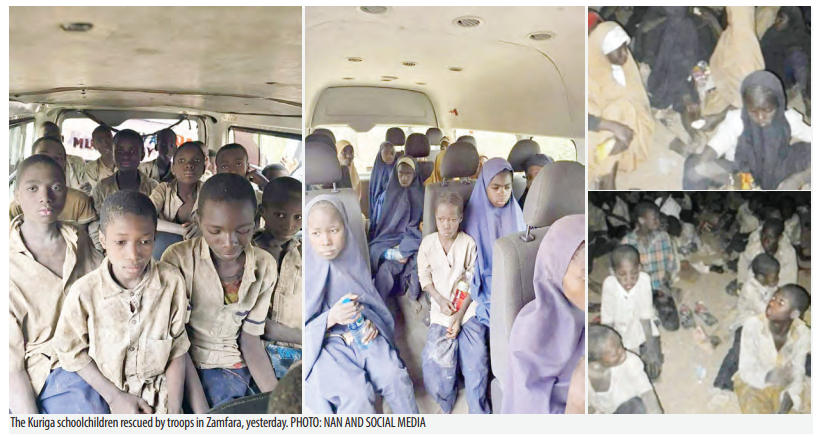
After a lull of about three years, the terrorists struck again. On 7 March 2024, at Kuriga in Kaduna State, about 287 pupils were abducted from LEA Primary and Secondary School, Kuriga. Two days later, on 9 March 2024, about 15 pupils were kidnapped from a Qur’anic Tsangaya school in the Gidan Bakuso area of Sokoto State.
In each of these incidents, the schoolchildren were eventually returned home, but in none of the cases did the government follow the matter to its logical conclusion by identifying the culprits and dealing decisively with them.
Crimes are punished to serve as a deterrent to other would-be offenders. Where this is not done, it breeds impunity—the very type we have witnessed in the persistent attacks on schools.
We therefore urge the government to go beyond merely securing the release of abductees and to apprehend the kidnappers and diligently prosecute them to their logical conclusion. That is one way to serve justice to the victims and guard against further crimes of this nature.
We’ve got the edge. Get real-time reports, breaking scoops, and exclusive angles delivered straight to your phone. Don’t settle for stale news. Join LEADERSHIP NEWS on WhatsApp for 24/7 updates →
Join Our WhatsApp Channel