
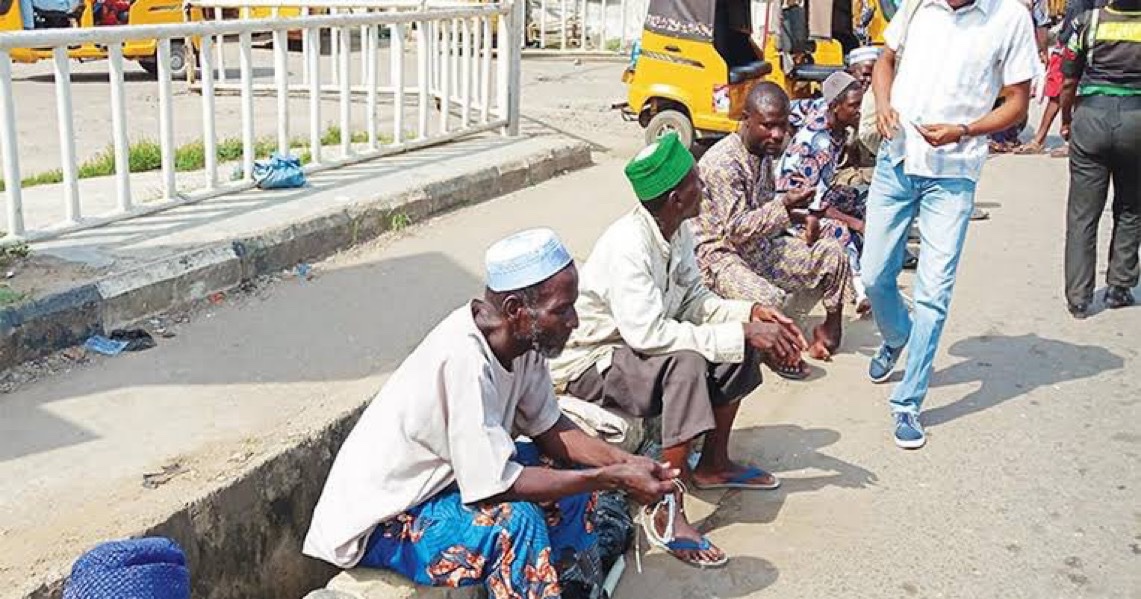
The Federal Capital Territory Administration (FCTA) says it is winning the war against street begging, but the reality in Abuja’s satellite towns tells a different story. IGHO OYOYO writes that in communities such as Kubwa, Lugbe, Dutse, Nyanya , Karu, a visible surge in beggars—many without traceable identities, has triggered security concerns, environmental decay, and renewed questions about the effectiveness of the government’s clean-up operations.
Despite repeated claims by the Federal Capital Territory Administration (FCTA) of ongoing ‘Operation Clean-Up’ efforts to rid Abuja of street beggars, satellite towns such as Dutse, Kubwa, Lugbe, Nyanya and Karu continue to witness a growing influx of beggars on the streets. The trend now mirrors scenes at major traffic points in the city centre like Wuse II, Utako , Jabi and others, where clusters of beggars converge daily at intersections, approaching motorists and passersby for alms.
With rising incidents of bag snatching and the stabbing of late-night workers, residents are increasingly alarmed by the security risks posed by these individuals, many, who are without verifiable identities, alongside the social and environmental challenges their presence creates.
In Kubwa, a bustling suburb of Abuja, traders and homeowners say the growing population of beggars, including children and adults, many of whom are from neighbouring states and countries, has become a major concern.
“These beggars are everywhere, at the market, bus stops, even near schools and churches. Some of them are aggressive, harassing people for money. The worst part is that we don’t know who they really are.
“If the government says they have cleared beggars from the city, why are they still flooding our communities?” said Mr. Isah Yusuf, a shop owner in Kubwa Market.
Similar concerns were echoed in Lugbe, where motorists and pedestrians complain about the persistent presence of beggars, especially at major intersections.
Mr. John Okechukwu, a taxi driver, noted that some beggars loiter around late at night, which raises suspicions.
“You see them sleeping under bridges and in uncompleted buildings. Some of them could be criminals hiding under the guise of begging. The government needs to do more than just announce operations, they should actually enforce the law,” Okechukwu said.
The FCTA has on multiple occasions, announced crackdowns on street begging, especially around the city center.
Not long ago, the authority claimed that hundreds of beggars had been evacuated from the streets and repatriated to their states of origin, however, the situation in satellite towns tells a different story.
Apart from security worries, residents also lament the environmental impact of the beggars’ activities.
In Dutse and Kuma, where makeshift structures line the roads, beggars and homeless persons contribute to waste accumulation, blocking drainages and worsening flooding during the rainy season.
“They cook, sleep, and dump refuse anywhere. The gutters are always clogged because of them. The local authorities need to step in before this gets worse,” said Ibrahim Danjuma, one of the community leaders in Dutse.
Additionally, child beggars, mostly Almajiris from northern states, roam the streets unsupervised, exposing them to exploitation and abuse.
A civil servant at Dutse Makaranta, Grace Okon, expressed concern over the increasing number of children tagging along with their parents begging for alms.
“It is heartbreaking to see children who should be in school begging for food. The government should either enforce child protection laws or provide rehabilitation for them.
“Just go to opposite Living Faith Church aka Winners Chapel in Dutse during week days, you will see them in their numbers sitting on the pavement in the middle of the road begging for arms,” she said.
When contacted, an official from the FCT Social Developmental Secretrary, who preferred anonymity, admitted that while operations were ongoing in the metropolis, satellite towns were often neglected due to limited manpower and logistics.
“We focus more on the city center where visibility is high, but these beggars migrate to the outskirts when we carry out raids. We need more resources to sustain the operation across all areas,” he said.
While the FCTA insists that its operations are ongoing, residents argue that without a comprehensive and sustained approach, the problem will persist.
Some suggest that the government should establish rehabilitation centers and collaborate with state governments to reintegrate displaced beggars.
Mallam Kabiru Ahmed, a resident of Kubwa.”Arresting and dumping them elsewhere is not the solution. They always find their way back. The government should address the root causes, poverty and lack of education, to end this cycle,”
A widow and trader at Nyanya Market, Mrs. Philomena Nnamani, told our correspondent that her 15-year-old son, who had returned home for the Easter break from school, was tricked by an elderly man and beggar near the popular Nyanya Before Bridge bus stop. She said the man had pleaded for help crossing the road with his luggage but tricked his son into a criminal den at the scrap market.
We’ve got the edge. Get real-time reports, breaking scoops, and exclusive angles delivered straight to your phone. Don’t settle for stale news. Join LEADERSHIP NEWS on WhatsApp for 24/7 updates →
Join Our WhatsApp Channel