Nigeria is facing a looming food crisis as water scarcity and rising temperatures devastate farms and imperil the livelihoods of millions. Once-reliable harvests are now fraught with uncertainty, and the country’s food supply hangs in the balance. In this report, NONYE EKWENUGO explores how climate change is reshaping agriculture, straining rural communities, and threatening national food stability.
Across Nigeria’s key food-producing regions, the signs of stress are unmistakable. Farmlands that once brimmed with maize, rice, and vegetables are now parched and unpredictable. Rainfall patterns have shifted dramatically, heatwaves scorch crops, and growing seasons no longer follow the familiar rhythms farmers have relied on for generations. From the fertile plains of the North to the paddies of the Middle Belt, climate change has moved from theory to lived reality, transforming farming into a daily gamble against nature.
These threats are now directly undermining the nation’s ability to produce food, maintain peace and stabilise its economy.
Agriculturists have revealed that , disrupted rainfall patterns, shrinking water sources and relentless attacks on farming communities have combined to cripple agricultural productivity, as many experts believe that these realities, threaten not only food availability but also national stability and public health.
LEADERSHIP Weekend observed that the crisis extends beyond crops, as water scarcity and environmental stress are forcing thousands of farmers off their lands, leaving them vulnerable to economic ruin.
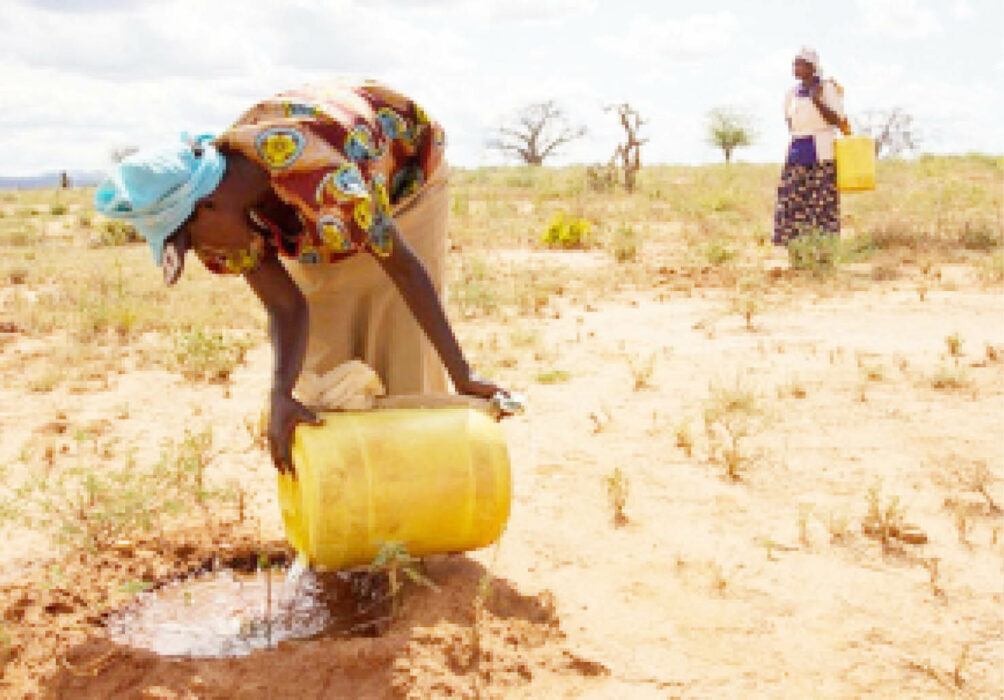
For farmers, water scarcity has become the most pressing threat. Without consistent rainfall or access to irrigation, crops wither at critical growth stages, yields plummet, and livelihoods crumble. The consequences extend far beyond the farm, driving up food prices, increasing dependence on imports, and heightening the risk of hunger across the country.
It is against this backdrop that the story of Ayuba Tambaya, a farmer in southern Kaduna, unfolds—a story that illustrates the human cost of Nigeria’s growing water and climate crisis.
Tambaya was said to have walked through his soybean farm, his boots crunching on soil that should have been rich and damp. Instead, the earth cracked beneath him, splitting open like an unanswered prayer. For Tambaya, the signs were all too familiar: yet another season had failed.
A seasoned farmer, he remembers when the seasons followed a reliable rhythm. April would bring steady rains that stretched into November, marking the months for planting, growth, and harvest. Those predictable cycles once gave him confidence in his crops and his livelihood—confidence now shattered by shifting weather patterns and relentless heat.
Tambaya said, “That pattern is gone. April usually arrives with little or no rain, or maybe a single shower that disappears quickly. Even when it rains, it is unpredictable. In April and May, the most critical months for planting farmers may not get five consecutive days of rain. That is disastrous for crop establishment.”
This year, Tambaya planted over seven hectares of soybeans, expecting up to two-and-a-half tonnes per hectare. But the rains failed him. His harvest barely reached half a tonne, translating to a loss of more than 2,000 bags worth millions of naira. His rice farm fared even worse: on land planted with the resilient Jamila variety, he harvested only 300 kilograms, scorched by prolonged dry spells and extreme heat.
“When you plant your seeds, the first two or three weeks are everything. If the rain fails then, the crop is already suffering,” he explains.
Beyond rainfall failures, rising temperatures have intensified farmers’ struggles. Heat waves now scorch crops that once thrived under moderate conditions, drying soils and weakening yields. Root crops such as ginger and turmeric have been particularly hard-hit.
“Ginger does not like too much heat,” Tambaya says. “When the temperature rises too high, it gets damaged underground.”
Maize farmers face similar challenges. In the past, maize planted as late as mid-July could still yield well. Today, even early July planting offers no guarantee.
Such losses are not isolated. Across the country, farmers are harvesting far below potential, shrinking Nigeria’s food supply. From maize to rice, soybeans to ginger, declining access to water has become a common thread linking poor harvests nationwide.
Ahmed Mohammed of the Maize Farmers Association of Nigeria noted that thousands of hectares have been affected by inconsistent rainfall, prolonged dry spells and destructive flooding. Traditional rainfall calendars have collapsed, with farmers who once relied on six to seven months of rain now experiencing barely four to five.
Experts insist that farmer education is now critical. Mohammed said training farmers in Good Agricultural Practice (GAP) is no longer optional.
“We cannot continue farming the way our fathers did and expect the same results,” he said.
Similarly, Alhaji Nuhu Aminu, Chairman of the All Farmers Association of Nigeria, warns that abandoned water infrastructure is worsening losses.
“There are dams that need rehabilitation. If these dams are working, they will support irrigation and encourage dry-season farming. Mechanisation is equally vital as climate change has reduced the margin for error in planting timelines.
The scale of the crisis is reflected in the Cadre Harmonisé Food and Nutrition Insecurity Report, which projects that no fewer than 34.7 million Nigerians across 27 states and the FCT may face severe food insecurity between June and August 2026.
At the 12th National Water Conference in Kaduna, Dr Abduljalal Dan Baba, Director General of the National Water Resources Institute, warned that Nigeria’s worsening water crisis could cripple food production without urgent investment in management and skilled professionals.
He stressed that prolonged droughts, flooding and degraded watersheds are already disrupting agriculture.
Dan Baba added that the country risks catastrophic consequences if it fails to invest in skilled water management professionals capable of responding to climate-related challenges.
According to Baba, the absence of a well-trained workforce to manage Nigeria’s water resources is already affecting agricultural output and energy generation.
He added that the situation would worsen without deliberate investment in human capacity development.
Baba also underscored the importance of international collaboration, disclosing that the institute recently signed Memoranda of Understanding with the Hungarian University of Technology and Economics, Budapest, to promote knowledge transfer and climate-responsive water management practices.
Also Jamilu Abu, a director of Water Quality Control and Sanitation at the Ministry of Water Resources, assured that the federal government remains committed to improving access to safe and reliable water across the country.
He said President Bola Tinubu was prioritising policies and programmes aimed at strengthening water infrastructure and sanitation, noting that the administration is determined to deliver sustainable water solutions for Nigerians.
In the face of this crisis, there is an urgent need to integrate technology, education and infrastructure. Farmers must be trained in climate-smart agriculture, dams rehabilitated, irrigation expanded and mechanisation adopted. Early-warning systems and efficient water management can reduce crop failure, stabilise yields and safeguard Nigeria’s food security.
Without these steps, abundance will continue to slip into anguish, leaving farmers like Tambaya at the mercy of a rapidly changing climate.
Prof. Simeon Ortuanya, Vice Chancellor of the University of Nigeria, Nsukka (UNN), recently warned that these pressures, combined with rising insecurity in rural areas, are undermining the nation’s ability to feed itself, maintain peace, and stabilize its economy. He emphasizes that Nigeria’s agricultural system, once a pillar of resilience, is now highly fragile.
As communities dependent on farming are grappling with shrinking incomes and mounting debt. Smallholder farmers, who constitute the backbone of Nigeria’s food supply, are increasingly unable to afford seeds, fertilizers, or irrigation solutions. Markets feel the ripple effects: food prices surge, staple crops dwindle, and urban consumers face higher bills for basic sustenance. Experts caution that if the trend continues, hunger and malnutrition could escalate, particularly among the most vulnerable populations.
It’s a fact that while policy interventions remain urgent. Experts argue that Nigeria must invest in climate-resilient agriculture, expand irrigation infrastructure, and implement water management strategies to safeguard food production.
“Without immediate action, these combined pressures could push Nigeria into a full-blown food emergency,” Ortuanya said at the 2025 Policy Day. For a nation where millions still rely on farming to survive, the clock is ticking, and the cost of inaction could be catastrophic.
We’ve got the edge. Get real-time reports, breaking scoops, and exclusive angles delivered straight to your phone. Don’t settle for stale news. Join LEADERSHIP NEWS on WhatsApp for 24/7 updates →
Join Our WhatsApp Channel