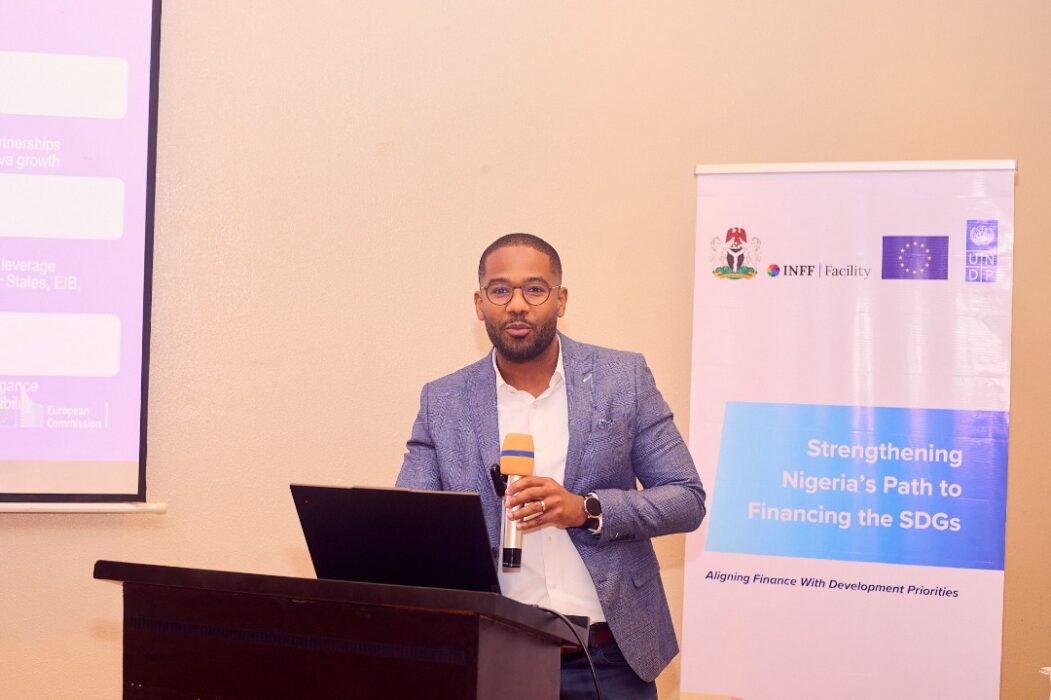
Nigeria has taken a significant step toward strengthening the financing architecture for its Sustainable Development Goals (SDGs) as senior government officials, development partners, private sector leaders, and civil society groups concluded a three-day retreat in Lagos to deepen the implementation of the Integrated National Financing Framework (INFF).
Held from November 24 to 26, 2025, the retreat—co-chaired by the Office of the Senior Special Assistant to the President on SDGs (OSSAP-SDGs), the United Nations Development Programme (UNDP), and the Ministry of Budget and Economic Planning—focused on translating the INFF from a policy tool into a practical instrument capable of mobilising resources for Nigeria’s development priorities.
A statement by the Special Assistant on Media, Publicity and Strategic Communications to OSSAP-SDGs, Desmond Utomwen, said the gathering was one of the most consequential engagements on Nigeria’s development financing future, aiming to confront persistent funding gaps and propose actionable solutions for domestic revenue mobilisation, private sector investment, and improved coordination across federal and state levels.
Participants agreed that Nigeria’s development challenges cannot be resolved through public resources alone, stressing that the INFF must evolve into a unifying framework for aligning public, private, domestic, and external financing toward the National Development Plan and the SDGs.
A significant outcome of the retreat was the strong call for deeper sub-national integration.
Stakeholders noted that while most development challenges manifest at the state level, financing strategies remain heavily centralised.
They resolved that the INFF must adopt state-specific approaches, support better FAAC utilisation, and strengthen state capacity in investment readiness and project preparation.
To address the chronic issue of poorly structured proposals, the retreat recommended the establishment of a National Project Preparation Facility to help states and Ministries, Departments, and Agencies (MDAs) convert ideas into bankable projects capable of attracting investors.
The facility, participants noted, would ensure that viable projects are not lost due to inadequate planning or structuring.
The meeting also emphasised the importance of a high-level political commitment to restore investor confidence.
Stakeholders urged the National Steering Committee of the INFF to take a more visible and active role in driving reforms, particularly those relating to tax policy, investment alignment, and public finance restructuring.
Development partners encouraged stronger government co-financing to demonstrate ownership and signal seriousness to investors.
Representing the European Union, Reuben Alba-Aguilera emphasised that Nigeria cannot rely exclusively on public revenue to close its widening financing gaps.
He identified innovative partnerships, blended finance tools, and private sector mobilisation as indispensable components of a modern development financing strategy, reaffirming the EU’s support for governance, climate action, and public finance reforms.
Senior Special Assistant to the President on SDGs, Princess Adejoke Orelope-Adefulire, highlighted Nigeria’s progress in institutionalising the INFF, citing ongoing Development Finance Assessments and established coordination structures.
She described the INFF as a roadmap for mobilising resources “prudently, effectively and inclusively,” while acknowledging the need for stronger domestic resource mobilisation and better alignment of external finance with national priorities.
Technical presentations from experts at UNDP, the Bank of Industry, the Centre for the Study of the Economies of Africa (CSEA), the Federal Inland Revenue Service (FIRS), and private sector institutions highlighted both the scale of Nigeria’s financing needs and the opportunities available through blended finance, green bonds, impact investment, and Public-Private Partnerships (PPPs).
Co-Chair of the INFF Core Working Group, Mr. Felix Okonkwo, described the INFF as Nigeria’s “strategic vehicle for orchestrating and mobilising resources across public and private quadrants,” stressing that the retreat was deliberately focused on problem-solving rather than theory.
At the end of the Lagos retreat, participants resolved to intensify efforts to move from policy to implementation, confront bottlenecks directly, and ensure that the INFF becomes a results-driven tool for closing financing gaps and accelerating Nigeria’s progress toward the Sustainable Development Goals.
We’ve got the edge. Get real-time reports, breaking scoops, and exclusive angles delivered straight to your phone. Don’t settle for stale news. Join LEADERSHIP NEWS on WhatsApp for 24/7 updates →
Join Our WhatsApp Channel