
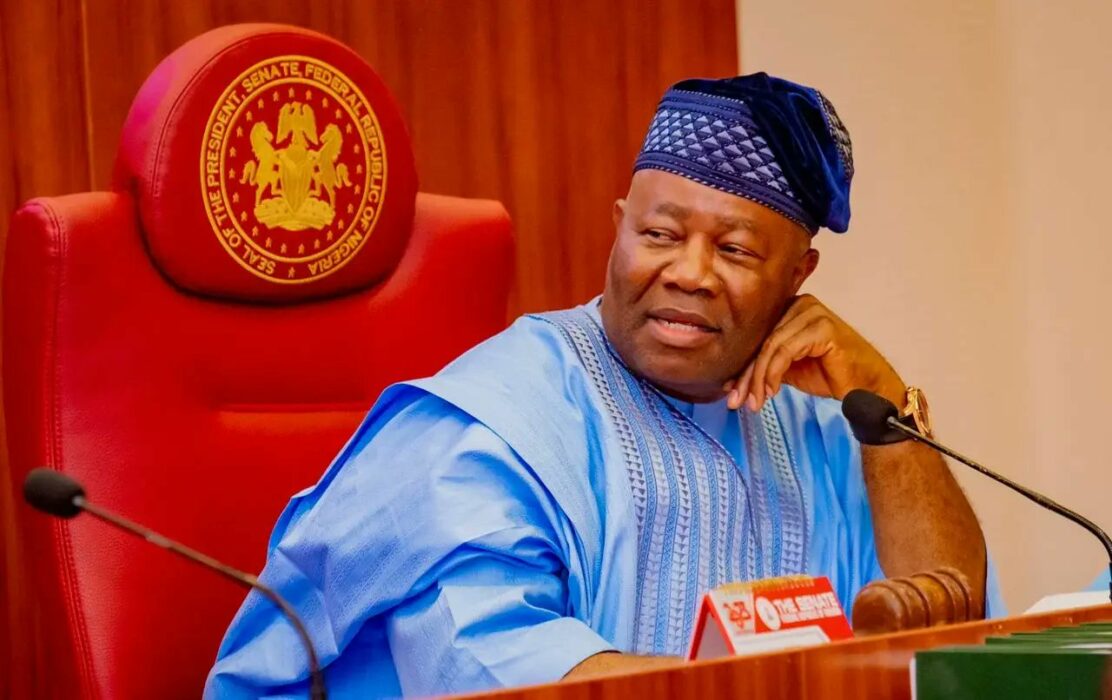
A controversy erupted in the Senate following the amendment to the Senate Standing Orders restricting eligibility for presiding offices in the 11th National Assembly.
The changes triggered constitutional debates, fierce clashes among lawmakers, and accusations of political manipulation, despite the Senate’s partial reversal of controversial provisions on oath-taking procedures.
The amendment, announced by Senate President Godswill Akpabio after its adoption through a voice vote during plenary, has generated intense controversy within the National Assembly, with some senators describing it as a strategic move aimed at narrowing the contest for the leadership of the 11th Senate in 2027.
In practical terms, the amendment excludes former senators seeking a comeback in 2027, newly elected senators entering the 11th Assembly, political heavyweights returning to the Senate after years away, and governors or ministers seeking Senate leadership positions after returning to the chamber.
Under the new arrangement, only current members of the 10th Senate who secure re-election into the 11th Senate will qualify to contest for the offices of Senate President and Deputy Senate President.
Though officially presented as a measure to promote institutional continuity and parliamentary stability, the amendment’s political implications have been difficult to ignore.
The new rule provides that only senators who have completed two consecutive terms immediately preceding nomination would be eligible to contest for the Senate presidency and deputy presidency after the 2027 general elections.
The development is believed to have directly affected the political ambitions of several prominent politicians, including Edo North Senator Adams Oshiomhole and Imo State Governor Hope Uzodimma, who has been linked with a possible Senate presidency bid after leaving office in 2027.
Uzodimma, a former senator, would be disqualified under the amended rules because he is not currently serving in the 10th Senate.
The governor had already appeared before the All Progressives Congress (APC) screening committee and is expected to vacate office if he wins the January 2027 National Assembly election to return to the Senate in the 11th Assembly.
The development immediately fuelled speculation that the amendment was less about legislative reform and more about the politics of exclusion.
Behind the constitutional arguments lies a fierce struggle for control of the Senate ahead of 2027.
Several senators, including Oshiomhole and Senator Ezenwa Onyewuchi, who represents Imo East Senatorial District, openly argued that the amendment was designed to preserve the dominance of ranking lawmakers and prevent outsiders from disrupting existing power arrangements.
The strongest constitutional challenge came from Onyewuchi, who declared that the amendment violated Section 50 of the Constitution.
According to him, Section 50 simply states that the Senate President and Deputy Senate President shall be elected “by members from among themselves.”
For Onyewuchi and other critics, the Constitution deliberately avoided imposing additional qualifications for the offices.
Their argument is that once an individual is duly elected as a senator, every senator should enjoy equal constitutional rights to contest any office within the chamber.
Anything beyond that, they insist, amounts to constitutional overreach.
Onyewuchi also invoked Section 1(3) of the Constitution, which states that any law inconsistent with the Constitution becomes void to the extent of its inconsistency.
He warned that the amendment could create the dangerous impression that the leadership of the 11th Senate was already being predetermined years before Nigerians vote in 2027.
That argument has resonated strongly because public trust in democratic institutions remains fragile, and any perception of political manipulation naturally raises suspicion.
Before the amendment, any ranking senator — defined as a lawmaker with at least four years of legislative experience — could contest for presiding offices in the Senate.
The amendment immediately sparked resistance within the chamber, with Oshiomhole emerging as the leading voice against the new rule despite being a member of the ruling APC.
The disagreement escalated during Wednesday’s plenary when Oshiomhole openly challenged the adoption of the Senate Votes and Proceedings, insisting that the records did not accurately reflect what transpired during deliberations on the amendment.
“We cannot proceed to adopt proceedings that do not reflect what was agreed,” Oshiomhole protested during plenary.
However, Akpabio overruled him, insisting that Senate procedures must be followed and warning that the senator could be ordered out of the chamber if he remained unruly.
“Let me emphasise once again, Senator Oshiomhole, if any member becomes unruly in the Senate, such a member will be asked to leave. This is the final warning,” Akpabio said.
Although the Senate later re-amended part of the rules concerning the procedure for electing presiding officers on inauguration day, the controversial clause requiring eight years of consecutive service remains intact.
The re-amendment restored the previous practice, allowing senators-elect to first elect the Senate President and Deputy Senate President before taking their oath of office.
Opeyemi Bamidele Moves to Prevent Constitutional Crisis
Senate Leader Opeyemi Bamidele explained that the adjustment became necessary to avoid constitutional inconsistencies and align Senate procedures with parliamentary convention.
In the rush to amend the rules, the Senate ran afoul of the 1999 Constitution by altering the inauguration procedure.
While the Constitution provides that senators may participate in the election of presiding officers before taking their oath of office and oath of allegiance, the Senate, through amended Orders 2(2) and 3(1), changed the oath-taking procedure before the election.
The controversial reordering was adopted earlier on Tuesday.
Two days later, Bamidele moved for the Senate to rescind the decision and reverse the changes to restore compliance with the rules’ constitutional provisions.
In his motion, Bamidele said: “The Senate observes that upon further legislative and constitutional review, certain provisions introduced under Orders 2(2) and 3(1) may give rise to constitutional inconsistencies and unintended tensions with the provisions of the Constitution of the Federal Republic of Nigeria, 1999 (as amended), particularly Section 52 thereof.”
Section 52 of the Constitution allows lawmakers to participate in the election of Senate leaders before taking their oaths.
The Senate eventually reversed the oath-taking provision following Bamidele’s intervention, a move that further validated concerns raised by lawmakers such as Oshiomhole about the hurried amendment process.
Oshiomhole said, “The way we rushed the rules because certain people wanted certain things concluded is one flaw in this process. Next time, we should allow for robust debate.”
Despite the reversal, the Senate retained the core amendment restricting eligibility for Senate leadership positions.
To clarify the situation, Akpabio’s office quoted the Chairman of the Senate Committee on Judiciary, Human Rights and Legal Matters, Senator Adeniyi Adegbomire (SAN), as saying the Senate only reversed the oath-taking procedure and not the eligibility requirements.
According to Adegbomire: “The issue of eligibility stays, and it is different from what we rescinded.”
The development means the battle has now shifted from parliamentary procedure to constitutional interpretation.
Legal analysts say the courts may eventually be called upon to determine whether the Senate can legally impose additional qualifications for leadership positions beyond what is already contained in the Constitution.
Echoes of the Past
LEADERSHIP Weekend reports that this is not the first time amendments to standing orders have generated controversy at the National Assembly.
In the 4th Assembly, the late Umar Ghali Na’Abba amended the House rules to preserve the leadership structure after the 2003 elections, but the strategy ultimately failed when he lost his re-election bid.
Similarly, during the 8th Senate, Bukola Saraki faced legal battles over allegations that Senate rules were manipulated to aid his emergence as Senate President.
Ironically, one of the lawmakers who challenged Saraki’s emergence at the time was current Deputy Senate President Barau Jibrin, who has not opposed the latest amendment despite its far-reaching implications.
Battle for 2027 Intensifies
Political observers believe the amendment has exposed deepening divisions within the Senate ahead of the 2027 succession battle.
Insiders say the move is seen as part of broader calculations by the Akpabio leadership to retain power in the 11th Senate, especially if the current zoning arrangement for political offices remains unchanged.
However, several uncertainties remain.
The ruling APC would first need to maintain its majority in the Senate, while Akpabio and key members of the current leadership would also have to secure re-election.
Even then, there is no guarantee that fresh contenders from states such as Akwa Ibom, Edo, Delta, Cross River, Rivers and Bayelsa would not emerge to challenge existing power structures.
Speaking with journalists after the plenary, Oshiomhole described the amendment as self-serving and unconstitutional.
“To determine the decision of the Senate, you want to use the ‘ayes’ and the ‘nays’. It is open to abuse. I wanted Nigerians to know those senators who are making laws that are self-centred and driven by selfish interests,” he said.
The former Edo State governor also argued that the amendment was inconsistent because Akpabio himself had not completed eight consecutive years in the Senate before becoming Senate President.
“Even the Senate President has not done eight years in office. If we pass the rule that senators must complete eight consecutive years before becoming Senate President, he has to lead by example by vacating,” Oshiomhole argued.
Similarly, Bauchi Central Senator Abdul Ningi said the amendment was clearly driven by selfish interests.
Ningi referenced a similar situation during the amendment of the Electoral Act when some lawmakers raised objections to certain clauses, but the Senate leadership proceeded regardless.
“This is self-serving and self-centred from those who moved it and those who opposed it. You’re a living witness when we stood up on this floor to raise our concerns about the Electoral Act as presented before the Senate. Having worked on the Electoral Matters Committee for almost two years, we raised serious concerns about provisions in the Electoral Act.
“In the name of party supremacy, people kept quiet. Now, because some people feel they have ambition… This particular matter is not about Nigeria; it is about the Senate and those who want to aspire,” he said.
Ningi also pointed out that some principal officers and committee chairpersons were appointed despite being first-term senators.
“In 2023, when we came here, this particular ranking was thrown under the bus. You could see the principal officers and senators who are coming to the Senate for the first time. The biggest committees were given to new senators. After three and a half years, how have those senators performed as chairmen of committees? Sometimes, when they come, they cannot even preside.
“People make noise when it touches them. There are committees that have been in place for three and a half years, and their chairmen have not called a single meeting, except at budget time. So the entire scenario has been seen as personalised, and therefore until we’re ready to cure this menace, we’ll continue to see it because a lot of laws are passed tailored to particular groups, tailored to particular party advantage, and tailored to certain individuals.”
Despite the backlash, supporters of the amendment insist that the new rule would ensure experienced lawmakers emerge as leaders of the upper chamber and strengthen institutional stability within the Senate.
We’ve got the edge. Get real-time reports, breaking scoops, and exclusive angles delivered straight to your phone. Don’t settle for stale news. Join LEADERSHIP NEWS on WhatsApp for 24/7 updates →
Join Our WhatsApp Channel