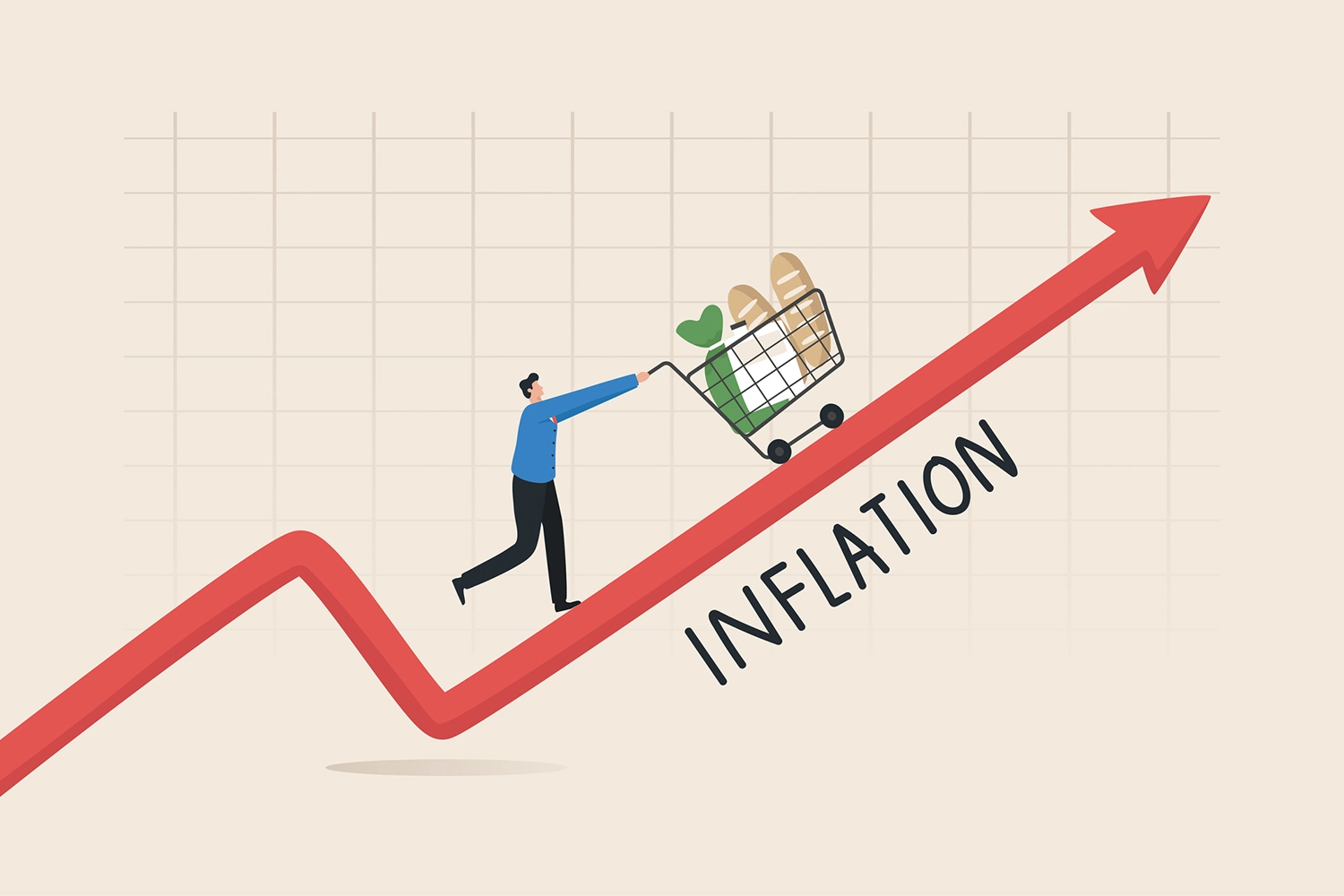
Headline inflation rate for the month of July 2023 increased to an all-time high of 24.08 per cent compared to 22.79 per cent recorded in June 2023. This is an increase of 1.29 per cent points from the June 2023 inflation figure.
Similarly, on a year-on-year basis, the headline inflation rate was 4.44 percentage points higher compared to the rate recorded in July 2022, which was 19.64 per cent according to the latest figure released by the National Bureau of Statistics (NBS).
This is as analysts said the surging inflation has had a devastating effect on citizens’ welfare and the health of small businesses.
The increase in the headline index for July 2023 was attributed to an increase in contributions of some items in the basket of goods and services at the divisional level.
These increases were witnessed in food & non-alcoholic beverages (12.47 per cent), housing, water, electricity, gas & other fuel (4.03 per cent). Nigeria removed the subsidy on gasoline in May this year, causing a spike in the prices of petroleum products, with a spiral effect on the prices of other commodities.
The hike in general inflation was also reflected in clothing & footwear (1.84 per cent), transport (1.57 per cent), furnishings & household equipment & maintenance (1.21 per cent), education (0.95 per cent) and health (0.72 per cent).
The food component sub-index for July 2023 increased by 26.98 per cent on a year-on-year basis; this was 4.97 per cent points higher relative to the rate recorded in June 2022 (22.02 per cent).
The rise in the food index on a year-on-year basis was caused by increases in prices of oil and fat, bread and cereals, fish, potatoes, yam and other tubers, fruits, meat, vegetables, milk, cheese, and eggs.
Similarly, the food inflation rate on a month-on-month basis, in July 2023 rose to 3.45 per cent, this was 1.06 per cent points higher compared to the rate recorded in June 2023 (2.40 per cent).
Commenting on the rising inflation, the CEO of Centre for the Promotion of Private Enterprise (CPPE), Dr. Muda Yusuf stated that, “the surging inflation has had a devastating effect on citizens welfare and the health of small businesses. Headline inflation accelerated to 24.08 per cent in July as against 22.79 in June.
“Food inflation maintained its upward trajectory, accelerating to 27 per cent. Evidently, we are yet to see an abatement to the key factors fueling inflation. The inflationary pressures have intensified.”
He stated that some of these factors are global, others are domestic, stating that “these factors include the depreciating exchange rate, spike in energy prices, rising transportation costs, logistics challenges, forex market illiquidity, hike in diesel cost, insecurity in many farming communities and structural bottlenecks impeding productivity. These are largely supply side and policy concerns. But the petrol price increase following the fuel subsidy removal and the sharp depreciation in the exchange rate were dominant factors.”
He noted that mounting inflationary pressures have the following consequences for the economy: weakening of purchasing power of citizens as real incomes are eroded thus aggravating poverty incidence; escalating production costs which negatively impacts profitability; erosion of shareholder value in many businesses; weakening of investors’ confidence; and declines in manufacturing capacity utilisation as a consequence of weakening sales and erosion of profit margins.
Yusuf added that “tackling inflation requires urgent government intervention to address the challenges bedevilling the supply side of the economy. It is imperative to urgently fix production and productivity constraints, stabilise the exchange rate by ensuring liquidity in the forex market, tackle insecurity, accelerate efforts to ensure domestic refining of petroleum products and fast-tracking tax and fiscal reforms to curb escalating deficit spending.
“To give producers and citizens some relief, the government should tweak the tariff policies by granting concessionary import duty on intermediate products for industrialists, especially those in the food processing segments of the agriculture value chain.”
The director-general of Lagos Chamber of Commerce and Industry (LCCI), Dr Chinyere Almona said that, between January and July 2023, the headline inflation rate accelerated for the seventh consecutive month to 24 per cent and is expected to rise further due to subsidy removal, exchange rate harmonisation, and the anticipated impact of the palliative distribution in the near term.
She said that “the CBN should moderate the key rate given the weak relationship between it and inflation, especially after manufacturers and other businesses are groaning under high operating costs, low growth, and more especially in the face of high unemployment.
“Furthermore, monetary policy alone appears insufficient to guarantee the desired results of low, stable, and predictable prices. We are of the view that structural rigidities around infrastructure and agriculture should be explored and tackled to rein in inflation.”
Also speaking, senior research analyst at FXTM, Lukman Otunuga noted that, whilst inflationary pressures are gradually easing across the globe, it remains rampant in Africa’s largest economy.
According to him, Unlike the United States which has witnessed consumer prices coming down from a peak of 9.1 per cent in June 2022, Nigeria’s inflation remains hot, stubborn, and unyielding.
“With the inflation beast drawing strength from rising food prices, transportation, and import costs, it is forecast to tick even higher for July. Ultimately, persistent signs of rising inflation may force the Central Bank of Nigeria to act once again at its next policy meeting in September.
“It is worth keeping in mind that the CBN has recently lifted its benchmark rates by 25bp to 18.75 per cent – its fourth consecutive rate hike in 2023. While higher rates have the potential to cap and control inflation, it could come at the cost of economic growth which expanded by 2.31 per cent during the first quarter of 2023.”
He stressed that “should the current themes negatively impacting the Naira remain present, prices may hit N1000 in a matter of time. Such a development that will most likely increase the cost of living and squeeze households further in the short to medium term. Outside of Nigeria, we have witnessed how higher interest rates have somewhat capped and controlled inflation albeit at a price. For Africa’s largest economy, the key question is when will inflation eventually peak?”
We’ve got the edge. Get real-time reports, breaking scoops, and exclusive angles delivered straight to your phone. Don’t settle for stale news. Join LEADERSHIP NEWS on WhatsApp for 24/7 updates →
Join Our WhatsApp Channel