For a migrant, living far from home has its challenges. It’s especially so when one is a woman, pregnant and on the verge of childbirth.
The same goes for women separated or divorced from their husbands in a foreign clime, owing to either death or domestic abuse.
Both often have nowhere to turn to for support.
In the Igbo culture of Nigeria, the ‘Omugwo’ culture enables the woman’s mother to visit for an official period of three months. The role of the mother ranges from taking care of her daughter, taking care of the baby, like bathing them in a particular traditional manner, cooking for and attending to the house chores that the daughter at this point cannot attend to. In fact, it can be argued that the ‘Omugwo’ period helps mitigate postpartum depression, often experienced by women after childbirth.
However, living 2,862 miles away from one’s family, such help is difficult to access, and in the case of Nigerian women in Antwerp, Belgium, near impossible, for a handful of reasons.
First, the Belgian Government’s cancellation of the Parental Visa due to abuse, the limitation of the Igbo Union Antwerpen By-Law regarding private family relations, and limited access to information about available opportunities for first-generation migrants who do not speak Dutch.
In the past, pre-to -ate 90s, the Belgian government issued Parental Visas to Nigerians. However, due to visa abuse, President, Igbo Union Antwerpen, Women’s Wing and Volunteer (Diasporan Board Member), International Organisation for Migration (IOM), Anwurika Ohalezim, said the visa was cancelled.
“Parents come and refuse to return home, becoming a burden on the country’s medical care and insurance. When it’s time to leave, the person either disappears into thin air or reappears in another part of the country for a residential document or claiming asylum.”
A victim of the circumstance, Ohalezim, a mother of four, gave birth to three of her children without the ‘Omugwo’ experience, because each time she and her husband applied for a visa for her mother, it was rejected.
It took a change in strategy, probing for further information, to understand that “absence of convincing proof” of her mother’s visit meant providing an extra document to show she has a business, a house, and a family back home to ensure she is not running away.
Consequently, her mother did eventually arrive for the Omugwo of her last child, but that was six months after delivery, when much of the heavy-lifting needed was done.
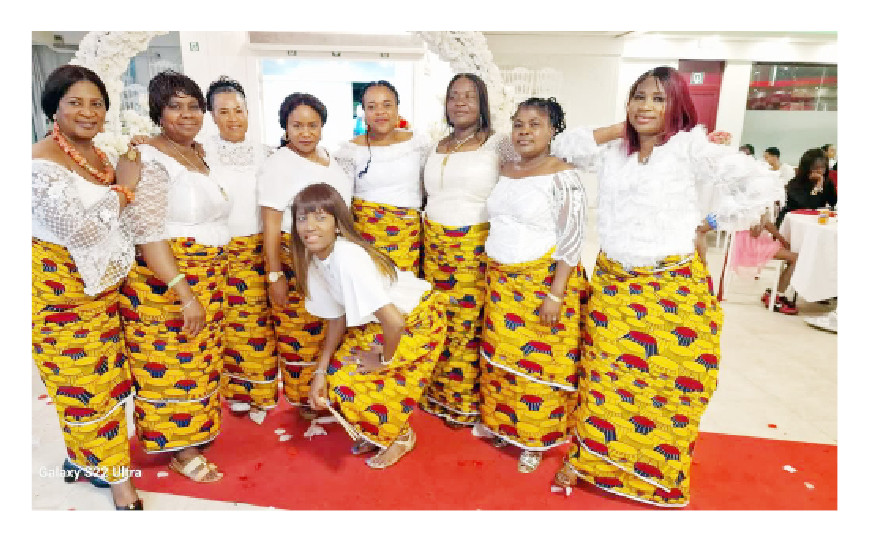
Several Igbo women share this experience with Ohalezim, and so to ease their hardship, the union’s women’s wing takes turns in caring for new mothers who are members.
“When a member gives birth, we try to delegate people to go help for a couple of hours. Of course, that help is never enough because we are working and have other things to do, but we try to carve out time and say, “A, B, can you be there this week? C, D, can you be there next week?” Sometimes, A says, “It’s convenient for me, and B says, “It’s not,” we try to swap. When it’s not possible to swap, we let A or B go alone.”
On occasion, Ohalezim makes it a personal responsibility, if informed on time, both by members and non-members, to prepare ‘Ji Mmiri’ (Water Yam) with ‘Pepper Soup Spices’, part of the culture’s new mothers’ cuisine, and bathe their babies to increase their comfort. Even, she says, “it’s a percentage of the help new mothers need.”
She advocated the need for the union to rally and speak with a united voice to the Belgian government on the needs of the community, which is the largest diaspora group in Antwerp, and if necessary, take up the responsibility of ensuring that, on the issue of parental visit, the visitors leave as and when due.
On issues around women dealing with separation, divorce or abuse, the union has no influence and remains neutral. Reasons being that its By-Law – which comprises the role, jurisdiction, scope and mechanism of support, from employment search, integration, quest for documentation, among others, is socio-cultural mainly. Secondly, the union wishes to avoid circumstances where, at the end of the day, it is seen as an interloper in a couple’s marriage.
Additionally, a certain mindset persists amongst the men, who make up the larger part of the union, and who have restricted some of their wives from joining the women’s wing, that being part of the group gives them access to knowledge that encourages them to misbehave in the future.
“As the women’s wing, we can only advise and refer those who reach out to us to organizations that can help. We belong to a network of female organizations called that organizes meetings where the organizations highlight what they do, and how they can support women who have been abused, going through a divorce, job hunting or are unable to meetup with the minimum wage and more.”
At the same time, these women also took on the responsibility of volunteering with the Igbo Union Antwerpen Integration School –to ensure that the union’s objective of grounding their children in their culture and language, integrating new migrants, while simultaneously enlightening them in the history, operation, and opportunities available to them in Belgium, their country of birth.
Activities of the school include a recent excursion to the EU Parliament in Belgium on the invitation of the Belgian government, and physical language and culture classes.
She continues, “Sometimes, we reach out to people in Nigeria who support us and are willing to help us with virtual classes. But it’s largely the union members that facilitate the physical classes,”
“Us, first-generation migrants, I don’t think there is much we can do now. With our second generation, those born here, who can speak Dutch, we are doing our best. We try to establish mentorship classes to tell them, “These are areas we wish we had better opportunities to do well. You have the opportunity to do so, and have no excuses,” concluded Ohalezim.
Founded in 1997/98, the Igbo Union Antwerpen, is made up of Igbo men and women living in and around the city of Antwerpen, Belgium. Its strong membership makes it the largest diaspora group recognized by the Belgian government.
But to make its membership more effective, it must speak with a united voice to overcome obstacles and break barriers.
“(As a union) We have to find ways to break barriers (aforementioned), hence the theme of our latest event ‘Breaking Barriers’. You need to break barriers before you can achieve anything,” concluded Ohalezim.
We’ve got the edge. Get real-time reports, breaking scoops, and exclusive angles delivered straight to your phone. Don’t settle for stale news. Join LEADERSHIP NEWS on WhatsApp for 24/7 updates →
Join Our WhatsApp Channel