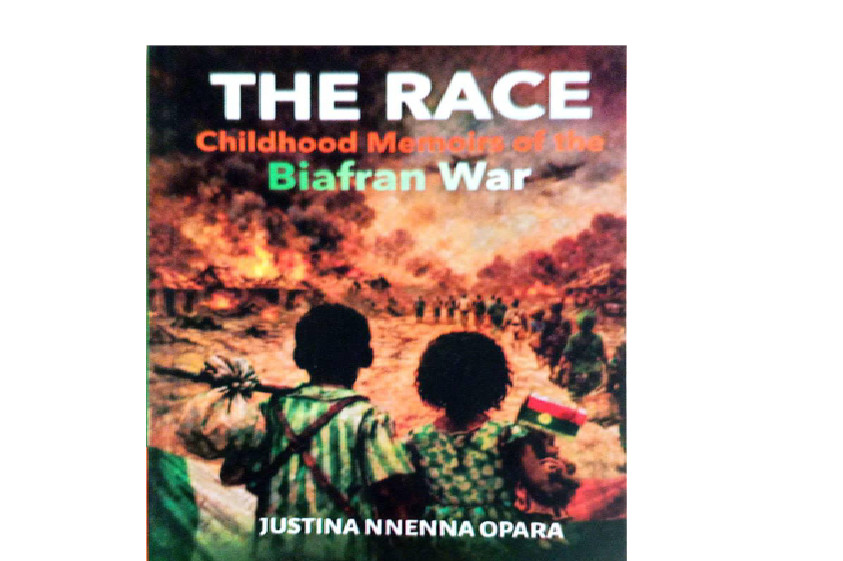
Justina Nnenna Opara’s slender but weighty memoir arrives as an act of remembrance and moral witness. Written from the vantage of a woman recalling her girlhood in Owerri and its surrounding villages during the Nigerian-Biafran War (1967–1970), The Race is a domestic chronicle of survival, told in plain, unhurried prose, rooted in the sensory textures of daily life under siege.
Opara writes in the retrospective voice of an elder looking back with clarity and without bitterness. The prose is shaped by decades of reflection.
The author does not dramatise or inflate; rather, they observe. When she describes carrying a heavy metal trunk during the chaos of January 1970’s “Last Race” and feeling no weight at all, it is a moment of extraordinary psychological truth rendered in a single sentence.
”I carried a large metal trunk filled with food items, so heavy under normal circumstances, yet I did not feel its weight at all.”
The voice is characteristically Igbo in its communal orientation: the “I” frequently dissolves into a “we,” situating the narrator within her family, her village, and the wider Biafran experience. This is not a memoir of collective endurance.
Three interlocking themes animate the text. The first is resilience through routine. Opara is extraordinary in her documentation of how ordinary life persisted in the cracks of catastrophe: children playing moonlight games, women trading gold trinkets at the Market, and dance competitions with prizes of salt and egg yolk. These constitute the memoir’s argument that the human need for joy and normalcy is itself a form of resistance.
The second theme is the moral economy of scarcity. The book quietly charts how war rewrites the codes of social life. Social stratification does not disappear but transforms; respect is measured by who eats and how often. Theft becomes comprehensible, if not excusable.
The third, and most persistent, theme is gendered vulnerability in wartime. Opara returns again and again to the particular dangers faced by women and girls. The threat of forced mobilisation into soldiers’ domestic or sexual service, the nightly flight into the bush at seven o’clock, and the strategies of disguise adopted at the Emekuku refugee camp. These passages are among the most quietly devastating in the book and represent an important contribution to the gendered historiography of the Biafran conflict.
The fourteen chapters mirror the lived experience of waiting and displacement: time moves, but not cleanly.
The book opens with a useful historical introduction that contextualises the war’s origins in the coups of 1966 and the betrayal of the Aburi Accord.
The inclusion of war songs, folktales, communal solidarity chants, and the Biafran National Anthem is one of the memoir’s signal contributions. These oral and musical fragments preserve a cultural layer of the war that formal history rarely captures, and they give the text a genuinely archival dimension.
Limitations
The memoir occasionally relies on summary where a dramatic scene would serve better, and some emotional experiences are stated rather than rendered. Readers accustomed to the interiority of contemporary literary memoir may find the prose emotionally restrained to a fault. The editing, while generally clean, leaves a handful of repetitive passages standing. These are minor imperfections in a work whose chief virtue is authenticity rather than artifice.
Conclusion
The Race is a document of moral importance and quiet literary achievement. This is a book written so that those who did not live through the war might begin to understand what it cost those who did. It deserves to be read widely, taught in schools, and placed alongside Nigeria’s essential testimonial literature.
Recommended for readers of African literature, historians of the Biafran War, students of memoir and oral history, and all those concerned with the civilian experience of conflict.
We’ve got the edge. Get real-time reports, breaking scoops, and exclusive angles delivered straight to your phone. Don’t settle for stale news. Join LEADERSHIP NEWS on WhatsApp for 24/7 updates →
Join Our WhatsApp Channel