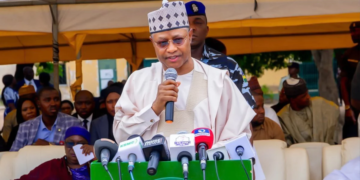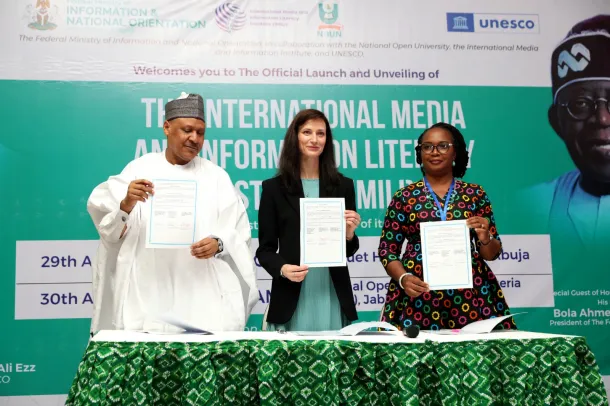
As Nigeria gradually approaches the 2027 election, concerns are growing among experts that the country’s public discourse is increasingly shaped by half-truths, manipulated narratives, and viral falsehoods. It is for this reason that the establishment of the Institute for Media and Information Literacy (IMILI), in partnership with the UNESCO, deserves more than passing attention. Speaking at the inauguration, President Bola Ahmed Tinubu, represented by the Secretary to the Government of the Federation (SGF) George Akume, described the development as a historic milestone for Nigeria, Africa, and the global community. “This is a historic moment, not only for Nigeria and Africa, but for the global community. Today, we open the first UNESCO Category 2 Institute for Media and Information Literacy anywhere in the world.”
At first glance, the institute may appear to be just another addition to Nigeria’s growing list of public-facing institutions, well-intentioned, ceremonially launched, and ultimately underwhelming in impact. Properly understood, however, this initiative represents a strategic intervention in what is fast becoming one of Nigeria’s most critical democratic vulnerabilities: the quality of information shaping citizen judgment.
For decades, the Nigerian state has invested, albeit unevenly, in physical infrastructure: roads, bridges, rail lines, and power. Yet far less attention has been paid to what may be described as “cognitive infrastructure” — the ability of citizens to access, analyse, and evaluate information in an increasingly complex media environment. This gap is evident in everyday political engagement, where public opinion is often driven less by verified facts than by algorithmically amplified content.
The implications are profound. Elections are influenced not only by candidates and policies, but also by the narratives surrounding them. Public trust in institutions rises or falls depending on how information is framed, circulated, and contested. In such an environment, a poorly informed electorate becomes fertile ground for manipulation, polarization, and ultimately, democratic fragility.
It is within this context that the new institute must be situated. If designed and implemented with seriousness, it has the potential to strengthen media literacy across multiple layers of society, including journalists, students, civil servants, and the broader public. The institute can serve as a hub for research, training, and policy development, equipping citizens with the tools to distinguish credible information from deliberate falsehoods. In doing so, it would not merely complement democratic processes; it would help safeguard them.
However, Nigeria’s institutional history calls for caution. The country is replete with examples of promising initiatives that failed to move beyond symbolic existence. Without sustained funding, clear strategic direction, and measurable outcomes, the institute could easily become another well-branded but functionally limited entity.
The first test, therefore, is whether this initiative will truly be built for impact. Media literacy cannot be reduced to periodic workshops in Abuja or high-level conferences attended by a narrow elite. Its real value lies in its ability to penetrate everyday spaces: classrooms, community centres, local media houses, and digital platforms where misinformation thrives most aggressively. If the institute does not deliberately extend its reach beyond formal circles, it will fail to address the very problem it was created to solve.
Equally important is the question of integration. Media literacy must not exist as a standalone concept; it should be embedded within the broader educational and civic framework. From basic education to tertiary institutions, critical thinking and information evaluation must become core competencies. This requires collaboration not only with media organisations, but also with state ministries of education, journalism and mass communication training departments, civil society groups, and technology platforms.
Another important question is whether the political environment is prepared to accommodate the outcomes of a truly media-literate population. An informed citizenry is not merely better educated; it is more questioning, more demanding, and less susceptible to simplistic narratives. It challenges authority, interrogates policy, and resists manipulation. For media literacy to thrive, it must be matched by a commitment to openness, transparency, and respect for dissent. Otherwise, the effort risks contradiction — promoting critical thinking on one hand while constraining it on the other.
None of these concerns, however, diminishes the importance of the initiative. On the contrary, they underscore its significance. At a time when Nigeria is quietly preparing for the next electoral cycle, the battle for credible information is already underway. Technology will play its role, as will regulatory frameworks. But neither can substitute for a citizenry equipped to think independently and critically.
This is why the UNESCO IMILI should be regarded as a central pillar in the country’s democratic architecture. Its success will not be measured by the number of events it hosts, but by the extent to which it reshapes how Nigerians engage with information.
Nigeria has spent years building roads to connect places. It must now invest, with equal urgency, in building minds capable of navigating the information highways of the modern world. If the institute rises to this challenge, it could become one of the most consequential public investments of this decade. If it does not, it will simply join the long list of missed opportunities.
We’ve got the edge. Get real-time reports, breaking scoops, and exclusive angles delivered straight to your phone. Don’t settle for stale news. Join LEADERSHIP NEWS on WhatsApp for 24/7 updates →
Join Our WhatsApp Channel