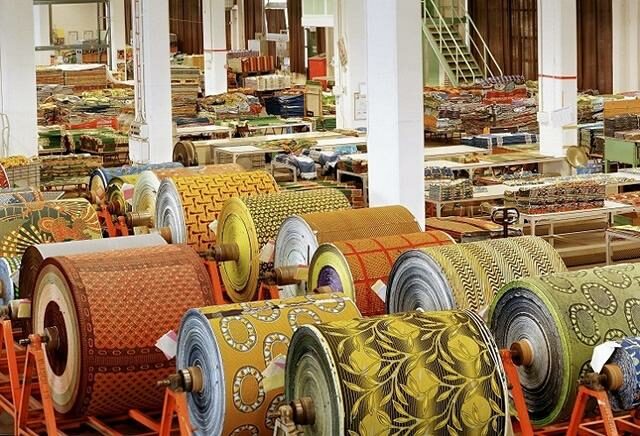
Even though foreign fabrics now dominate Nigerian markets—from bustling Dugbe to the sprawling stalls of Onitsha Main Market—the country once stood tall as a continental powerhouse of textile manufacturing.
For many Nigerians, the memories of the 1970s and early 1980s linger like a beautiful but fading tapestry: a time when over 180 textile mills operated across the nation, employing more than one million workers and giving life to cities such as Kaduna, Kano, Lagos, Asaba and Benin. Firms like United Nigerian Textile Limited, Aswani Textile, Afprint, Asaba Textile Mills and Edo Textile Mills were not just factories; they were engines of prosperity that powered families, communities, and the national economy.
But today, the story reads differently. What was once a symbol of industrial pride has become a representation of missed opportunities and policy missteps. Hamma Ali Kwajaffa, Director General of the Nigerian Textile Manufacturers Association, captures it poignantly. To him, the journey of the textile sector is “a story of grace to grass.” He recalls the 1990s, when local textile manufacturing was a key economic driver, offering hundreds of thousands of jobs in Africa’s most populous nation. “From Kaduna to Kano, Lagos to Onitsha, textile factories were full of activity,” he said. “Today, only a few remain—and even those are struggling amid the influx of cheap textiles from abroad, particularly from China.”
Attempts to salvage the industry have been long and winding. In 1997, the Federal Government introduced the Textile Development Fund Levy Policy—a 10% tax on imported textiles meant to support domestic manufacturers. More than two decades later, Kwajaffa says that the funds “have not reached the manufacturers,” leaving many to wonder what became of the intervention intended to revive the sector.
At a forum in Abuja, recently, stakeholders painted a vivid picture of the structural constraints limiting the industry’s revival. A textile merchant, Ahmed Tijan, highlighted one of the sector’s most damaging burdens: energy. Textile production is notoriously energy-intensive, and unreliable grid supply has made operations nearly impossible.
“Mills rely heavily on diesel,” he lamented. “As long as they continue depending on generators, production costs will keep rising—and we cannot compete with cheaper imports.”
Yet, the Nigerian textile story is not one of decline alone. It is a deeply historical narrative rooted in creativity, craftsmanship, and cultural identity. Long before the hum of modern machines, indigenous textile traditions thrived in places such as Kano, Abeokuta, Akwete, Iseyin and Osogbo. These communities built vibrant cottage industries sustained by master weavers, skilled dyers, and expert spinners who transformed locally grown cotton and silk into iconic fabrics that travelled across regions as symbols of identity and trade.
The post-independence era marked a significant turning point. With the establishment of Kaduna Textiles Limited (KTL) in 1957, Nigeria began a rapid rise into large-scale industrial textile production. By the 1980s, the country had become home to more than 180 mills—one of the largest textile manufacturing hubs in sub-Saharan Africa. The sector not only boosted GDP but also supported cotton farming in northern Nigeria, strengthening the link between agriculture and industry.
But from the late 1990s, policy inconsistencies, high operating costs, smuggling, and aggressive imports began to unravel the industry’s fabric. One mill after another shut down. Machines went silent. Entire textile clusters collapsed, leaving behind abandoned complexes and shattered livelihoods.
Still, the memories remain—vivid, almost defiant—as reminders of Nigeria’s capacity for self-sufficiency and industrial greatness. The question that now persists among experts, workers and policymakers is urgent but straightforward: can the giant rise again?
For many, the answer lies in a combination of political will, energy reforms, targeted incentives, strict border control, and a commitment to reviving cotton farming. Without these, the once-mighty textile sector may continue its slow fade into nostalgia, remembered fondly but lost to time.
Yet with the right strategies, Nigeria’s textile story—rich, colourful, and uniquely its own—could once again reclaim its pride of place in the nation’s industrial future.
We’ve got the edge. Get real-time reports, breaking scoops, and exclusive angles delivered straight to your phone. Don’t settle for stale news. Join LEADERSHIP NEWS on WhatsApp for 24/7 updates →
Join Our WhatsApp Channel