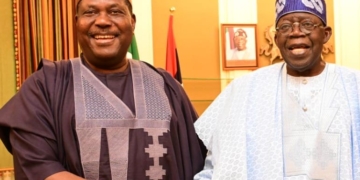

The Minister of Information and National Orientation, Mohammed Idris, has reaffirmed the Federal Government’s commitment to the establishment of State Police, stating that President Bola Tinubu was determined to ensure the reform becomes a reality once the necessary legal framework was secured.
Idris made the declaration on Thursday in Abuja while receiving a delegation from the Centre for Crisis Communication (CCC), led by its Chairman, Major General Chris Olukolade (Rtd), during a courtesy visit to the Ministry’s headquarters.
He emphasised that decentralised policing has become essential in addressing Nigeria’s evolving security challenges, noting that the President has already urged the National Assembly to enact the required legislation.
“It is the desire of President Bola Ahmed Tinubu to ensure that we have State Police as soon as it is practicable in this country. The time has indeed come for that,” the Minister said.
According to him, strengthening Nigeria’s internal security structure must be complemented by a robust national communication framework, particularly in the digital era where crises are shaped not only by events but also by the speed at which information spreads.
“In today’s digital age, crises are no longer defined only by events, but also by how quickly information circulates. Digital innovation is central to timely, accurate, and coordinated communication, especially during moments of national importance,” he stated.
The Minister welcomed proposals presented by the Centre, including the establishment of a National Crisis Communication Hub and a Crisis Communication Performance Index.
He described the initiatives as consistent with the Ministry’s mandate and assured the delegation that the report of the November 2025 National Symposium on Digital Innovation and Crisis Communication would be carefully reviewed to align its recommendations with ongoing government reforms.
Idris further stressed that while artificial intelligence, social media, and other digital tools are indispensable to modern communication, they must be deployed responsibly, honestly, and patriotically, balancing freedom of expression with national interest and public trust.
In his remarks, Major General Olukolade (Rtd) commended the Minister for supporting efforts to strengthen crisis communication in Nigeria.
“Your gesture added weight and authority to a gathering that brought together spokespersons, technology experts, security personnel, scholars, and media professionals from across the country,” he said, referring to the November 2025 symposium.
Olukolade noted that the symposium produced actionable recommendations aimed at modernising Nigeria’s crisis communication system through improved infrastructure, enhanced capacity building, and inclusive governance.
He urged the Minister to endorse the proposed National Crisis Communication Hub and performance index framework, describing them as vital tools for real-time monitoring, coordinated responses to misinformation, and strengthened institutional accountability.
The Minister also commended the Centre for promoting inter-agency collaboration, research, training, and media monitoring, including its monthly Strategic Communication Inter-Agency Policy Committee meetings conducted in partnership with the Office of the National Security Adviser.
He reiterated that government alone cannot address complex communication and security challenges and welcomed continued engagement with credible civil society organisations and professional bodies to strengthen Nigeria’s communication architecture.
We’ve got the edge. Get real-time reports, breaking scoops, and exclusive angles delivered straight to your phone. Don’t settle for stale news. Join LEADERSHIP NEWS on WhatsApp for 24/7 updates →
Join Our WhatsApp Channel