Cape Verde have written one of the greatest stories of the 2026 FIFA World Cup, becoming the smallest nation ever to reach the tournament’s knockout stage.
The Atlantic island nation, with a population of just over 525,000, secured a historic place in the last 32 after a goalless draw with Saudi Arabia and Spain’s victory over Uruguay confirmed them as Group H runners-up.
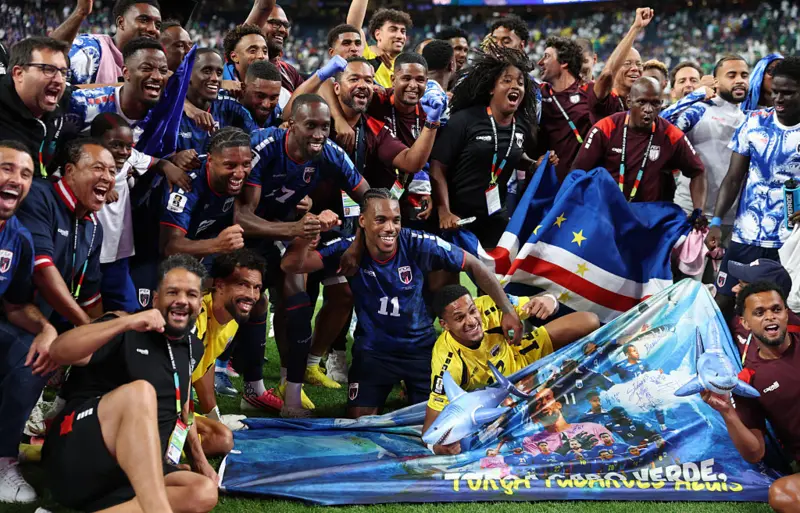
The result sparked emotional celebrations as players gathered around a mobile phone on the pitch to watch the closing moments of Spain’s win before learning they had qualified for the knockout rounds.
Scenes of jubilation followed as tears of joy flowed among players and supporters alike, marking a landmark achievement in Cape Verdean football history.
Their reward is a mouth-watering last-32 encounter against reigning world champions Argentina.
Cape Verde’s remarkable campaign has been built on resilience and discipline. They opened the tournament with a memorable goalless draw against Spain, where veteran goalkeeper Vozinha produced a string of outstanding saves, before earning an impressive 2-2 draw with two-time world champions Uruguay.
Those results, combined with another hard-fought stalemate against Saudi Arabia, proved enough to seal a historic qualification.
Former Spain international Juan Mata praised the Blue Sharks’ consistency throughout the group stage.
“It’s incredible what they are doing. It wasn’t just one game against Spain—it has been three outstanding performances at the highest level.”
Diaspora strategy driving Cape Verde’s rise
Cape Verde’s success is the culmination of years of careful planning by the Cape Verde Football Federation (FCF), which has successfully integrated players from the country’s extensive diaspora into the national team.
Strong historical links with Portugal, coupled with decades of migration to Europe—particularly the Netherlands—have provided the Blue Sharks with a rich talent pool.
Fourteen members of Cape Verde’s 26-man World Cup squad were born outside the country, with six players originating from Rotterdam alone.
Among them is forward Dailon Livramento, who scored the decisive goal in Cape Verde’s crucial World Cup qualifying victory over Cameroon last September, helping eliminate the five-time African champions.
The federation’s innovative recruitment strategy has also produced remarkable stories, including the discovery of Dublin-born defender Roberto Lopes through LinkedIn in 2019, while former Manchester United winger Bebe has also represented the nation after featuring for Portugal at youth level.
Cape Verde’s long-term vision has earned widespread praise.
Josina Freitas Fortes, a member of the country’s parliament, credited the achievement to years of dedication and strategic planning.
“The FCF has made significant progress through passion, commitment and a clear technical plan. The results we are seeing today are the product of years of consistent work and unwavering belief.”
Lopes echoed that sentiment, insisting the squad always believed they could compete with the world’s elite.
“There has always been an inner confidence that we are good enough to compete with the best. This isn’t a surprise—it is the result of a long-term project to put Cape Verde among football’s top nations.”
Now, after becoming the smallest country ever to reach the World Cup knockout stage, Cape Verde have the opportunity to extend their fairytale when they face Lionel Scaloni’s Argentina in one of the most eagerly anticipated ties of the last 32.
We’ve got the edge. Get real-time reports, breaking scoops, and exclusive angles delivered straight to your phone. Don’t settle for stale news. Join LEADERSHIP NEWS on WhatsApp for 24/7 updates →
Join Our WhatsApp Channel