The United Kingdom, alongside key religious and community leaders, has reaffirmed its commitment to supporting inclusive, gender-responsive peacebuilding initiatives in Northwest Nigeria.
The pledge was made on Tuesday at the 2026 Northwest Regional Conference on Women, Peace and Security, organized by Global Rights and Partners West Africa Nigeria (PWAN).
The conference, with the the theme: “Strengthening Inclusive Peacebuilding and Access to Justice in Northwest Nigeria: Evidence, Impact and Lessons from Practice,” brought together traditional rulers, government officials, civil society, security agencies and community stakeholders to review progress and set the stage for sustainable peace in the region.
Speaking at the event, UK Deputy High Commissioner to Nigeria, Gill Lever, emphasised the country’s dedication to promoting community-led peace initiatives. She noted that the Northwest continues to face a range of challenges, including intercommunal tensions, banditry, limited access to justice, and entrenched socio-cultural norms that disproportionately affect women and girls.
“The Northwest continues to face complex challenges, including intercommunal tensions, banditry, limited access to justice, and deeply rooted sociocultural norms that disproportionately affect women and girls,” Lever said.
She highlighted that the UK, through its Integrated Security Fund, was proud to support PWAN and Global Rights in implementing inclusive peace and justice programmes across Katsina, Kebbi, Kano, and Sokoto States.
Lever outlined the tangible results of these initiatives, stressing the importance of women and marginalised groups in peace processes.
“When women and marginalised groups participate meaningfully in peace and justice processes, communities become safer, more resilient, and more cohesive,” she said.
Among the achievements she highlighted was the establishment of gender-balanced Community Dialogue Committees with at least 40 per cent women’s participation, as well as the historic turbanning of women into traditional leadership structures in Sokoto State.
“This is not just symbolic progress — it is structural change,” Lever explained. She also pointed to the expansion of the Police Duty Solicitor Scheme, which has enabled more than 323 detainees to regain their freedom through lawful channels. “Access to justice can restore trust and reduce rights violations,” she added.
Lever concluded her remarks by urging stakeholders to consolidate gains and embed successful structures within state institutions. “Let us approach this conference not as an ending, but as a launching point for deeper, more inclusive, and more sustainable peacebuilding across the Northwest,” she said.
Women at the Centre of Peacebuilding – Kukah
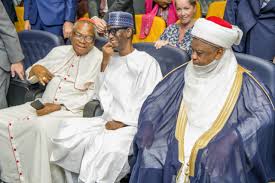
The Catholic Bishop of Sokoto Diocese, Most Rev Hassan Kukah, delivered the keynote address, underscoring the pivotal role of women in advancing peace within communities.
Drawing on historical examples such as Rosa Parks and Harriet Tubman, Kukah encouraged women not to wait for permission from entrenched systems to exercise their God-given abilities.
Recalling his visit to Rwanda in 2002 to observe the gacaca community justice system, he noted the critical role women played in the post-genocide justice process.
“What struck me when I attended one or two of the sessions is the number of women among the judges. In one case it was nine women and four men, and when I asked why, they told me the individuals were selected based on trust,” Kukah recounted, highlighting women’s value a
He emphasised that sustainable peace is more likely in communities where women are actively involved in discussions on security, justice, and social well-being.
Represented by senior counsel Alhaji Muhammad Jabbi Kilgori, the Sultan of Sokoto, His Eminence Alh Muhammad Saad Abubakar, also highlighted the centrality of women to societal stability. “Women form an important part of every society, and empowering them translates to empowering the entire society,” the Sultan said, adding that he looked forward to the implementation of resolutions from the conference within his domain.
Olubimni Aweda, Country Manager of Global Rights, presented a comprehensive overview of the organisation’s work across Kano, Sokoto, and Kaduna states.
She explained that the intervention, supported by the United Kingdom Foreign, Commonwealth and Development Office (FCDO), aimed to address insecurity, communal tensions, youth violence, and deeply rooted gender inequalities.
“When Global Rights began this work in Kano, Sokoto, and Kaduna States, we were not starting from a blank slate. We were stepping into communities that had long been navigating insecurity, communal tensions, youth violence, banditry, and deeply rooted gender inequalities,” Aweda said.
She noted that structural barriers often limited justice and inclusion: disputes were frequently resolved informally, women and youth were excluded from decision-making, survivors of sexual and gender-based violence carried stigma, and many citizens found the justice system distant or intimidating.
Aweda stressed that the programme’s approach was anchored on community ownership.
“Sustainable peace cannot be delivered to communities; it must be built with them,” she said. Over an eight-month implementation period, measurable gains were recorded in civic participation, access to justice, and community resilience. Civic participation in Kano and Sokoto increased from 48 per cent to 88.2 per cent. Four new Community Dialogue Committees were established, six Gender-Based Violence Response Teams strengthened, and more than 3,400 community members were reached through sensitisation sessions and town halls.
Access to justice also improved significantly, she said.
“We recruited, trained, and deployed 24 Police Duty Solicitor Scheme lawyers — twice our original target,” Aweda said. “A total of 855 detainees and community members accessed pro bono legal services, while community trust in police divisions where PDSS lawyers were present rose by 86.8 per cent.
“In Kaduna State, the programme strengthened community peace infrastructure and accountability mechanisms across Igabi, Zaria, and Zangon Kataf LGAs. Early warning systems resolved 249 cases through dialogue, while 88 per cent of respondents reported improved community safety and reductions in violent conflict. Aweda noted a behavioural shift, with community members moving from retaliation to structured mediation.
“Community members began to describe a shift from retaliation to structured mediation. Instead of waiting for escalation, they called the CDC first. Instead of ignoring rumours, they reported them early,” she said.
According to her, women’s participation in leadership also expanded, with appointments into traditional cabinets in parts of Kaduna and Sokoto.
“In spaces that were historically male-dominated, women are now being formally recognised within traditional governance structures. Inclusion is no longer treated as an external requirement; it is internalised within community leadership itself,” Aweda said.
Sustaining Progress Through Partnership
Noya Sedi, Global Rights programme manager, further highlighted the gains of women’s rights and peacebuilding initiatives across Northwest Nigeria.
She said, “Since 2023, Global Rights, in partnership with PWAN, has implemented programmes aimed at empowering women, reducing gender-based violence, and improving access to justice for marginalised groups.
“The project, part of the FCDO-backed Strengthening Peace and Resilience in Nigeria initiative, has already shown measurable results. In Sokoto State, all 21 reported cases of gender-based violence in one month led to convictions. In Kaduna State, women were appointed to traditional councils and became focal points for community-level advocacy,” Sedi said.
She emphasised that communities have increasingly taken ownership of initiatives, mainstreaming gender and women’s leadership in local governance.
Sedi also highlighted partnerships with other organisations, including P1, noting that collaborative learning and community adoption of initiatives have created a lasting legacy for women’s rights and inclusive governance in the Northwest.
At the conference, Dr Abiodun Essiet, Senior Special Assistant to the President on Community Engagement, called for stronger community-driven approaches to peacebuilding and access to justice.
She stressed that complex security challenges require more than military responses, highlighting the importance of social cohesion, community dialogue, and justice systems that serve women and vulnerable groups.
Dr Essiet also emphasised women’s critical role in early warning, mediation, and building community resilience, noting that their inclusion in decision-making processes is essential for sustainable peace.
“Trust, dialogue, and inclusion are essential for preventing conflict and promoting stability. Insights from community engagement help bridge the gap between citizens and the Presidency and inform policy decisions,” she said.
Representatives from the police, Civil Defence, Katsina State judiciary, National Human Rights Commission, Legal Aid Council, and women’s rights advocacy groups attended the event.
The highlight was the launch of the Project Impact and Learning Report by Global Rights and PWAN.
We’ve got the edge. Get real-time reports, breaking scoops, and exclusive angles delivered straight to your phone. Don’t settle for stale news. Join LEADERSHIP NEWS on WhatsApp for 24/7 updates →
Join Our WhatsApp Channel