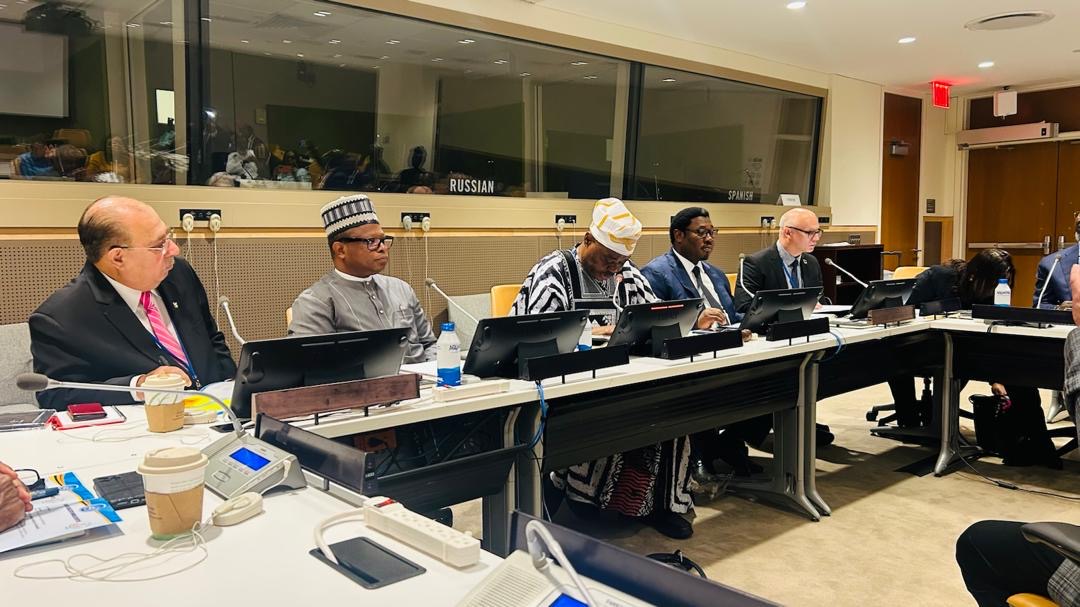
Nigeria has received commendation for its efforts in climate change governance, climate financing, Sustainable Development Goals (SDGs), primary healthcare and basic education at the High-Level Global Executive Roundtable Side Event held on the margins of the 81st United Nations General Assembly (UNGA) in New York.
The roundtable, held at Conference Room 11 of the United Nations Headquarters, brought together stakeholders to discuss strategies for mobilising financing for climate action and SDG implementation in the Global South, with Nigeria serving as a pilot demonstration country.
The event was co-convened by the Global Organization for Sustainable Development Goals (GOFSDGs), in partnership with the Civil Society Organizations on Community Advancement and Humanitarian Empowerment Initiative (CSCHEI), and in collaboration with the United Nations Institute for Training and Research (UNITAR).
In a statement signed by the Secretary of the 2026 UNGA High-Level Global Executive Roundtable, Kunle Yusuff, participants commended the investments of the Nigerian government under the leadership of President Bola Ahmed Tinubu in climate governance, climate finance and SDG implementation.
The participants also acknowledged what they described as Nigeria’s political commitment and institutional strengthening in addressing climate change.
According to the statement, Nigeria has established 21 substantive appointments with dedicated mandates on climate change, which it described as a comprehensive climate governance architecture.
It added that the strategic revitalisation of the National Agency for the Great Green Wall (NAGGW) was aimed at combating desertification, enhancing carbon sequestration, promoting climate adaptation and strengthening livelihood resilience in frontline communities.
The initiatives, according to the statement, align with Nigeria’s Nationally Determined Contributions, the Paris Agreement and obligations under the United Nations Framework Convention on Climate Change.
The roundtable further noted that the measures could position Nigeria to attract green bonds, carbon credits and climate adaptation financing.
On SDG implementation, participants welcomed the presidential approval for the domestication of the Sustainable Development Goals across Nigeria’s 774 local government areas.
The initiative was described as a step towards strengthening community-level ownership, data-driven planning and accountability in SDG delivery, in line with the principle of leaving no one behind.
The meeting also recognised sub-national initiatives in Lagos and Zamfara states.
Lagos State was commended for investments in primary healthcare, educational infrastructure and the establishment of civil society desks across ministries, while Zamfara State was acknowledged for efforts in water provision, human capital development and community protection support systems.
At the end of the deliberations, the roundtable adopted five resolutions aimed at strengthening climate financing, SDG implementation and international partnerships.
The resolutions included the establishment of the Global Partnership Network Support System (GPNSS), a platform designed to facilitate private sector access to sustainable, concessional, blended and climate financing for humanitarian and development initiatives.
The participants also agreed to institutionalise a follow-up and impact-tracking mechanism anchored by UNITAR and supported by donor agencies, development finance institutions and international non-governmental organisations.
The mechanism is expected to focus on capacity building, peer learning, monitoring, evaluation and reporting in line with OECD-DAC criteria.
The roundtable further mandated newly decorated Ambassadors of Humanitarian Affairs and Goodwill Ambassadors to support advocacy, stakeholder engagement and resource mobilisation for climate and SDG projects.
It also called for strengthened United Nations presence in Nigeria, including dialogue on the re-establishment and expansion of UN agencies and programmes that have relocated from the country.
The meeting resolved to institutionalise the roundtable as an annual high-level side event at the UN General Assembly to track progress on pledges and partnerships.
The organisers expressed appreciation to member states, UN entities, donor agencies, development partners, global executives and civil society organisations for their participation.
The roundtable concluded that strengthened political will, predictable climate financing and credible private-sector partnerships would be necessary to advance the 2030 Agenda for Sustainable Development.
We’ve got the edge. Get real-time reports, breaking scoops, and exclusive angles delivered straight to your phone. Don’t settle for stale news. Join LEADERSHIP NEWS on WhatsApp for 24/7 updates →
Join Our WhatsApp Channel