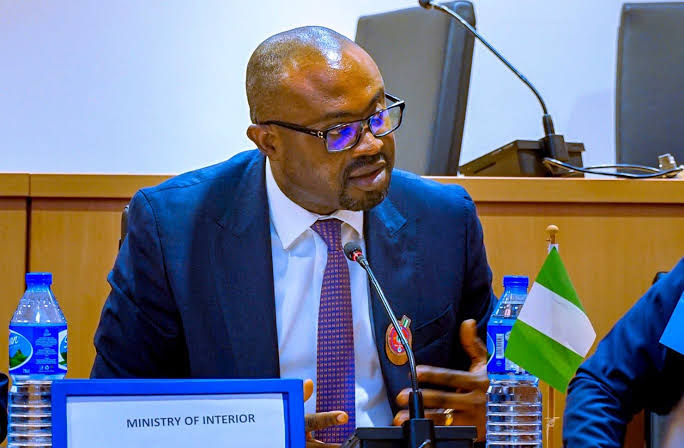
Heads of paramilitary agencies under the Ministry of Interior were on Thursday handed a stern warning to deliver concrete security results or face repercussions, as the minister of interior, Dr Olubunmi Tunji-Ojo, demanded strategic performance and accountability across the sector.
Tunji-Ojo, who warned heads of the paramilitary agencies under the ministry to up their games or face consequences, stressed that their institutions remain critical to achieving effective national security in the country.
He further warned agency heads that the era of routine operations was over, stressing that “there will be repercussions and consequences for non-delivery of targets in what he described as an “era of business unusual.”
Tunji-Ojo sounded the warning today in Abuja during the 2026 Sectoral Performance Review Retreat of the ministry, saying the new technology has equipped the government with unprecedented intelligence on travellers entering the country.
The minister who noted that agencies under the ministry’s supervision ; the Nigeria Immigration Service,( NIS) Nigeria Security and Civil Defence Corps( NSCDC) , Nigerian Correctional Service ( NCoS) and the Federal Fire Service ( FFS) , occupy strategic positions in the nation’s security architecture, charged their leadership to raise operational standards and deliver measurable results in line with the government’s security objectives.
This is even as he also declared a decisive nationwide crackdown on irregular migrants, revealing that the government now operates an advanced AI-driven tracking system capable of identifying foreigners who have overstayed their visas over the last 10 years.
He said, “In NIS, I know we are doing a lot already. As of today, we have been able to build our Integrated Operations Centre and the Network Operations Centre which we never had before. With that, we can access, in the last 10 years, everybody who has entered, where you came from, everything, we have all your records, we have everything, we know the exact people who have overstayed in our country, and we will go after them, with due respect, because, outside of Nigeria, they go after the irregular immigrants and we think we have to protect the sanctity of our borders,” the minister stated.
He added that the Nigeria Immigration Service (NIS) is evolving beyond traditional border control into what he described as “an internal security enabler and a protector and guardian of our border space.”
Turning to the Nigeria Security and Civil Defence Corps (NSCDC), the minister insisted that specialised security services must be democratised and insulated from influence-peddling.
He maintained that NSCDC VIP protection must be “corruption-free, where the son of a nobody will have the chance of being protected without knowing anybody.”
Charging the Corps to take the lead in confronting economic terrorism, Tunji-Ojo emphasised that security protection should be accessible to any citizen facing a genuine threat “without knowing the Commandant General or anybody.”
The minister also tasked the National Identity Management Commission (NIMC) to accelerate the capture of Nigerians into the national database, warning that partial success in identity enrolment cannot guarantee national security.
“A lot of people have been captured, a lot of progress has been made but not until every Nigerian has been captured, we cannot say we have succeeded,” he told the commission’s leadership.
He assured Nigerians that despite the approaching political season, the ministry would remain focused on its mandate . He said, “The 2027 polls won’t distract us from our mandate,” he said.
Minister who acknowledged that the retreat also spotlighted the urgent need for reforms within the correctional system to curb repeat offences argued that persistent recidivism reflects a failure of the reformation process within custodial centres.
He said, “Anybody who goes in there must be reformed and transformed,” he said, stressing that the goal is to drive recidivism close to zero.
Earlier, the permanent secretary of the ministry, Dr Magdalene Ajani, also called for stronger accountability across agencies, noting that leadership must be defined by “devotion, promises, performance, and impact.”
She emphasised that the ministry’s institutions play critical roles in the daily lives of Nigerians, making transparency and institutional responsibility essential for national stability.
We’ve got the edge. Get real-time reports, breaking scoops, and exclusive angles delivered straight to your phone. Don’t settle for stale news. Join LEADERSHIP NEWS on WhatsApp for 24/7 updates →
Join Our WhatsApp Channel