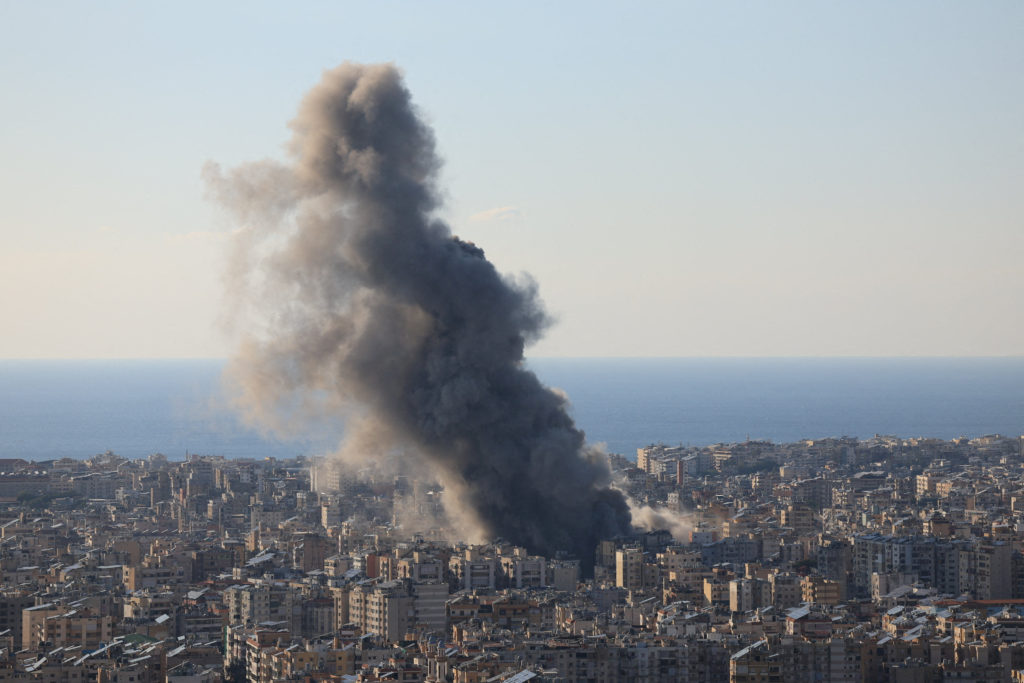
The ongoing war that the United States and Israel unleashed against the Islamic Republic of Iran is rapidly deteriorating and the risk is so high about the involvement of Iran’s neigbours in the Middle East especially the Gulf States who are reportedly prepared to attack Iran following missile attacks on their territories by the Islamic Republic.
The United States and Israel conducted a strike that killed Iran’s spiritual leader Ayatollah Khamenei and over 40 top officials of the Iranian regime just as the Islamic Republic has since unleashed a barrage of missile attacks on Israel killing 10 people on Sunday.
Iran has also fired missiles at Gulf states such Bahrain, Saud Arabia, Jordan, Kuwait, Qatar, United Arab Emirates (UAE) in retaliation causing damage to civilian infrastructure and risking reprisal attacks from the Gulf States.
On Monday Qatar’s Ministry of Defence said it shot down two aircraft coming from Iran, as well as seven missiles and five drones. It is believed that if the situation continues Qatar and other Gulf States may intensify attacks against Iran.
The situation is getting more dangerous as experts have warned Nigeria and other African countries to brace up for the consequences of this global conflict.
Speaking to LEADERSHIP, former permanent secretary of the Ministry of Foreign Affairs, Ambassador Bulus Lolo, said the pre-emptive strike by the US and Israel has put the global community in a “flux and desperately needing and crying for mature and compassionate leadership and direction.
“America is setting the wrong example for the use and application of power. Before long, we will see hegemonic powers in different parts of the world moving into countries with less power under one pretext or the other. We have once again entered another era where success in negotiation will not depend on the power of persuasion, but on the weight and capacity of a country’s military might.
“This is the new reality, and perhaps, the immediate and long-term implication of the pre-emptive strikes against Iran.”
With regard to the implications of the strikes for Africa, the former Nigeria’s Ambassador to Ethiopia said that the cost of energy, more especially, crude oil, will spike, stressing that there will be a toll on trade.
Also reacting, former Nigerian High Commissioner to Singapore, Ambassador Ogbole Ode, said the conflict has deeper implications within the global power equation that is inexorably changing with new power centers emerging, especially in the eastern hemisphere.
“Consequently, the imperative to control critical mineral resources is becoming more important. And I argue that, though alternative sources of power and energy are gaining ground, crude oil remains important as a source of power and energy generation and usage.
“Given that Iran sits on a significant crude oil deposit and is still outside the US Zone of influence since 1979, there is desperation to rein in the country away from the emerging eastern powers.
“Recall that with the kidnapping of Maduro of Venezuela, the Americans have yanked that country’s huge crude deposits from the Chinese. Recall also that they did the same to the Russians after the fall of Saddam Hussein. Therefore it is a fight for who dominates the world’s hydrocarbons deposits.”
He said that for oil producing African countries like Nigeria there will be a spike in income from oil sales because of the hostilities. He however warned that given the centrality of the Middle East in world affairs, the kinetic exchange is bound to rebound across the globe, including Africa.
International Affairs analyst, Dr. Austin Maho warned that the war will have far -reaching consequences on the global scene which no one can as yet anticipate.
He said , “The conflict risks escalating into a broader regional war, involving countries like Lebanon, Syria, Iraq, and Yemen, and potentially drawing in other global powers, like Russia and China. However one thing is certain, by the time the dust settles the region will never be the same.”
He added that while the war rages there would be global economic disruption. Disruption of oil flows through the Strait of Hormuz, a critical global energy chokepoint controlled by Iran. The consequence would be dare and could lead to soaring energy prices and inflationary shocks worldwide, he warned.
He condemned the US and Israel for undermining the rule-based global order under the United Nations, stressing that the use of military force by the US and Israel to invade and undermine the sovereignty of Iran is setting a dangerous precedent for future conflicts.
“The conflict may strain relationships between the US, Israel, and other countries, particularly those sympathetic to Iran.
“Currently, the situation is fluid, complex, and outcomes are uncertain, the US and Israel may have walked eyes wide open into a quagmire; the war is not one that is winnable by my estimation. Iran may not have the military capabilities of both Israel and the US but Iran is not a pushover by any estimate,” he noted.
As for Nigeria, the expert said impact would be both economic and religious. “At the economic level, expect a spike in oil prices, which could boost the 2026 budget. However, considering that oil windfalls have been more of a curse than a blessing, the outcome depends on our political leadership.
“At the religious level, past events show that developments in the Middle East can evoke strong emotions among certain religious groups in the country. The government must pay attention to this to prevent any spillover effects from religious zealots who prioritize their religious beliefs over the Nigerian constitution and government,” he added.
Director of the Center for China Studies, Charles Onunaiju, said the war against Iran was a “dangerous state of affairs” and blamed the US President and Israeli Prime Minister Benjamin Netanyahu for “reckless and dangerous power politics to promote hegemonic agenda” thereby violating international law.
He added that the US was acting based on the “historic grudge” of perceived humiliation of the US when the Islamic Revolution of 1979, replaced American lackey, the Shah of Iran.
He added that the attempt at regime change in Iran will fail, stressing that “Iran will not go down without the region going down even if the Spiritual leader of Iran has been eliminated.
“Regime change is a vain and idle dream,” he said, adding that the Iranian people will not allow the country to fall into the hands of the Americans.
He also called on Nigerian leaders to be ready for the unforeseen consequences of the conflict and build a resilient economy through domestic investment and focused leadership to withstand the coming shocks that might be triggered by this conflict.
An international affairs analyst and security expert, Professor Mukthar Imam said the United States is acting with impunity against the international rule- based order that speaks respect for sovereign states.
“The US is acting arbitrarily; and this will have implications for Africa on several fronts. We don’t know what the regime change is all about and who fits the category of being removed. It could be anybody, especially emerging economies like Africa.
“One act of violence in one part of the world could be replicated in other parts. Yesterday it was Venezuela and today it is Iran and nobody knows who is next. I think the international community should speak out against this act of aggression,” he said.
We’ve got the edge. Get real-time reports, breaking scoops, and exclusive angles delivered straight to your phone. Don’t settle for stale news. Join LEADERSHIP NEWS on WhatsApp for 24/7 updates →
Join Our WhatsApp Channel