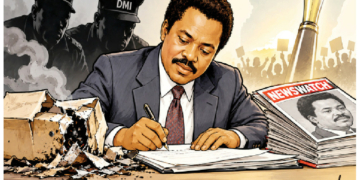
History has a curious way of treating reformers. While they are confronting entrenched interests, they are often portrayed as villains. Years later, the same society that doubted them celebrates their courage. Between those two moments lies a lonely battlefield where character is tested, reputations are bruised, and resolve is measured. Nigeria’s mining sector is now witnessing a familiar story.
For decades, illegal mining flourished in the shadows of weak enforcement, porous regulation and powerful patronage networks. The consequences were devastating: billions in lost government revenue, environmental degradation, insecurity in mining communities and the steady erosion of public confidence in the state’s capacity to protect its mineral wealth.
Reforming such a system was never going to be a polite exercise. It was bound to provoke resistance from those whose fortunes depended on disorder.
Against this backdrop emerged the Mining Marshals of the Nigeria Security and Civil Defence Corps (NSCDC), under the operational leadership of Assistant Corps Commander John Onoja Attah. Their assignment was simple in description but formidable in execution: restore the authority of the Nigerian state over its mineral resources.
That mission has inevitably come at a cost. Commander Attah has, in recent times, found himself at the receiving end of sustained criticism and repeated media attacks. Admirers argue that many of these campaigns coincide with the growing disruption of illegal mining operations, raising understandable questions about who benefits whenever those enforcing the law are themselves placed on trial in the court of public opinion.
Whether every criticism is fair or unfair is ultimately for evidence—not emotion—to determine. Public officials must always remain accountable. Yet accountability should never become a convenient instrument through which criminal enterprise seeks revenge against lawful enforcement.
This pattern is hardly unique to Nigeria.
Across the world, reformers who threaten illicit wealth have routinely attracted fierce opposition.
In Italy, anti-Mafia magistrates Giovanni Falcone and Paolo Borsellino endured relentless smear campaigns before organised crime eventually assassinated them in 1992. Their integrity was questioned long before history vindicated their sacrifice.
In Colombia, judges, prosecutors and police commanders who challenged the Medellín and Cali cartels became subjects of intimidation, propaganda and assassination attempts. Criminal organisations understood a timeless principle: if you cannot defeat an institution, destroy public confidence in those who lead it.
In Hong Kong, the Independent Commission Against Corruption (ICAC) encountered fierce institutional resistance during its formative years as it dismantled entrenched corruption networks. What initially appeared controversial later became one of the world’s most celebrated anti-corruption success stories.
The lesson is remarkably consistent.
Entrenched interests rarely surrender quietly. They fight back—not only in courtrooms but in newspapers, on social media, through lobbying, misinformation and political pressure. Reputation becomes another battlefield.
Nigeria should recognise this dynamic.
The Mining Marshals have recorded notable institutional milestones. Their legal record reflects careful adherence to procedure, with investigations designed to withstand judicial scrutiny. Cases instituted against the unit have largely failed or been withdrawn after legal review. More importantly, the Federal Government has publicly linked broader mining reforms—including the work of enforcement agencies—to substantial growth in sectoral revenue over the past two years.
These outcomes deserve scrutiny, certainly. They also deserve acknowledgement.
The danger for Nigeria lies not in questioning enforcement officers; democratic societies should always question power. The greater danger lies in allowing coordinated campaigns—whoever may be behind them—to discourage honest officers from confronting organised economic crime.
If every effective officer concludes that professionalism merely invites harassment, the rational response will be caution instead of courage.
That would be a tragedy. Institutions are strengthened not only by laws but by the confidence that honest officers will be protected when they act within the law. This does not mean immunity from investigation. It means refusing to sacrifice principled enforcement on the altar of orchestrated outrage.
Commander John Onoja Attah’s uncompromising posture against illegal mining has undoubtedly made him a polarising figure. That is often the fate of those who disturb profitable illegality. The question Nigeria must answer is whether it wishes to reward such resolve or make it a cautionary tale for future officers.
History rarely remembers those who profited from disorder. It remembers those who confronted it.
If the Mining Marshals have indeed helped restore order to a sector long plagued by impunity, then their story should not be reduced to the noise of campaigns against them. It should instead provoke a broader national conversation about how democracies protect those entrusted with enforcing the law against powerful interests.
Every nation eventually decides whether it will stand with reformers or with the resistance to reform.
That choice ultimately determines whether the rule of law governs the economy—or whether the economy is governed by those who can most effectively intimidate the rule of law.
We’ve got the edge. Get real-time reports, breaking scoops, and exclusive angles delivered straight to your phone. Don’t settle for stale news. Join LEADERSHIP NEWS on WhatsApp for 24/7 updates →
Join Our WhatsApp Channel