
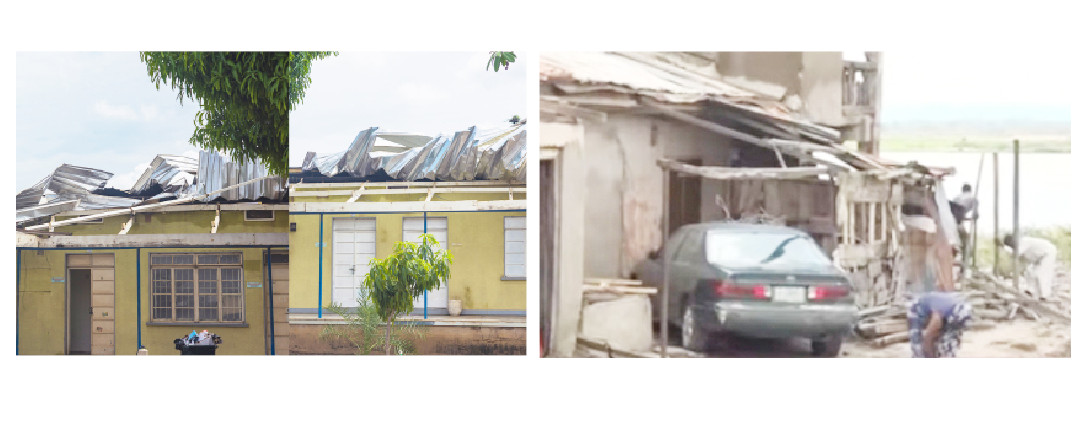
In this special report, IBRAHIM OBANSA goes behind the headlines to detail the sheer scale of the disaster that recently tore through Lokoja, the Kogi State capital. He examines the extensive property damage and crushing financial losses hitting local businesses, while highlighting the unfolding humanitarian crisis now confronting displaced communities.
Residents of Lokoja, the Kogi State capital, are counting massive losses after a devastating rainstorm swept through the metropolis. The violent tempest left a trail of destruction, obliterating homes, ripping apart public facilities, and crippling electricity infrastructure, vehicles, and businesses, while displacing scores of families overnight.
What began as a routine downpour in the state capital quickly turned into a nightmare for thousands of residents, and flattening critical public infrastructure. Beyond the immense financial toll, the disaster which struck at the heart of the community, stripped many of their source of livelihood, and left others completely vulnerable to the elements.
Today, the skyline of the Kogi State capital is a patchwork of twisted zinc sheets, shattered timber, and exposed rafters. Days after the violent rainstorm ripped through Lokoja, the physical destruction is only eclipsed by the unfolding human tragedy on the ground. Hundreds of families and businesses have been thrust into sudden homelessness, forced to squeeze into overcrowded makeshift shelters.
LEADERSHIP Weekend writes that the violent downpour, which was driven by gale-force winds, battered the city for an hour between 8:30 p.m. to 9:30 p.m. on Friday, May 13, 2026. In its wake, the storm left a trail of severe destruction across major sectors of the capital, with Adankolo, Lokongoma, the Phase Two Housing Estate, IBB Way, and Murtala Muhammed Way bearing the brunt of the damage.
Beyond the twisted roofing sheets, flooded stalls and shattered wooden structures, the rainstorm left behind something less visible but far more painful , fear, uncertainty and heartbreak for the people whose lives were upended overnight.
At the affected places, families and business owners stood silently beside soaked goods they could no longer sell, while families, security guards of some establishments picked through debris in search of valuables the floodwaters had carried away.
When approached by our correspondent, a middle-aged landlady , Mama Agada said, “Everything I worked for is gone,” her voice trembling as she tried to salvage some of her belongings ruined by the rain.
For many residents, the storm was not just a natural disaster but a cruel interruption to daily survival in an economy already weighed down by hardship.
Staff of the National Inland Waterways Authority (NIWA) were equally shaken by the devastation. Some workers described the terrifying moments when strong winds tore through the area, forcing people to flee for safety as buildings shook violently under the storm’s pressure.
The state headquarters of the National Inland Waterways Authority (NIWA) was heavily hit, with the storm ripping off the roofs of an office block housing key departments and bringing official activities to a sudden halt.
Speaking on the disaster, NIWA’s assistant general manager, Corporate Affairs, Suleiman Makama,
described the scale of destruction as both devastating and unfortunate. He disclosed that the unroofed structure accommodated several vital arms of the authority, including the Engineering, Survey, Special Duties, Project Management, and Area Office Coordination departments.
Business owners around the affected area recounted how customers and passersby ran for cover in panic, leaving behind personal belongings in the chaos. “We have seen heavy rains before, but nothing this destructive,” one shop owner, Ameh Okpanachi, lamented, staring at the remains of his damaged kiosk.
LEADERSHIP Weekend reports that as cleanup efforts continue, many victims say their greatest concern is not only rebuilding structures, but rebuilding the sense of security and stability the storm swept away within a matter of minutes.
Makama further disclosed that sensitive and critical data-gathering equipment and administrative files were completely ruined by the downpour, leaving the affected personnel without a workspace.
Lamenting the operational breakdown, Makama added: “The damage inside the building was just as severe as the exterior ruin, One other serious challenge is the affected staff of those departments who have been displaced are unable to work for the moment.”
When LEADERSHIP Weekend visited the NIWA headquarters, staff members were seen salvaging soaked furniture, waterlogged files, air conditioning units, and other office equipment from the battered structure.
Underscoring the severe financial blow dealt by the evening storm, a staff member, who spoke on the condition of anonymity, revealed that the value of the destroyed property and equipment runs deep into millions of naira.
“We cannot ascertain the exact monetary value for now, but the losses are comfortably in millions of naira,” the anonymous source said.
Another employee, who gave his name only as Yahaya, lamented the acute lack of workspace following the destruction. “For now, we have nowhere to sit. Sometimes we have to gather under the trees or crowd into unaffected offices, causing major inconveniences for our colleagues,” he said.
He noted, however, that management has already initiated emergency repair work on the damaged roof to restore full operations as quickly as possible.
Beyond the paralysis at the NIWA headquarters, the violent storm also dealt a severe blow to public utilities, knocking out critical electricity infrastructure across the state capital.
LEADERSHIP Weekend observed that a 33KVA transformer directly opposite the Kogi State Specialist Hospital was severely damaged during the storm, triggering a fire outbreak that razed five fuel dispensing pumps at a nearby A.A. Rano filling station.
The station has remained completely shut since the disaster, with only a single dispensing pump left intact. Speaking on the impact of the closure, a fuel attendant at the station, Safiya Hassan, lamented that the prolonged shutdown has dealt a heavy blow to the livelihoods of the workers.
“If the filling station is working, we make some extra money daily apart from our basic salaries. But now, we are left with absolutely nothing. We just hope management can restore operations soon,” she lamented.
When our correspondent took a stroll across the state capital, he noticed that the trail of destruction extended to several other public facilities across Lokoja. At the Police Area Command near the Ministry of Health, as well as the Federal Ministry of Works, the violent winds uprooted massive trees, blocking access roads and damaging surrounding property.
Along IBB Way, the storm brought down at least three massive trees and ripped apart several commercial billboards across the metropolis. A popular relaxation spot opposite the Nigeria Union of Journalists (NUJ) secretariat was also severely compromised by the fierce winds.
At the entrance of the Kogi State Tourism Board, another fallen tree snapped overhead electricity cables, instantly plunging the entire neighborhood into darkness.
LEADERSHIP Weekend reports that the most harrowing incident occurred along the Murtala Muhammed Way, where an uprooted tree crashed directly onto a moving vehicle. Though eyewitnesses disclosed that the lone occupant of the car was immediately pulled from the wreckage by rescuers, the condition of the victim could not be officially confirmed as of press time.
The Police public relations officer (PPRO) for the Kogi State Command, ??????? confirmed the widespread devastation across the capital, but noted that no casualties had been officially reported.
Meanwhile, local entrepreneurs are reeling from the economic fallout. A boutique shoe merchant, Emeka Nweze, told LEADERSHIP Weekend that inventory worth over ₦2 million was completely ruined after the tempest ripped off his shop’s roof, exposing his stock to the torrential downpour.
Nweze lamented thus, “My premium shoes were completely soaked. I just returned from the market with fresh stock worth over ₦2 million, only for everything to be washed away,” highlighting the broader crisis of sudden homelessness and displacement facing hundreds of Lokoja residents.
In the hard-hit Adankolo neighborhood, Ademu Damudi, a middle-aged resident, recounted how his family was forced to flee to a relative’s house after the storm compromised their home.
Damudi aid, “As I speak with you, my wife, our three children, and I are squeezed into my uncle’s house. Our privacy and freedom are gone because it is not our home. It is a deeply painful situation.”
For Nimat Tanko, a petty trader in the same community, the night was nothing short of terrifying. What began as a routine evening rain suddenly turned violent, ripping the roof off her family’s mud house before the relentless downpour dissolved the walls entirely.
“My husband, our four children, and I are completely homeless. We are begging the government to come to our aid. Even when the economy was manageable, building a home was incredibly difficult. Now that daily survival itself is a battle, we simply do not know where to start.”Tanko said tearfully.
Beyond the immediate physical ruin, residents across the affected communities are battling a prolonged blackout following the wholesale destruction of power infrastructure. Several key sectors of the Kogi State capital have remained plunged in total darkness for days, crippling local commerce and worsening security anxieties.
Left with shattered properties and severed livelihoods, the victims of the torrential rain have issued a passionate appeal to the Kogi State Government, emergency management agencies, and philanthropic organisations and individuals, to deploy urgent relief materials and financial support to cushion the catastrophic effects of the disaster.
We’ve got the edge. Get real-time reports, breaking scoops, and exclusive angles delivered straight to your phone. Don’t settle for stale news. Join LEADERSHIP NEWS on WhatsApp for 24/7 updates →
Join Our WhatsApp Channel