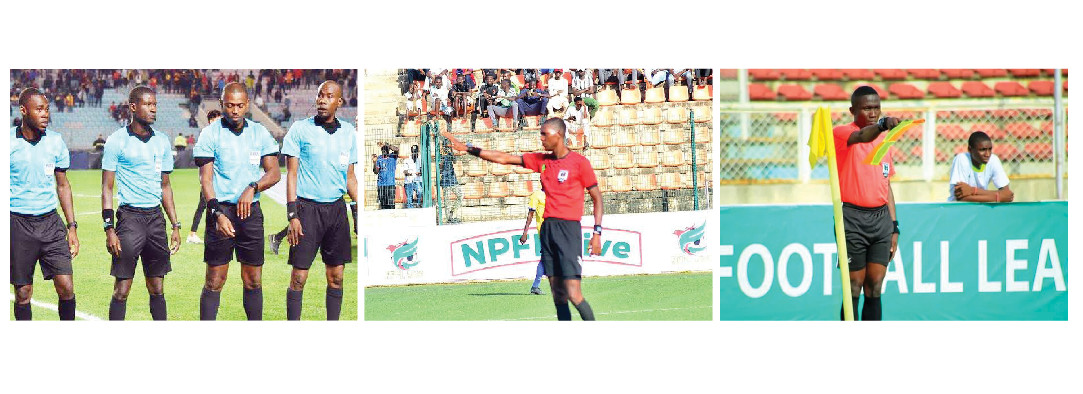
At the 2025 Africa Cup of Nations (AFCON) in Morocco, the glaring absence of Nigerian officials on the list of 73 referees, assistant referees, and VAR personnel served as a stark reminder of a once-dominant legacy now marred by neglect and corruption. For the third consecutive edition, Nigeria failed to secure a place in the ranks of officiating, a situation that can be traced back to a series of missteps and an alarming decline in standards. AFFA ACHO delves into the trajectory of Nigerian refereeing, from its golden age of continental prominence to its current state of disarray.
The story of Nigerian refereeing is rich and complex, rooted in the fervor of the 1960s and 1970s when Nigerian football began to carve its niche on the international stage. This era saw the emergence of pioneering officials who laid the groundwork for what would become a celebrated tradition of officiating excellence.
As Nigerian football grew, so did the stature of its referees. The 1980s and 1990s represented the golden age when Nigerian officials were not just participants but pacesetters on the continent.
The Golden Era: The Foundation of Nigerian Refereeing
Chief Augustine Chike Anisha epitomizes this narrative. He was among the first three FIFA-badged referees in Nigeria, alongside the late Sunny Badru and Reverend Father Slattery. Originating from the Warri/Sapele region, Anisha not only made a name for himself as a player but also transcended his role to become a symbol of integrity in officiating. His contemporary, Reverend Father Slattery, brought a unique perspective to the profession, infusing religious discipline into his officiating style. These men were more than mere referees; they were architects of a national identity that understood the profound impact of integrity on the beautiful game.
Festus Bolaji Okubule, a towering figure in this era, stood as a testament to this legacy. His passing in April 2022 at the age of 80 left a void in Nigerian football. NFF Secretary-General Dr. Mohammed Sanusi described him as “an icon of the whistle and a man of high integrity.” Okubule’s career was highlighted by historic achievements, including his role as the second Nigerian referee to officiate at AFCON, following Sunny Woghiren in 1974, and being Nigeria’s first referee at a FIFA-graded event—the 1983 World Youth Championship in Mexico.
Alongside Okubule were names like Faith Irabor, Linus Mbah, and Sani Zubair, who commanded respect in stadiums across the continent. Referees like Emmanuel Nwanyanwu Jnr. and Temidayo Ayeni continued this proud tradition, bringing Nigerian officiating to international platforms. These officials walked onto pitches from Cairo to Dakar with the confidence of knowing they belonged and earned the respect of players, coaches, and fans alike.
The Decline: A Silent Crisis
However, the decline of Nigerian refereeing is starkly illustrated by the fact that the last Nigerian referee to officiate at the Africa Cup of Nations was Emmanuel Imiere in 2006, during a match between Zambia and Guinea. Few recognized it at the time, but that match symbolized the end of an era. Since then, the silence from Nigeria’s refereeing community at major tournaments has been deafening.
For those who have witnessed this decline, the sense of loss is profound—not just of opportunities but of a national institution that once inspired pride and respect. Retired referee Fatai provides a candid assessment of the situation: “Nigerian referees are their own problems. They focus on immediate gains rather than the broader picture. They accept inducements to manipulate football matches because they are swayed by what they can gain.”
This culture of short-term thinking has far-reaching consequences. “It will be hard for either CAF or FIFA to trust a high-profile match with a Nigerian referee,” Fatai continues. “You’ll recall that in the 1998 World Cup final between France and Brazil, it was an African (Morocco’s Said Belqola) who officiated. Such honors cannot come to Nigeria because our referees have failed to demonstrate the necessary integrity and professionalism.”
Another retired referee, Quadri Isa, highlights a different yet equally critical issue: security. “Referees are human beings and are susceptible to fear. The level of intimidation they face is alarming. It’s not uncommon to see home fans threaten referees at halftime. This has happened to me numerous times.” Isa’s testimony reveals a grim reality: even those who strive to officiate with integrity find themselves worn down by a system that offers little protection.
The Systemic Failures
The absence of television coverage exacerbates these issues. Without cameras to capture their decisions, officials operate without fear of accountability, allowing corruption to fester in the shadows. While the global football community has embraced Video Assistant Referee (VAR) technology, Nigerian refereeing remains ensnared in the analogue age. CAF now mandates that referees must undergo advanced VAR certification to be considered for major tournaments, yet Nigeria’s training infrastructure has not evolved to meet these requirements.
Most local officials rarely officiate matches where VAR is employed, leaving them ill-prepared for continental duties. As one analysis pointed out, Nigerian referees have “limited experience with VAR systems, now mandatory for top-tier officials.”
In an effort to bridge this gap, the NPFL has belatedly selected a group of referees for VAR training in Morocco and directed clubs to upgrade their stadiums to meet technological standards. However, this initiative comes after years of neglect that have left a generation of officials unprepared.
The conditions under which Nigerian referees operate would demoralize any professional. Delayed allowances, subpar working conditions, and scant institutional support are the norm. When referees are forced to worry about their safety and financial remuneration, striving for excellence becomes a luxury few can afford.
Perhaps most tragically, Nigeria has lost an entire generation of referees who should now be at their peak. The absence from AFCON since Imiere’s last officiating in 2006 means that many potential referees have missed invaluable experience at the continent’s biggest tournament.
The Path to Redemption
To reverse this decline, one of the most impactful reforms would be to ensure that every match in every division is televised. As one observer aptly put it, “Sunlight is the best disinfectant.” When officials know they are under scrutiny, the culture of corruption tends to evaporate.
The NPFL’s return to television is a positive step, but the real rot is found in lower divisions where coverage remains non-existent. Extending visibility to the Nigeria National League’ (NNL) and Nationwide League One (NLO) would fundamentally alter incentives for referees and officials.
Moreover, the current system of internal cover-ups must come to an end. An independent body empowered to investigate complaints transparently and administer penalties would help restore confidence in the officiating community. Refereeing at the highest level requires more than mere knowledge of the laws; it demands integrity under pressure, resilience in the face of intimidation, and a steadfast rejection of financial inducements.
Mandatory performance reviews and psychological screenings to identify those unable to handle pressure would further professionalize the selection process. The VAR training initiative is a commendable start, but it must be sustained and expanded. Nigerian referees need regular exposure to CAF and FIFA standards through coaching clinics and international exchange programs.
Integrity cannot flourish when wrongdoers face no consequences. While the recent suspension of eight referees is a welcome development, it must be viewed as the beginning of a long-overdue crackdown, not just a one-off gesture.
Quadri Isa’s concerns about intimidation should not be overlooked. The NFF must collaborate with clubs and security agencies to ensure that referees can officiate without fear. Home teams need to educate their fans about civility and the importance of accepting match outcomes gracefully.
A Crossroads: The Future of Nigerian Football
Nigerian football stands at a critical crossroads. One path leads to continued decline, more AFCON tournaments watched from the sidelines, and a future where a nation that once produced legends like Okubule and Irabor fades from discussions surrounding African refereeing. The other path, however, demands confronting uncomfortable truths: acknowledging that corruption has been allowed to thrive, that political interference has overshadowed merit, and that neglect has become a policy.
Rebuilding the system that once produced referees of unparalleled integrity requires a commitment to investing in technology, safeguarding officials, punishing wrongdoers, and constructing institutions that outlast any single administrator.
The referees who once dominated the continent did not emerge from a vacuum; they were products of a system that valued integrity, rewarded excellence, and protected its own. Reconstructing that system is possible, but only if those in power recognize that the current one is broken.
As one observer poignantly noted, “The dustbin of history is wide open, waiting. And right now, Nigerian football is dangerously close to being tossed inside.” The whistle has fallen silent; the pressing question remains: does Nigeria possess the will to pick it up once more?
We’ve got the edge. Get real-time reports, breaking scoops, and exclusive angles delivered straight to your phone. Don’t settle for stale news. Join LEADERSHIP NEWS on WhatsApp for 24/7 updates →
Join Our WhatsApp Channel