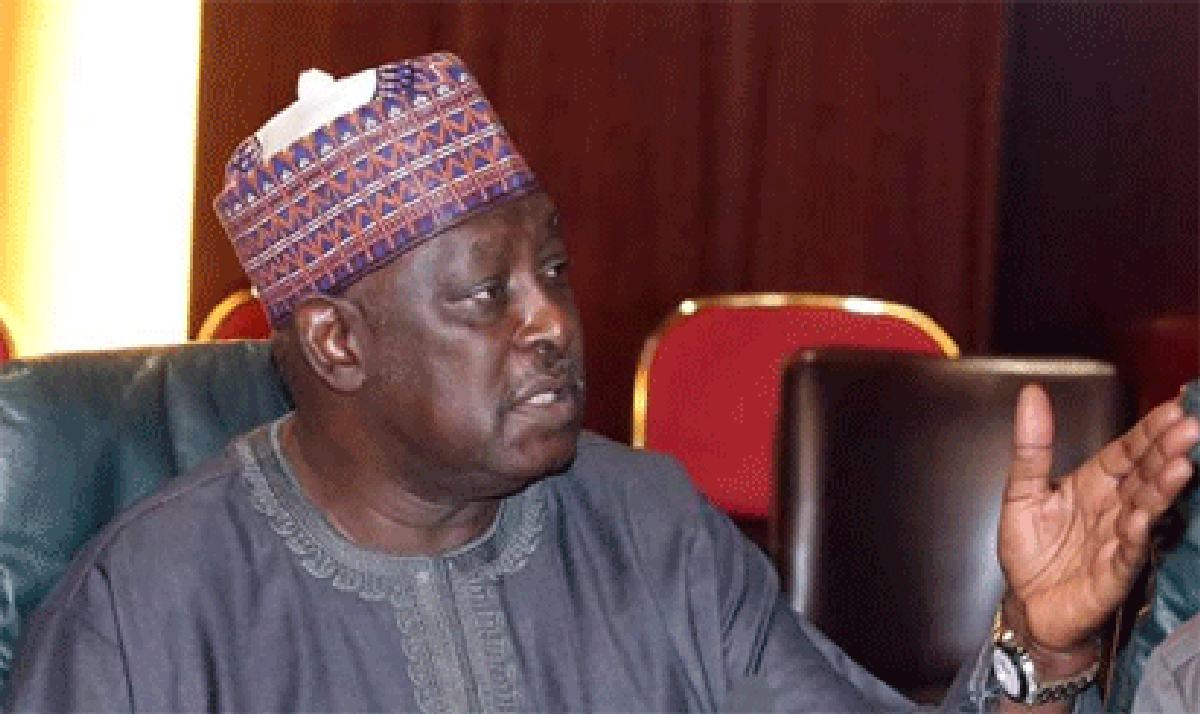
Babachir Lawal has credited President Bola Tinubu with paving the way for his appointment as Secretary to the Government of the Federation in 2015. Yet, with his recent public admissions, Lawal now portrays himself as a political power broker.
His political journey reflects the complicated nature of Nigeria’s elite politics, where personal conviction, ambition and strategic interests often overlap.
What happens behind closed doors rarely becomes public. But as far as public manoeuvring is concerned, Nasir el-Rufai and a handful of northern governors boxed President Muhammadu Buhari into a corner in 2022, persuading him to allow the APC presidential ticket to go to Tinubu.
Lawal, however, paints a different picture. In a recent television interview, he said Buhari initially had reservations about Tinubu’s ambition but that it was primarily he who persuaded the former president not to oppose Tinubu’s candidacy.
Beyond portraying himself as a man repeatedly betrayed, it is difficult to understand why the former SGF has chosen to revisit these events now.
After the APC presidential primary in 2022, it was no secret that Lawal lobbied to become Tinubu’s running mate.
Their relationship later collapsed. Lawal has denied that his personal ambition to become vice president influenced his decision to switch allegiance to Peter Obi, then the Labour Party’s presidential candidate.
Instead, he became one of the strongest critics of the Tinubu-Shettima Muslim-Muslim ticket, arguing that it undermined Nigeria’s religious balance and weakened national inclusion.
Last year, he joined the African Democratic Congress (ADC), presenting it as a platform to challenge the APC and offer Nigerians an alternative.
That alliance also ended in disagreement. After Atiku Abubakar emerged from the ADC primary, Lawal criticised the process as manipulated and rejected Atiku’s candidacy, arguing that he was not the right person to lead the opposition. Atiku’s supporters dismissed the allegations as politically motivated.
Again, there were insinuations of a conflict of interest. ADC Chairman Shehu Yohana accused Lawal in 2025 of attempting to replace him with an ally in order to gain control of the party’s structure in the state.
Supporters see a consistent pattern: a politician willing to leave powerful alliances whenever he believes they conflict with his principles. They cite his opposition to both Tinubu and Atiku as evidence that he is motivated by fairness, inclusion and national interest.
Critics, however, argue that his political positions have often shifted after he lost influence over key decisions. They contend that his disagreements were driven not only by principle but also by access, relevance and political power.
Just as President Tinubu could compile a long list of people who have betrayed him over the course of his career, many others could equally claim they were disappointed by him. That is the nature of politics. But few choose to air those grievances publicly.
We’ve got the edge. Get real-time reports, breaking scoops, and exclusive angles delivered straight to your phone. Don’t settle for stale news. Join LEADERSHIP NEWS on WhatsApp for 24/7 updates →
Join Our WhatsApp Channel