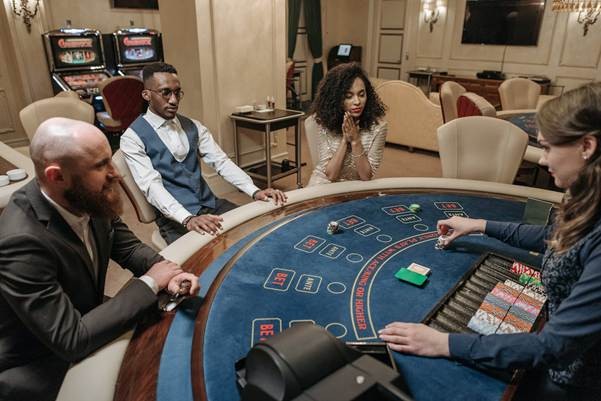
Most beginner blackjack advice gets one thing wrong. It treats the dealer’s visible card like a dramatic signal, instead of a practical one. An upcard is not a prophecy. It does not tell you what the dealer will finish with, and it does not turn one hand into a certainty. What it actually does is narrower, but still useful: it changes the pressure of the situation. A dealer 6 creates a different decision environment from a dealer ace, even before any later cards appear.
That matters because people naturally overweight the clue they can see most easily. In research on judgment under uncertainty, visible cues and prior expectations often shape fast decisions more than they deserve to, especially when the mind wants a quick story, rather than a balanced read of the evidence. A blackjack hand works the same way. The upcard matters, but only in relation to your own total, your flexibility, and the dealer’s fixed drawing rules. Read that way, it becomes a clean decision cue that fits into a bigger picture.
Watching the Cue Instead of Mythologizing It
The fastest way to understand an upcard is to stop asking what it predicts and start asking what it changes. A low dealer card, such as 4, 5, or 6, usually places more strain on the dealer because the dealer must keep drawing to at least 17. A 10 or an ace starts from a stronger position, so your hand often has less room for casual optimism.
That is why the same player total can call for different decisions depending on what the dealer shows. It is also why context helps more than an isolated theory. For instance, on this live blackjack category page, the value is not just that there are many blackjack tables. It is that you can watch the same public cue repeat across different rounds, dealers, and table speeds without treating a single hand like a foregone conclusion.
The page includes multiple live-dealer blackjack variants, and it states that new players can load a game and watch first. Used that way, live blackjack becomes a practical observation space. You can compare how a dealer 5 feels against a dealer 10 over several rounds, notice how often players overread streaks, and see why the upcard works best as a piece of context. When you approach live blackjack with that calmer lens, the visible card stops feeling mystical and starts feeling legible.
What the Upcard Really Does to Your Hand
A useful way to think about the upcard is to sort hands by flexibility rather than emotion.
- Hard hands with no ace counted as 11 have less room to recover after one bad hit.
- Soft hands can absorb more pressure because the ace gives them a built-in cushion.
- Pairs raise a different question entirely because the hand may be worth separating, rather than simply hitting or standing.
This is where beginners often drift off course. They see a dealer 10 and feel defeated before judging their own position. Or they see a dealer 6 and relax too early, as if the round has already tilted in their favor. Neither reaction is precise. The dealer’s card matters, but your own total still defines what kind of choice is even available.
A hard 16 against a 10 is a different problem from 12 against a 4. A soft 18 against a dealer 9 asks for a different level of caution than a hard 18 against a 6. The upcard changes the logic of the hand, but it never replaces the hand. Seen this way, the upcard is less about fear or hope than proportion. It tells you how carefully to weigh the next choice, not how emotionally to narrate the hand.
Why Repetition Is Key
One reason the upcard confuses newer players is that single memorable rounds stick in the mind too easily. Let’s say a dealer shows a weak card, pulls several more, and wins anyway. That image can linger longer than 20 ordinary rounds where the cue behaved exactly as expected. Human judgment tends to remember the vivid exception and underweight the quieter pattern. In practice, blackjack becomes easier to read when you watch repeated games, instead of building your view around one dramatic outcome.
That is also why observation is more valuable than mystical language. If you spend time watching multiple rounds, you begin to notice that the upcard is best understood as a pressure signal. Sometimes, it puts the dealer under more strain. Sometimes, it places more pressure on the player to avoid loose decisions. Either way, it is a guide to conditions, not a sealed result.
Research on cue utilization and cognitive load points in a similar direction: people perform better when they identify useful cues without overloading themselves with noise. That is the real lesson of the dealer’s visible card. It needs to be read at the right size.
We’ve got the edge. Get real-time reports, breaking scoops, and exclusive angles delivered straight to your phone. Don’t settle for stale news. Join LEADERSHIP NEWS on WhatsApp for 24/7 updates →
Join Our WhatsApp Channel