Yobe, Northeast Nigeria, is providing continental answers to who produces medical science and technology and for whom it is produced, Kamal Ibrahim writes.
On a quiet morning in Yobe State, far from the traditional centres of global science, a familiar question echoed through the mind of Professor Amadi Ihunwo. For decades, the Nigerian-born neuroscientist, now Head of the Department of Anatomical Sciences at the University of the Witwatersrand in Johannesburg, had watched Africa sit patiently on the margins of biomedical discovery.
The continent supplied patients, samples and statistics, but rarely authored the questions or owned the answers. Standing before the Biomedical Research and Training Centre (BioRTC) in Damaturu, that long imbalance felt, for the first time, negotiable.
To Prof Ihunwo, BioRTC is not just another laboratory complex; it is Africa asserting its right to define its own scientific destiny. He describes the centre as a deliberate response to a painful reality: drugs consumed across the continent are often designed, tested and validated on populations with entirely different genetic and environmental profiles.
When treatments fail, or side effects manifest differently in African bodies, the surprise is misplaced. “We were never in the room where the science was done,” he says. BioRTC, in his view, is Africa pulling up a chair to that table.
He sees deeper symbolism in its location. Yobe, which has recently been associated with conflict, displacement, and underdevelopment, now hosts the most advanced biomedical infrastructures in Nigeria. That choice, Prof. Ihunwo argues, reframes Africa’s narrative. Scientific excellence, he insists, should not be geographically inherited; it should be intentionally built.
For young African scientists, BioRTC signals that world-class research no longer requires an exit visa. It can, and should, grow from African soil, shaped by African realities.
From Johannesburg, the ripple of that ambition reached Paris, where Professor Bassem Hassan, a neurobiologist and developmental geneticist at the Paris Brain Institute, has spent years thinking about sustainability in global science.
Prof. Hassan has seen too many African research initiatives bloom briefly, only to wither once donor attention fades. What struck him about BioRTC was its insistence on durability. From the start, the centre was designed not as a project, but as an institution, one embedded in local governance, accountable to global standards and resilient enough to outlive individual champions.
Hassan speaks of sustainability not just in financial terms, but in intellectual continuity. BioRTC’s model prioritises training local scientists to lead, not merely assist, high-impact research.
By anchoring expertise in Yobe, the centre reduces dependence on external laboratories and ensures that African questions are investigated by African minds. To him, that is the difference between symbolic inclusion and structural change.
“This is how you future-proof African science,” he says, “by making it indispensable to itself.”
The story of how BioRTC came to be is inseparable from the convictions of its director, Professor Mahmood Bukar Maina. For years, Maina watched Africa consume imported knowledge with little power to challenge or adapt it. Journals were read, technologies imported and medicines prescribed, often with consequences that puzzled clinicians and devastated families. The explanation was simple but uncomfortable: Africa had outsourced its scientific voice.
Maina describes BioRTC as a conscious refusal of that silence. Built to operate with scientific independence, transparent governance and international standards, the centre is also firmly aligned with the development priorities of Yobe State.
At its heart is a moral argument that the persistent under-representation of African populations in biomedical research is not just a technical oversight, but one of the great scientific injustices of modern times.
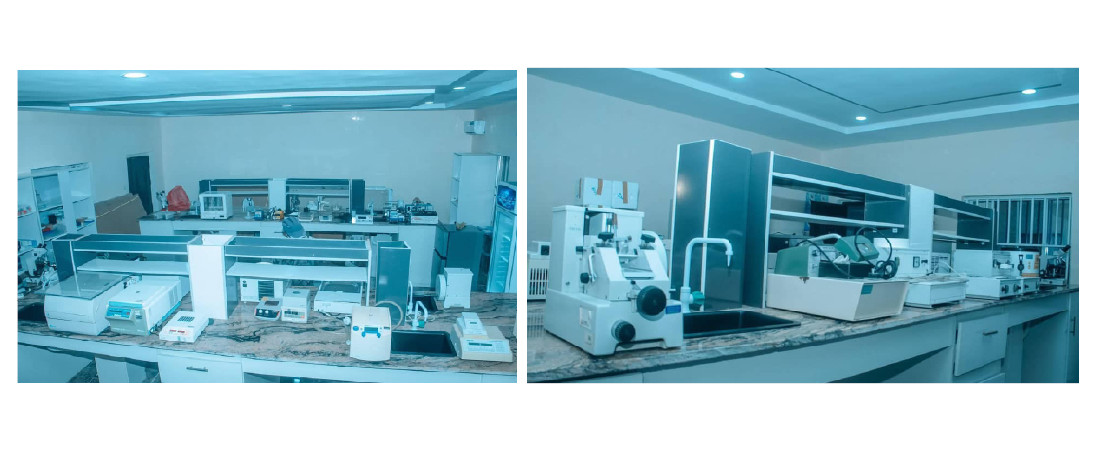
Inside the walls of BioRTC, sit research facilities valued at over N10 billion, including technologies unavailable anywhere else in Nigeria. Yet the true measure of BioRTC’s ambition lies in what those machines are being asked to do. In the Bade Emirate, where chronic kidney disease has quietly claimed lives for generations, BioRTC is leading one of the most comprehensive investigations into the illness ever attempted in Nigeria. For communities along the River Yobe, science is no longer abstract; it is personal, urgent and overdue.
Innovation at the centre is also guided by pragmatism. BioRTC scientists have designed a new class of open-science microscopes, cheaper, battery-powered, and rugged enough for fieldwork. Now being tested for malaria diagnosis, these tools promise to bring life-saving diagnostics closer to communities that have long been distant from laboratories. It is science-engineered not for prestige, but for proximity.
Perhaps the most radical achievement is BioRTC’s establishment of Africa’s first open-access induced pluripotent stem cell biobank. Using African-derived biological systems, researchers can now study diseases and treatments in ways that reflect the continent’s genetic diversity and lived realities.
Alongside this is Nigeria’s most deeply characterised dementia research cohort, finally placing African populations within global conversations on Alzheimer’s disease and brain health.
Training remains central to the BioRTC’s mission. Over 1,000 scientists from Yobe, Nigeria and across Africa have passed through BioRTC’s programmes in bioimaging, infectious diseases, artificial intelligence and neuroscience.
Also, through its partnership with the University of Maiduguri, the centre now hosts Nigeria’s first structured postgraduate neuroscience programme, and only the second of its kind in Africa.
For Yobe State Governor, Mai Mala Buni, the centre represents a strategic investment in recovery and relevance. His administration committed over N800 million to provide BioRTC with a permanent home, driven by the belief that education, research and innovation are essential to rebuilding societies long defined by crisis.
Buni speaks with particular pride about the iPSC biobank and the dementia cohort, seeing them as proof that Nigeria can contribute meaningfully to global knowledge rather than merely consume it.
The governor’s personal involvement in courting international partnerships, from London’s School of Hygiene to the Francis Crick Institute, helped accelerate BioRTC’s emergence. Three years on, international recognition has followed. Scientists at the Janelia Research Campus in the United States have described the centre as an exemplary model for building research capacity in underdeveloped regions.
From Yobe to Johannesburg, from Paris to London, BioRTC’s story is now unmistakably Pan-African. It is a reminder that Africa’s future in science does not lie in imitation, but in ownership. Here, in a state once written off, Africa is not waiting for permission to be relevant. It is already doing the work.
We’ve got the edge. Get real-time reports, breaking scoops, and exclusive angles delivered straight to your phone. Don’t settle for stale news. Join LEADERSHIP NEWS on WhatsApp for 24/7 updates →
Join Our WhatsApp Channel