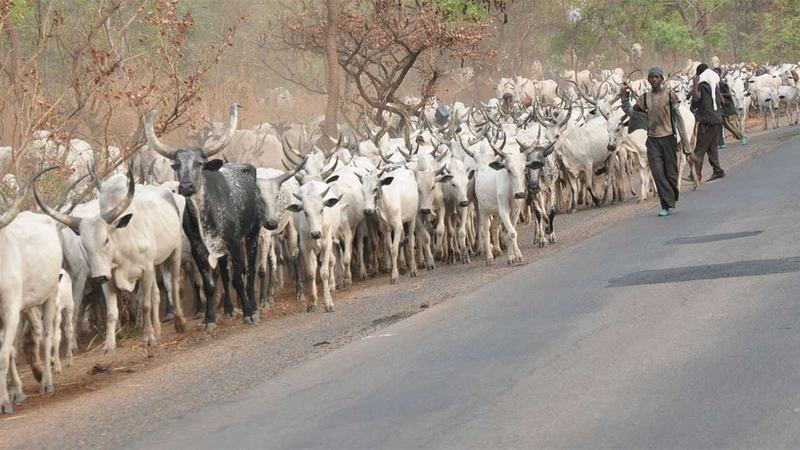
A group, Youths Against Disaster Initiative (YADI), has called for the urgent implementation of a comprehensive, structured cattle ranching system across Nigeria, describing it as a strategic solution to persistent farmer-herder clashes and a pathway to economic transformation.
Addressing journalists in Abuja, the programme officer for YADI, Farouk Bala, said decades of open grazing have fuelled violent conflicts, economic losses and displacement, particularly in the North Central region.
Citing findings referenced by the Centre for Crisis Communication and the Nigerian Security Tracker, the group said between 2018 and 2023, about 3,000 people were killed in farmer-herder clashes, while more than 300,000 were displaced from their communities.
Bala added that the 2024 Nigeria Watch Report documented 567 deaths linked to farmer-herder violence across 20 states and the Federal Capital Territory (FCT) within a single year. “These are not mere statistics. They represent lives lost, livelihoods destroyed and communities fractured,” the group said.
YADI argued that structured ranching has emerged as a sustainable alternative to open grazing, capable of reducing friction over land and water resources while promoting peaceful coexistence.
The group commended President Bola Ahmed Tinubu’s commitment to implementing ranching reforms, noting that Kwara State has been selected as the pilot state for the initiative.
However, the organisation acknowledged resistance in some quarters, attributing it largely to misinformation and inadequate stakeholder engagement.
According to Bala, most pastoralists, farmers and community leaders are not fundamentally opposed to ranching but lack adequate information about its economic prospects and long-term sustainability.
Beyond security concerns, YADI described ranching reform as critical to economic revitalisation.
Also, a research fellow at the Centre for Crisis Communication, Mukhtar Madobi, said farmers fear possible displacement, while herders worry about abandoning the long-standing tradition of open grazing. “This reflects not outright rejection, but a gap in consultation, engagement and public sensitisation,” he stated.
He noted that the federal government estimates Nigeria’s livestock sector contributes over $32 billion to the country’s Gross Domestic Product.
Under the National Livestock Growth Acceleration Strategy (2025–2030), the sector is projected to grow its contribution to between $74 billion and $94 billion within a decade if properly structured.
Drawing global comparisons, YADI said Brazil earned about $9.3 billion from beef exports in 2024, while the United States and Australia recorded $7.2 billion and $8 billion, respectively.
In contrast, Nigeria, despite having an estimated 20 million cattle and ranking among the top 15 countries globally in cattle population, generated only $172,000 from cow exports in 2024.
The country also recorded $1.15 million from live animal exports in 2021 and less than $200,000 from meat and edible offal exports, figures the group described as evidence of vast untapped potential.
YADI maintained that modern ranching would enhance revenue generation, improve foreign exchange earnings and reduce reliance on imported dairy and meat products.
Bala said compliance with international standards in traceability, hygiene and quality control would enable Nigeria to access regional and global markets.
The group further highlighted job creation opportunities across the livestock value chain, including ranch management, veterinary services, feed production, meat processing, logistics and leather manufacturing.
It added that structured ranching would increase productivity through controlled breeding, improved genetics and professional veterinary supervision, shifting livestock production from subsistence practice to a commercially viable enterprise.
On national security, Madobi stressed that designated ranching zones would prevent encroachment on farmlands and reduce violent confrontations.
The organisation said geographically defined ranching communities would improve surveillance, livestock traceability and intelligence gathering, thereby strengthening early warning systems and coordinated security responses.
The group emphasized that ranching reform is neither a cultural eradication policy nor a land-grab agenda.
Rather, it described the initiative as a development-oriented reform designed to modernize livestock production while preserving livelihoods and social cohesion.
For successful implementation, YADI called for inclusive stakeholder engagement involving pastoral associations, farmers’ groups, traditional rulers, state governments and civil society.
It also urged nationwide public sensitisation campaigns led by relevant government agencies, media institutions and community leaders.
YADI said Nigeria’s 20 million cattle could become a cornerstone of industrialisation, export growth and youth employment if properly harnessed.
We’ve got the edge. Get real-time reports, breaking scoops, and exclusive angles delivered straight to your phone. Don’t settle for stale news. Join LEADERSHIP NEWS on WhatsApp for 24/7 updates →
Join Our WhatsApp Channel