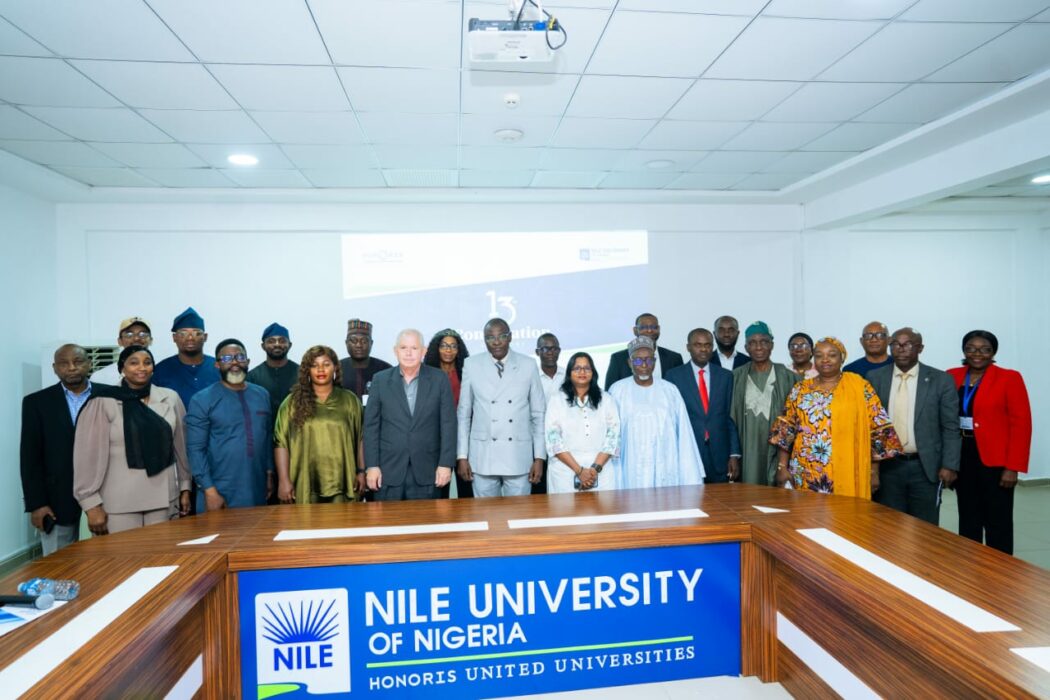
Ahead of its 13th convocation ceremony, Nile University of Nigeria has reaffirmed its commitment to producing world-class graduates, with Vice-Chancellor Prof. Dilli Dogo commending the international competitiveness of the 2025 cohort.
Prof. Dogo, who addressed a press conference in Abuja on Monday, announced that the 13th convocation ceremony of the institution will hold from 18 to 20 November 2025.
The Vice-Chancellor explained that the upcoming convocation represents a significant landmark for the university’s newest graduates.
He said the graduates are well prepared to excel and thrive in an increasingly competitive global environment.
According to him, the institution has continued to strengthen its academic delivery, research capacity, and industry partnerships to ensure that its graduates possess the skills and exposure required to stand out internationally.
Prof. Dogo added that the convocation activities will feature a series of events aimed at celebrating academic excellence, innovation, and community impact, while also highlighting the achievements of students and faculty across various disciplines.
He further stated that Nile University remains committed to nurturing well-rounded professionals, emphasising that the institution’s steady growth since joining the Honoris United Universities network has positioned it as a leading centre for quality higher education in Nigeria and beyond.
According to Prof. Dogo, this year’s convocation will also spotlight the university’s expanded academic programmes and infrastructural advancements, reflecting its mission to deliver world-class education in line with global best practices.
He revealed that several distinguished guests, industry leaders, and academic partners are expected to grace the ceremony, which will include the award of degrees, presentation of prizes, convocation lecture, and presentation of an honorary doctorate degree to former President Goodluck Jonathan.
The Vice-Chancellor also reiterated the university’s commitment to providing a conducive learning environment, noting that recent upgrades in digital learning facilities, laboratories, and campus amenities have further enhanced the quality of teaching and learning.
Prof. Dogo expressed confidence that the 13th convocation would serve as both a celebration of achievement and a reaffirmation of the university’s dedication to producing graduates who are not only academically sound but also equipped to contribute meaningfully to national development and global progress.
The Vice-Chancellor also unveiled the Nile Business School (NBS), which was graced by officials from the Central Bank of Nigeria, Securities and Exchange Commission (SEC), African Development Bank (AfDB), among others.
In his remarks, Dogo said the launch of the Nile Business School represents a major step toward strengthening the university’s role in shaping future business leaders, policymakers, and innovators.
He noted that NBS was conceived to bridge critical gaps in executive education, entrepreneurial training, and industry-driven research, particularly at a time when Nigeria and Africa require strategic thinkers to navigate emerging economic challenges.
Dogo explained that the school would offer a range of specialised postgraduate and professional programmes tailored to the needs of both the public and private sectors, with curricula designed in collaboration with industry experts and regulatory bodies.
According to him, this approach ensures that graduates are equipped with practical competencies and strategic insights relevant to today’s global marketplace.
The VC said: “We cannot afford to lose out in the Fourth Industrial Revolution. That’s why we have institutions that want to stand the test of time and make the right, positive impact to ensure that the kind of education we provide in the 21st century meets the expectations of the global workforce.
“Against that background, we specifically chose the theme of the 13th Convocation Lecture to focus on defining education for the benefit of the 21st-century workforce.
“Over the years, people have been collecting certificates or going to school, but many graduates leave without the necessary skills or qualifications expected of them. Here in Nigeria, our intention is to provide quality and appropriate education to those who cannot afford it,” he stated.
While announcing that the school would establish a branch of its business school in Lagos to cater for students in Nigeria’s commercial capital, Prof. Dogo emphasised that the strong presence of representatives from key financial and development institutions at the unveiling was a testament to the credibility and future impact of the new business school.
The launch of Nile Business School also represents the next chapter in Nile University’s digital evolution. The school’s hybrid and online Executive MBA programmes are powered by Nile Online, the university’s digital learning arm that delivers flexible, technology-enabled education experiences across Africa.
While Nile’s business programmes have been successfully running, this launch marks a new, structured, and elevated phase: clearer identity, stronger academic leadership, deeper industry integration, and a more intentional approach to shaping business leaders for Africa and the world.
In his keynote address, the Dean, Nile Business School, Prof. Noel Tagoe, noted that the establishment of NBS aligns with global trends that demand innovative, ethical, and digitally capable leaders who can respond effectively to the rapid changes driving today’s economies.
The school, he said, would compete with Harvard Business School, London Business School, and other global business institutions across the world.
Prof. Tagoe highlighted that the school’s curriculum is designed to go beyond traditional business training by integrating real-world problem-solving, experiential learning, and exposure to global best practices. According to him, this approach will empower students to think critically, act strategically, and lead responsibly within both emerging and established markets.
He further stressed the importance of collaboration between academia, industry, and regulatory institutions in building a pipeline of skilled professionals equipped to support Nigeria’s economic transformation. Tagoe expressed confidence that NBS would become a hub for cutting-edge research, leadership development, and innovative business solutions tailored to African contexts.
The Dean added that the school’s focus on technology-driven learning, international partnerships, and executive education will position it as a premier destination for professionals seeking to enhance their competencies and advance their careers in a rapidly evolving global business environment.
We’ve got the edge. Get real-time reports, breaking scoops, and exclusive angles delivered straight to your phone. Don’t settle for stale news. Join LEADERSHIP NEWS on WhatsApp for 24/7 updates →
Join Our WhatsApp Channel