2025 was not a quiet year in Nigerian politics. It played out as a high-stakes arena where power was contested, loyalties were tested, ambitions clashed, and political survival became a daily struggle. From party ruptures and courtroom showdowns to dramatic defections and unsettling security flashpoints, the nation weathered a turbulent season driven by larger-than-life personalities and shifting alliances. In this special political analysis, ADEMU IDAKWO examines the forces, faces, and fault lines that shaped Nigeria’s political story in 2025
Behind the headlines in 2025, maneuvering unfolded in smoke-filled rooms and public squares alike, as alliances shifted with startling speed and old certainties collapsed. Veterans and newcomers jostled for relevance, some reinventing themselves while others faded under the weight of miscalculation. Every move carried consequences, and every silence spoke volumes, revealing a system under intense strain and constant negotiation.
What emerged was a portrait of a nation wrestling with authority, accountability, and direction. Institutions were tested, ambitions laid bare, and the limits of influence repeatedly exposed. In tracing these moments, this account goes beyond events to capture the undercurrents, decisions made in haste, rivalries sharpened by urgency, and a populace watching closely as the stakes continued to rise.
Reforms, Recalibration, And The Battles Within The Corridors Of Power:
President Bola Ahmed Tinubu’s administration remained at the epicenter of Nigeria’s political discourse throughout 2025, as a series of major economic and governance reforms continued to dominate national debate. The government pursued a robust agenda focused on fiscal restructuring, subsidy rationalisation, foreign exchange adjustments, and revenue expansion, positioning the presidency as both the architect and arbiter of the country’s economic trajectory.
These reforms, while aimed at long-term stabilisation and growth, also became a focal point of political contestation, exposing fault lines within the Lagos–Abuja power axis. Federal institutions and state governments grappled with the demands of policy alignment, often negotiating between the pressures of reform implementation and the realities of local politics.
The Tinubu administration’s approach underscored a broader effort to recalibrate Nigeria’s governance framework, balancing the imperatives of economic prudence with the complexities of political negotiation. As debates over fiscal priorities and institutional authority intensified, the corridors of power became arenas where political strategy and policy execution intersected, shaping both the present and the future direction of the nation.
On the foreign policy front, the administration pursued diplomatic engagements within West Africa and with international partners, focusing on economic cooperation, security collaboration, and Nigeria’s regional leadership role.
Domestically, the government continued to emphasise infrastructure development, budget realignment, and security funding, while navigating legislative negotiations within the National Assembly and managing pressures from state governments and organised labour.
Public reaction to the reform agenda remained divided. While government officials and some policy analysts pointed to improved fiscal transparency, increased revenue efforts, and renewed investor engagement, critics highlighted the immediate social and economic consequences, including rising inflation, cost-of-living pressures, and declining purchasing power among citizens. Labour unions, civil society groups, and opposition figures frequently questioned the pace, sequencing, and social safeguards attached to the reforms.
Despite sustained criticism, President Tinubu remained the most influential political actor in 2025. His administration maintained strong control over executive policy direction, played a decisive role in party realignments, and shaped political alliances across party lines, reinforcing the presidency’s central role in Nigeria’s political landscape throughout the year.
Political Earthquakes Of The Year:
APC Leadership Shake-Up And The Battle For Party Control-
The ruling All Progressives Congress (APC) experienced one of its most dramatic internal upheavals in recent memory, driven by months of mounting tensions over leadership style, underperformance of key officials, and strategic positioning ahead of the 2027 elections. The spotlight fell on Abdullahi Ganduje, whose controversial tenure as national chairman ended amid sustained pressure from rival party blocs, anti-corruption advocates, and internal critics. Many argued that his ongoing legal challenges and political skirmishes in Kano had become a liability for the party’s national ambitions.
Ganduje’s departure triggered a fierce contest for the party’s helm, as rival factions jostled to install candidates aligned with their vision of APC’s future. The eventual appointment of a new national chairman, widely seen as technocratic, loyal to President Bola Ahmed Tinubu, and closely aligned with the administration’s national agenda , signaled a pivotal shift. The leadership shake-up recalibrated internal power dynamics, bolstered the president’s influence within the party, and injected fresh momentum into preparations for the next election cycle.
PDP’s Turbulent Journey:
From Crisis To The Ibadan Convention And Beyond
Few parties embodied the turbulence of 2025 quite like the Peoples Democratic Party (PDP). What began as quiet internal murmurs quickly erupted into one of the party’s fiercest leadership storms since 1999. Accusations of hijacked structures, unresolved zoning disputes, and covert alliances fueled the unrest, while the departure of key heavyweights, most notably former Vice President Atiku Abubakar, who defected to the resurgent ADC, further deepened the crisis.
The PDP also saw seven governors defect to the APC in a dramatic wave of departures triggered by the party’s prolonged internal breakdown. Fierce battles between rival National Working Committee factions splintered the party, culminating in parallel meetings that nearly brought it to the brink of collapse. Although the Ibadan National Convention ushered in new leadership, by December the party remained deeply fractured, weighed down by lawsuits, lingering mistrust, and unresolved questions about its identity.
Labour Party: A House Divided Against Itself
The Labour Party’s internal conflict persisted throughout 2025. The Lamidi Apapa faction, the Abure camp, and Peter Obi, aligned structures vied for legitimacy through court battles and public protests. Conflicting judicial rulings paralyzed party strategy, fundraising, and grassroots mobilisation. By mid-year, the crisis had significantly eroded public trust, leaving the LP weakened and far from the alternative platform many Nigerians had embraced in 2023.
The NNPP, Kano Drama, And Kwankwaso’s Survival Strategy
Kano remained politically volatile in 2025 as tensions between Governor Abba Kabir Yusuf and former Governor Abdullahi Umar Ganduje intensified. Legal battles over emirship, accusations of vendetta, and disputes over party structures dominated headlines, creating a climate of uncertainty. The NNPP’s national leadership crisis further compounded the situation, with rival factions fiercely contesting legitimacy.
Amid the turbulence, Rabiu Musa Kwankwaso maintained his political relevance. Leveraging deep grassroots loyalty in Kano and carefully calibrated strategies ahead of the 2027 elections, he kept himself at the center of national political conversations.
The Birth And Rise Of The Africa Democratic Congress (ADC)
2025 marked the unexpected resurgence of the Africa Democratic Congress (ADC) as an emerging political force. Once considered a fringe party, the ADC became a refuge for politicians escaping crisis-ridden platforms, most notably following former Vice President Atiku Abubakar’s high-profile defection.
The party made quiet but strategic gains nationwide, consolidating local structures, attracting technocrats, and courting youth movements disillusioned with traditional political options. By December, the ADC had repositioned itself as a potential third-force alternative ahead of the 2027 elections, despite facing pockets of legal challenges from aggrieved members opposed to Senator David Mark’s ascent as national chairman
The Defections That Reshaped Politics:
2025 saw sweeping political realignments, with governors, lawmakers, and influential figures defecting to the ruling APC. Motivations varied from political survival to the pursuit of access to federal power, but the overall effect was clear: opposition parties were weakened, while the APC’s dominance was further consolidated nationwide.
These movements not only altered party calculations but also reshaped the strategic landscape ahead of the 2027 elections.
The Rivers Political Inferno: Wike vs. Fubara
Rivers State emerged as the epicenter of intense political confrontation in 2025. The simmering cold war between FCT Minister Nyesom Wike and Governor Siminalayi Fubara played out through legislative manoeuvres, impeachment threats, parallel assemblies, and federal interventions.
Wike’s entrenched influence clashed with Fubara’s drive for autonomy, splitting the PDP and reshaping national political calculations. Even Fubara’s eventual defection to the APC did little to quell the feud, which continued to fester and influence broader party dynamics
Senate President Akpabio vs. Senator Natasha
The confrontation between Senate President Godswill Akpabio and Senator Natasha Akpoti-Uduaghan rocked the National Assembly in 2025. Allegations of bias, sexual harassment, and legislative manipulation dominated national discourse, exposing deep fractures within the 10th Senate and putting parliamentary leadership under intense scrutiny.
The Judiciary In The Eye Of The Storm:
The judiciary remained a central arena in Nigeria’s political struggles throughout 2025, with court decisions shaping party crises, state power battles, and debates over civil liberties.
Nnamdi Kanu’s Trial And Sentencing
One of the year’s most consequential legal developments was the conclusion of the terrorism trial of IPOB leader Nnamdi Kanu. In November 2025, a Federal High Court in Abuja convicted Kanu on multiple terrorism-related charges, ruling that his broadcasts and directives had incited violence in the South-East. He was sentenced to life imprisonment, bringing a dramatic climax to a prolonged and highly controversial legal saga.
The conviction reignited debates over judicial independence, political prosecutions, and the handling of sensitive security cases. While Kanu’s legal team vowed to pursue appeals, the judgment stood as one of the most defining legal moments of 2025.
Supreme Court Ruling On The Rivers State Crisis:
Another landmark judicial moment came from the Supreme Court’s intervention in the Rivers State political crisis. In a high-profile ruling, the apex court upheld the legality of the governor’s removal of disputed local government chairmen and clarified constitutional authority on state assembly powers , a decision that significantly influenced the unfolding political struggle in Rivers and served as a key reference point in state–federal power disputes.
Federal High Court Upholds PIA Provisions Amid Rights Challenge
In a major legal battle with implications for Nigeria’s oil policy and community rights, a Federal High Court in Warri dismissed a suit challenging host community liability provisions of the Petroleum Industry Act (PIA). The court’s judgment upheld critical sections of the statute, reinforcing legal backing for the government’s framework governing petroleum infrastructure and quelling one of the year’s notable constitutional arguments over statutory powers.
Insecurity , Insurgency And The Politics Of Force
Persistent insecurity continued to shape governance and politics. Banditry, insurgency, farmer–herder clashes, and separatist agitation remained entrenched. Military operations intensified across several states, yet mass abductions and civilian displacement fueled public anger.
A reported US airstrike on terrorist enclaves in the Sokoto forest ignited national debate over sovereignty and foreign military involvement. In the South-East, sit-at-home orders and attacks on security formations further strained stability.
US Pressure Over Christian Killings
In November, the United States imposed visa restrictions in response to religiously targeted killings, describing Nigeria as one of the world’s most dangerous countries for Christians. Abuja rejected this characterisation, sparking debate over foreign pressure, religious freedom, and domestic security failures.
In November, the United States imposed visa restrictions over religiously targeted killings, describing Nigeria as one of the world’s most dangerous places for Christians. Abuja rejected the characterisation, triggering debate over foreign pressure, religious freedom, and domestic security failures.
The Political Figures Who Defined 2025
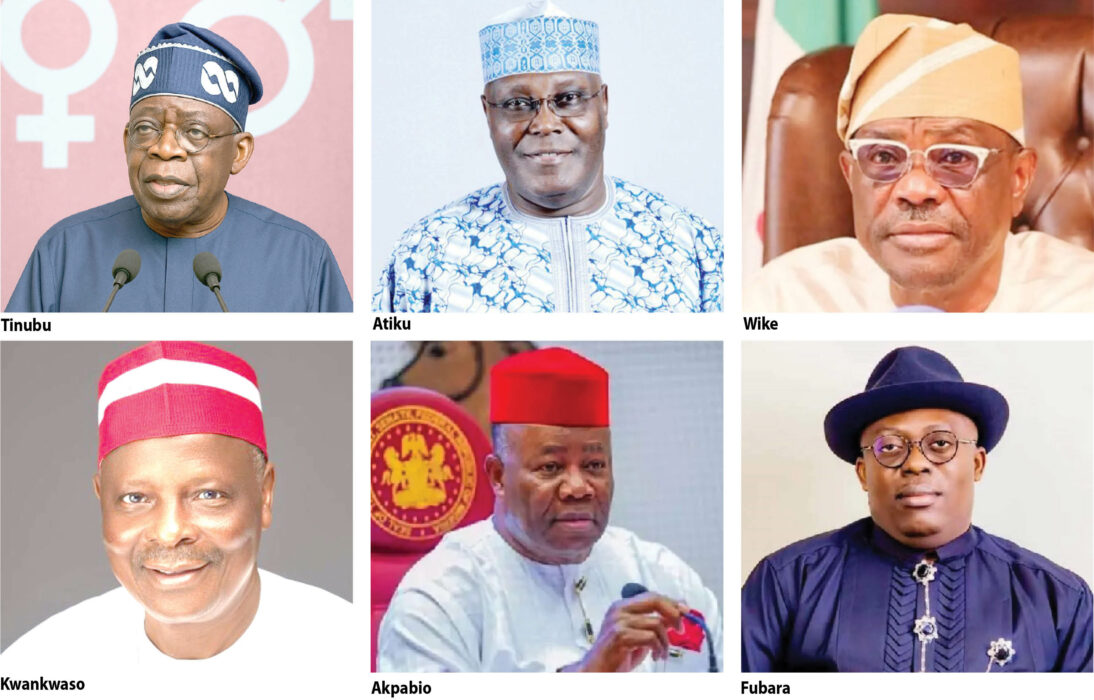
1. Bola Ahmed Tinubu — The Architect of Consolidation
President Tinubu spent 2025 consolidating political control, navigating complex party dynamics, stabilising security frameworks and sustaining regional influence despite persistent economic challenges.
2. Atiku Abubakar — The Defector Who Reshaped the Opposition
Atiku’s dramatic exit from the PDP to the ADC sent shockwaves nationwide. His move reordered alliances and energised ADC’s rise, making him one of the most influential opposition players of the year.
3. Nyesom Wike — The Powerbroker of the Year
Wike’s grip on Rivers politics, his confrontations with Fubara and his national influence through the FCT ministry kept him at the centre of 2025’s biggest political developments.
4. Rabiu Musa Kwankwaso — The Northern Strategist
Despite NNPP internal wars, Kwankwaso maintained relevance, strengthened grassroots loyalty and remained a defining force ahead of 2027.
5. Godswill Akpabio — The Controversial Senate President
From budget battles to high-profile clashes with Senator Natasha, Akpabio was one of the most visible political faces of 2025, shaping parliamentary direction under intense scrutiny.
6. Siminalayi Fubara — The Survivor
Fubara’s resilience against political suffocation in Rivers earned him recognition as one of the year’s unexpected political survivors.
2025 reaffirmed politics as Nigeria’s greatest theatre of power, conflict, and reinvention. Defections, court battles, party implosions, insecurity, and dominant personalities shaped a year whose consequences will echo into 2027. Beneath the turmoil lies a nation still searching for unity, stability, and a political system that works for all.
We’ve got the edge. Get real-time reports, breaking scoops, and exclusive angles delivered straight to your phone. Don’t settle for stale news. Join LEADERSHIP NEWS on WhatsApp for 24/7 updates →
Join Our WhatsApp Channel