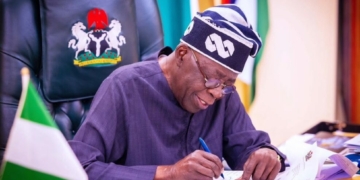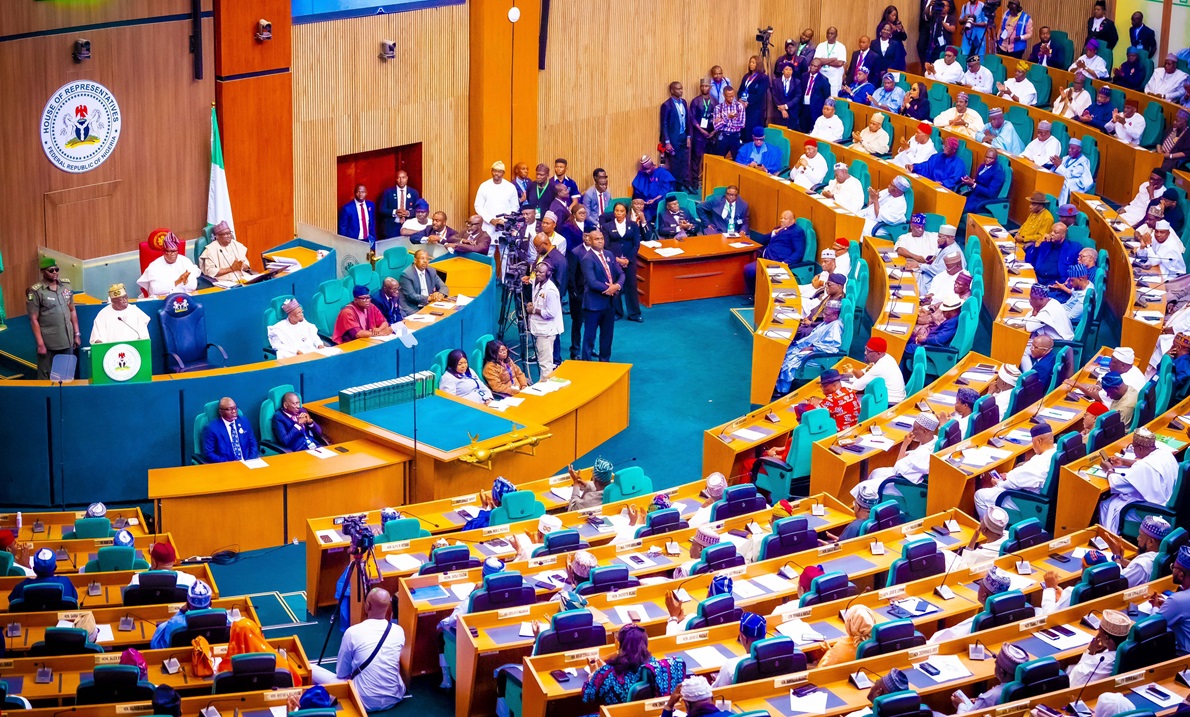
President Bola Ahmed Tinubu’s presentation of a N58.18 trillion 2026 Appropriation Bill to the National Assembly has ignited widespread debate over what Africa’s largest-ever national budget means for ordinary Nigerians grappling with high living costs, weak purchasing power and lingering economic uncertainty.
Analysts have called on the Federal Government to prioritise infrastructure, healthcare and single-digit interest credit facilities for SMEs, among others, for the budget to have direct impact on the masses.
The budget, which builds on the administration’s reform agenda, reflects the government’s resolve to pursue economic growth through large-scale spending on infrastructure, security, human capital development and social services, even as inflation, debt servicing and revenue constraints remain pressing concerns.
Economic experts say the real impact of the 2026 budget will be felt not in its size, but in how its provisions translate into jobs, prices, taxes and public services for everyday Nigerians.
Speaking on the implications of the spending plan, a development economist, Dr Justin Amase, described the budget as a bold signal of the government’s growth ambitions, particularly through capital investment.
“For the ordinary Nigerian, the N58 trillion 2026 budget signals the government’s determination to grow the economy aggressively, even amid tight fiscal conditions,” Amase said. “The scale of the budget suggests a clear emphasis on infrastructure, energy, transport and human capital, which—if properly implemented—can translate into jobs, better roads, improved power supply and lower business costs.”
He explained that while headline figures often dominate public discourse, ordinary citizens are more likely to feel the impact through improved infrastructure and economic activity.
“When government spends more on roads, rail, power, housing and agriculture, it indirectly affects food prices, transport costs and employment. Artisans, small contractors, farmers and suppliers benefit first,” he noted.
However, the experts stressed that timely budget releases and disciplined execution would be critical to whether Nigerians experience tangible relief. “If budget releases are timely and leakages are reduced, Nigerians could feel modest relief in living costs by late 2026, especially through improved logistics and food supply,” he added.
Not all analysts share the same optimism. A Professor of Economics at the University of Benin, Hassan Oaikhenan, warned that ordinary Nigerians should pay closer attention to how the budget will be financed.
“While N58.18 trillion sounds ambitious, the ordinary Nigerian should be more concerned about how the budget will be financed than its size,” Oaikhenan said. “Revenue projections remain very optimistic, while deficit financing and debt servicing still take a large share.”
According to him, this could have direct implications for households and small businesses.
“To meet revenue targets, government will likely intensify tax collection, widen the tax net and enforce compliance. Even if tax rates are unchanged, small businesses, traders and professionals will feel more pressure from levies, fees and enforcement. That indirectly affects prices of goods and services.”
Oaikhenan also cautioned that a large spending plan, if not matched by productivity gains, could prolong inflationary pressures.
“With a large spending plan in an economy still battling inflation, ordinary Nigerians may not see immediate relief in food and transport costs,” he said. “For most households, 2026 may feel like another year of adjustment rather than comfort, unless inflation comes down faster than expected.”
From a social policy perspective, a public finance expert, Prof. Aminu Danjuma, said the budget’s impact would largely depend on how well it improves public services and protects vulnerable groups.
“For ordinary Nigerians, the 2026 budget is best understood through what it means for education, health, security and social protection,” Danjuma said. “The reported increase in allocations to these sectors is significant, but it must be judged against population growth and rising costs.”
He noted that provisions for salaries, pensions and social interventions could help stabilise household incomes if fully implemented.
“If provisions for salaries, pensions and social interventions are fully funded and released, civil servants, teachers, healthcare workers and retirees will experience more stability,” he said. “That stability matters not just to them, but to local economies where their spending supports markets and small businesses.”
Danjuma, however, warned that benefits may not be evenly distributed across the country.
“Urban Nigerians may feel benefits faster through infrastructure and services, while rural households will only feel the budget if agricultural spending truly reaches farmers through inputs, extension services and rural roads,” he added.
Across expert opinions, a common theme emerges: implementation will determine whether the N58.18 trillion budget eases hardship or deepens pressure for ordinary Nigerians.
While the budget offers prospects of infrastructure-driven growth and improved public services, concerns remain around inflation, revenue mobilisation and debt sustainability. For most Nigerians, analysts say the real test will be whether the 2026 budget delivers visible improvements at the market, workplace, schools and hospitals.
As Amase succinctly put it, “The real budget Nigerians will judge is not the one presented in Abuja, but the one they experience in their daily lives.”
Nigerians who spoke to LEADERSHIP on Sunday, while applauding the ambitious budget, felt that it could only make the desired impact in their lives if it provides social security and amenities and addresses the infrastructural deficit in the country.
Nigerians’ Reactions
On her part, Mrs Ojo Tolulope emphasised the importance of healthcare, calling for free medical check-ups for all Nigerians.
“I believe every Nigerian citizen should be able to walk into any government hospital and receive adequate medical care. In addition, better pay should be provided for all medical practitioners, from the gateman to the surgeon. This would help build a thriving Nigerian society to a large extent,” she said.
She also highlighted agriculture as another critical area for investment. According to her, the government should partner with farmers to boost production and ensure food security.
“The government can purchase excess harvests from farmers so that their produce never goes to waste,” she added.
Another Nigerian from the South-West, Mr Kehinde Adegboyega, said the most critical issue the N58.1 trillion 2026 budget must address is transparency and accountability across the entire budget cycle—from formulation to implementation and reporting.
“Nigeria’s challenge is not only how much we budget, but how budgets are executed and monitored,” he said.
“Year after year, we see large allocations to priority sectors, yet weak disclosure, opaque procurement processes and limited public access to implementation data undermine impact. This gap between appropriation and delivery erodes public trust and fuels inefficiency.”
He added: “I would like to see the 2026 budget strengthen open budget practices: clear, accessible breakdowns of allocations, timely publication of implementation reports, and enforceable mechanisms for tracking expenditure outcomes at federal and subnational levels.”
In a chat with LEADERSHIP, a Lagos-based civil servant, Tunde Alao, said: “The 2026 budget should prioritise power supply and road infrastructure. Without stable electricity and good roads, productivity remains low and businesses continue to struggle. Government must invest more in transmission, renewable energy and the rehabilitation of federal highways.”
On her part, a small business owner, Aisha Makanjuola, remarked: “I want the budget to focus on access to affordable credit for SMEs and women-led businesses. Many of us are willing to grow, but high interest rates and multiple taxes are killing small enterprises. Go to the market and see how much petty traders are paying daily and weekly, then multiply that by a month. The budget should provide real support, not just promises.”
Meanwhile, a graduate job seeker, Chukwudi Emmanuel, said: “Job creation and education funding should be at the centre of the 2026 budget. Young Nigerians need skills, not just certificates. More investment in technical education, digital skills and industrial hubs will reduce unemployment and crime.”
Experts’ Reactions
Moreover, the Chief Executive of Economic Associates, Dr Ayo Teriba, stated that the budget is only one aspect of the economy. He said significant gains from sectoral reforms were showing some positivity in sectors such as telecommunications, oil and gas, but that the government was still struggling with the budget aspect of the economy.
Teriba noted that over the last two and a half years, the government had made efforts to shore up the budget by ramping up oil production and taxes, but these had not yielded the desired impact because the budget remained misaligned with reality.
He explained that unless the budget is aligned with reality and supported by increased revenues, there would be little benefit for the common man, as projects in infrastructure, health, education and social welfare require adequate funding.
Teriba proposed that the government should take a cue from business leaders such as Aliko Dangote by attracting equity to fund infrastructure projects instead of relying on debt and taxpayers’ money, an approach which he said has yielded limited results over the years. He stressed that only with the injection of equity would the dividends of reforms accelerate.
Also speaking, a financial economist at Nnamdi Azikiwe University, Dr Felix Echekoba, said the 2026 proposed budget is likely to offer some relief to the average Nigerian compared with the 2025 budget, mainly because of its stronger focus on social safety nets and targeted subsidies.
“The inclusion of expanded health, education and direct cash-transfer programmes suggests a deliberate shift towards cushioning low-income households from economic shocks,” he said.
He added that the real impact would depend on accountability, timely fund releases and strong monitoring, stressing that without effective execution, budgetary intentions rarely translate into real-world benefits.
Ultimately, analysts agreed that a budget only delivers value when citizens can see, scrutinise and hold institutions accountable for how public funds are spent. Without this, even the largest budget risks becoming disconnected from people’s lived realities.
We’ve got the edge. Get real-time reports, breaking scoops, and exclusive angles delivered straight to your phone. Don’t settle for stale news. Join LEADERSHIP NEWS on WhatsApp for 24/7 updates →
Join Our WhatsApp Channel