For once, Nigeria announced a programme that makes sense before you even get to the fine print.
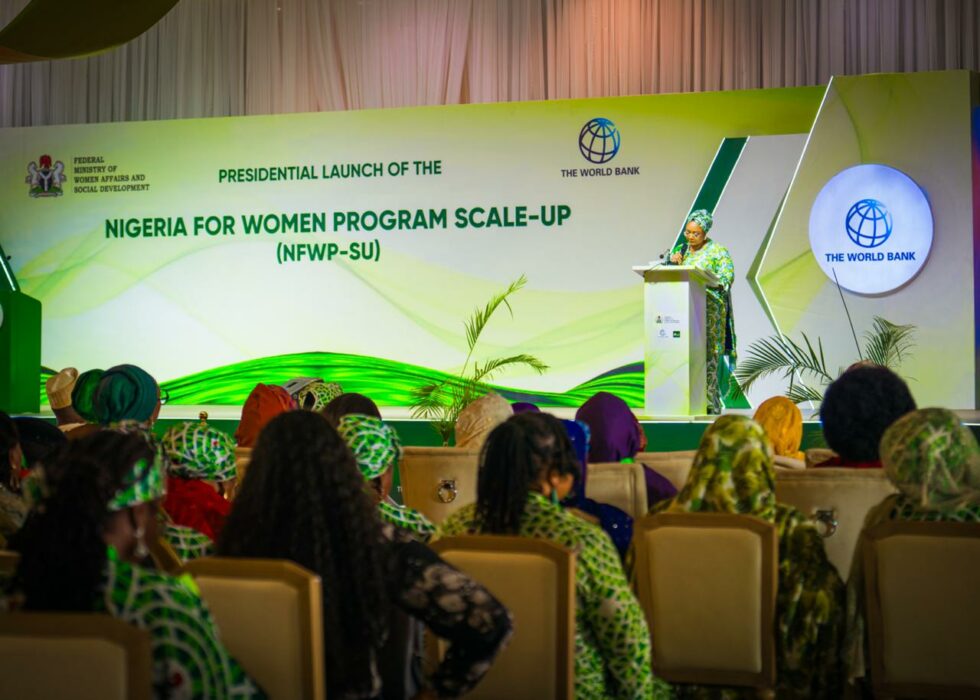
No drama. No ethnic arithmetic. No empty chest-thumping. Just a clear admission that if Nigerian women do better economically, the country follows. That was the quiet message behind the launch of the $540 million Nigeria for Women Programme Scale-Up. It is not a small statement.
At the Presidential Villa, government officials, development partners, and state representatives gathered to roll out a programme designed to reach at least five million women across all 36 states and the FCT, with an expanded ambition of touching 25 million lives nationwide. Big numbers, yes. But the thinking behind it is refreshingly grounded. Women are not being framed as victims. They are being treated as economic actors.
The Minister of Women Affairs and Social Development, Imaan Sulaiman-Ibrahim, put it plainly. Women are no longer peripheral beneficiaries. They are central drivers of economic stability, social cohesion, and national progress. That framing alone signals a shift in how social policy is being discussed. More importantly, the programme is not starting from zero.
Phase One, implemented in six states, produced results that are hard to dismiss. Over 26,000 Women Affinity Groups were formed. Membership crossed 560,000. And the women did something Nigerians respect instinctively ,they saved their own money. Over N4.9 billion, pooled, managed, and circulated within their communities.No slogans there. Just discipline.
Anyone who understands informal economies knows the power of that model. Small groups. Trust-based lending. Peer accountability. Capital that grows slowly but steadily. It is the kind of structure that survives policy changes and outlives donor cycles. The scale-up builds on this foundation, not on theory.
President Bola Tinubu, speaking through Vice President Kashim Shettima, went further by placing women at the centre of national planning. His declaration of 2026 as the Year of Social Development and Families may sound symbolic, but symbols matter when they shape budget priorities and inter-ministerial coordination. He also made a point that deserves attention: digital inclusion is now basic infrastructure.
The introduction of the Happy Woman App is not about fashion or tech hype. It is about access. Access to finance. Access to skills. Access to markets. Access to protection services. In a country where information gaps often decide who gets opportunities, aggregating these services on one platform is a practical move.
Ten million verified women registrations in ten months is an ambitious target. Ambition is not a crime. Execution will decide everything.
What strengthens confidence in this programme is the alignment across levels of government. The Nigeria Governors’ Forum, led by Kwara State Governor AbdulRahman AbdulRazaq, publicly committed state governments to implementation, counterpart funding, and accountability. Katsina State’s N4billion budgetary provision is one example of states putting skin in the game.
This matters. Programmes fail when states treat them as federal projects. They succeed when states claim ownership.
The World Bank’s role, articulated by its Nigeria Country Director Mathew Verghis, adds another layer of seriousness. The data he cited is sobering but instructive. Nigerian women remain disproportionately affected by poverty, yet they are central to agriculture, trade, and small enterprise. Closing gender gaps is not charity. It is economic sense.
Estimates suggesting that reducing gender inequality could add over $20 billion to Nigeria’s economy annually are not abstract projections. They reflect productivity currently left on the table.
And then there is the civic angle, one that quietly strengthens democracy.
During rollout in some states, women obtained formal identification for the first time to qualify for participation. Voter cards became their entry point into formal identity. Participation led to visibility. Visibility leads to voice. That is how inclusion grows not by decree, but by incentives.
What stands out is that this programme is not pretending to solve everything. It does not promise miracles. It does not suggest that an app will erase poverty or that savings groups will end inflation. It acknowledges that progress comes through systems, consistency, and time. That honesty is welcome.
The presence of other stakeholders reinforces the breadth of commitment. The Bill and Melinda Gates Foundation, represented by Uche Amaonwu, linked women’s empowerment to healthier families and safer communities. The Minister of Agriculture pledged collaboration, recognising women’s role in food security. The National Assembly reaffirmed legislative backing to expand women’s access to economic and political space. This is how national programmes should look multi-sectoral, coordinated, and grounded in lived realities.
There will be challenges. There always are. Scale introduces complexity. Inflation tests savings. Digital platforms demand data protection and trust. Implementation will need vigilance. But for once, the direction is right. Nigeria has spent years debating structures, identities, and abstractions. This programme shifts attention to function. What helps households earn more? What strengthens community resilience? What keeps families afloat during economic shocks?
When women earn, families stabilise. When families stabilise, communities breathe easier. When communities are stable, nations grow. That chain is not theoretical. It has been observed repeatedly, quietly, across markets and villages.
Dr Hadiza Maina, who heads the programme, carries a heavy burden. She needs political backing that doesn’t evaporate when the headlines move to the next crisis. She also needs the freedom to offend powerful people. Quietly, if possible.
If this programme stays focused, resists politicisation, and keeps its eyes on outcomes rather than applause, it can become one of those rare interventions Nigerians point to years later and say, “That one worked.”Not because of the speeches. Because of the systems.
And in a country tired of noise, that would be progress worth protecting.
We’ve got the edge. Get real-time reports, breaking scoops, and exclusive angles delivered straight to your phone. Don’t settle for stale news. Join LEADERSHIP NEWS on WhatsApp for 24/7 updates →
Join Our WhatsApp Channel